SME IPO Risks: Most SME IPO content sells you the dream: the listing pops, the multibaggers, the “90% deliver gains” headline. This page does the opposite. It tells you, plainly, everything that can go wrong, because in a segment where the exchange (not SEBI) does the primary vetting, the person most responsible for protecting your ₹2 lakh is you.
None of this is meant to scare you away from SME investing. It is meant to make you a survivor in it. The investors who lose money in this segment are almost always the ones who never read a page like this.
Read What Is an SME IPO? → and How to Apply → for the mechanics. This page is about the risks those pages only hinted at.
SME IPO Risks:
1: Liquidity: The Trap Nobody Feels Until They Try to Sell
This is the defining risk of the SME IPO segment, and it is the one investors underestimate most.
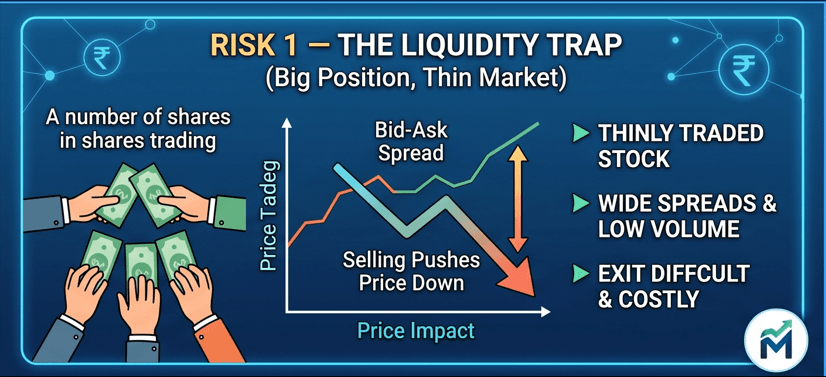
SME stocks are thinly traded. On any given day, only a small number of shares change hands. This means:
- Wide bid-ask spreads. The gap between the buy price and sell price can be large, so you lose value simply entering and exiting.
- Price impact on exit. If you hold a meaningful position and try to sell, your own selling can push the price down, sometimes sharply.
- You may not be able to exit at all at the price you see on screen. A quoted price with no volume behind it is not a price you can actually transact at.
Because the minimum application is now above ₹2 lakh, you are, by design, holding a large position in an illiquid stock. That combination, big position, thin market, is precisely what makes SME exits difficult. Getting in is a two-lot tap. Getting out can take days and cost you materially.
On the mainboard, once a company lists, you can sell a single share. If you bought 100 shares of Tata Motors and suddenly need cash, you can sell 12 shares with the tap of a button.
SME stocks do not work this way. Even after listing, SME shares must be traded in strict lot blocks on the secondary market. If the IPO lot size was 1,000 shares, you can only buy or sell in exact multiples of 1,000.
Why does this matter? If the stock price drops or the hype fades, finding a retail buyer willing to put up ₹2 lakh+ to buy your specific block of shares can be incredibly difficult. If the stock hits a lower circuit (where there are only sellers and no buyers), you cannot liquidate a fraction of your holdings to cut your losses. You are trapped in the entire block until a buyer with deep pockets steps in.
2: Market-Maker Dependency: Liquidity That Can Be Withdrawn
SEBI mandates a market maker for at least three years after an SME lists, precisely because organic liquidity is so thin. The market maker continuously quotes buy and sell prices to keep the stock tradeable.
Here is the double edge:
- The protection: without the market maker, many SME stocks would barely trade at all.
- The dependency: the liquidity is partly manufactured, not natural demand. It rests on a designated entity’s obligation. Once the mandatory market-making period ends, or if genuine interest never develops, liquidity can thin out dramatically.
So when you read “the stock is liquid,” ask: liquid because investors want it, or liquid because someone is obligated to quote it? In the SME world, it is often the latter, and that is a fragile foundation for an exit plan.
3: Lighter Vetting Means Hidden Risks Survive to Listing
We keep returning to this because it is the structural heart of SME risk.
For a mainboard IPO, SEBI vets the prospectus. For an SME IPO, the exchange does the primary vetting. The review is lighter and faster by design.
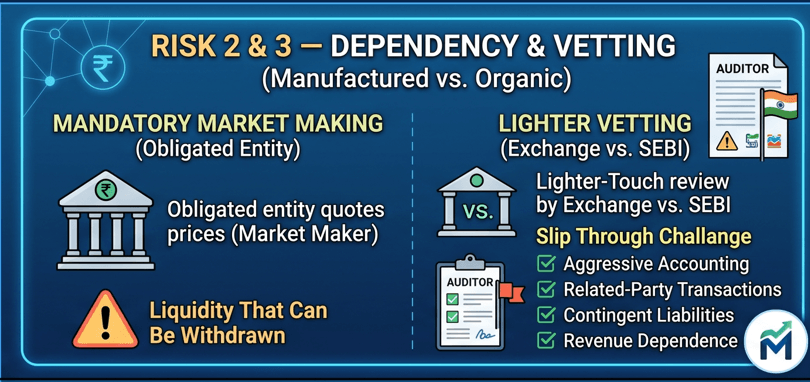
The practical consequence: the kinds of problems that a rigorous review would surface can slip through to the offer document unchallenged. Specifically:
- Aggressive or unusual accounting that inflates the picture.
- Related-party transactions where the company does business with entities the promoters control.
- Contingent liabilities and litigation buried in the footnotes.
- Revenue that depends on a handful of customers or a single contract.
In this segment, the footnotes are where the truth lives, and no regulator has combed through them for you. This is exactly why FinMinutes reads every SME filing forensically: contingent liabilities, related-party intensity, customer concentration, and auditor qualifications are the first things we flag, because they are the first things a light vetting process misses.
Real-World Case Study: Trafiksol ITS Technologies (Sept 2024)
The danger of light vetting was exposed when Trafiksol launched its SME IPO to raise ₹44.87 crore, getting oversubscribed a massive 345 times. In their prospectus, they earmarked ₹17.7 crore for “software procurement” from a third-party vendor.
Just one day before the shares were scheduled to list, SEBI was forced to intervene, halting the listing and ordering a complete refund to investors. A forensic probe revealed that the third-party vendor was a dubiously funded “shell entity” with fabricated profiles and forged financial statements. Because the exchanges missed this during the initial review, retail investors almost poured crores into a fraudulent deployment path.
The 2026 Fix: Regulators have since capped “General Corporate Purposes” (GCP) to 15% of the issue size (or ₹10 crore), but the burden of identifying shell-vendor relationships still falls squarely on you.
4: Promoter Concentration and Governance
SME companies are often founder-dominated. Promoters typically hold a large majority of the pre-IPO equity, and the business frequently revolves around one or two individuals.
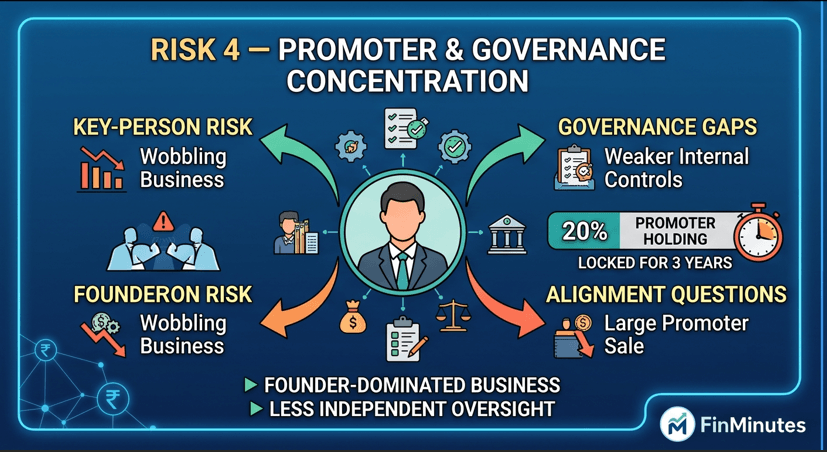
The risks this creates:
- Key-person risk. If the founder exits, falls ill, or loses interest, the business can wobble.
- Governance gaps. Smaller companies have less independent oversight, fewer independent directors, and weaker internal controls than mainboard peers.
- Alignment questions. Promoters must lock in at least 20% of post-issue capital for three years, but what happens when that lock-in expires? A large promoter sale after lock-in can pressure the price.
Concentration is not automatically bad; many great companies are founder-led. But it is a risk factor you must weigh, and it is far more pronounced in SME than in the mainboard.
5: The “90% Deliver Listing Gains” Statistic Is Misleading
You will see this everywhere: a large share of SME IPOs have historically listed at a gain. It is technically true and deeply misleading. Here’s why:
- It measures listing day, not your actual return. A stock can pop on day one and then bleed for months. Listing-gain statistics say nothing about where the stock is six months later.
- Averages hide the disasters. “Most went up” is cold comfort if the one you bought is among the ones that collapsed, and in an illiquid stock, you may not be able to sell before it does.
- Past performance is not a guarantee. The 2025 rule tightening happened because the speculative frenzy behind those gains was seen as unsustainable.
The honest framing: SME IPOs have produced real winners and real losers. Treating the listing-gain average as a personal expectation is how people get hurt.
Listing day metrics do not equal long-term returns. According to data tracking the SME boom, nearly 65% of SME listings from 2024 and 57% of listings from 2025 are currently trading below their issue price. Furthermore, in 2025, 37% of SME IPOs closed below their issue price on the very first day of trading.
6: Valuation and Hype (GMP Is Not Analysis)
Grey-market premium (GMP) is an unofficial, unregulated indicator of pre-listing sentiment. It is not a valuation, not a guarantee, and easily manipulated in a small segment. Applying to an SME IPO because “GMP is high” is speculation dressed up as research.
Real-World Case Study: Resourceful Automobile (Aug 2024)
Resourceful Automobile was a small Yamaha dealership operating just two showrooms with a handful of employees. They aimed to raise roughly ₹12 crore. Driven by rampant social media speculation, the issue was oversubscribed 418 times, drawing in nearly ₹4,768 crore of total bids.
The Grey Market Premium spiked to ₹105 (nearly an 90% premium over its ₹117 issue price). Retail investors were convinced they were about to double their money.
The Result: On listing day, the stock listed completely flat at ₹117. Zero listing gains. Investors who bought into the GMP hype without analysing the underlying 2-showroom business were left holding a highly illiquid stock.
Small companies can also come to market at rich valuations relative to their size and stability. A high P/E on a small, single-product, founder-run business with thin liquidity is a very different proposition from the same multiple on a diversified mainboard company. Always ask what you are paying for what you are getting.
7: Exit Is the Whole Game
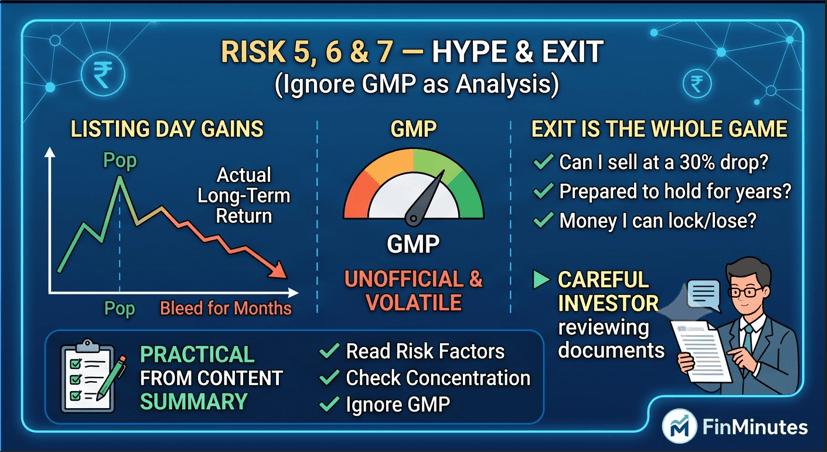
Everything above converges on one point: in the SME segment, your exit is not guaranteed and not painless. If you follow financial media, you have seen the headlines: SME IPOs listing at 100% or even 200% premiums. What you rarely see are the headlines about the investors who got trapped in those same stocks six months later when the trading volume vanished.
Investing in an SME IPO is not just a high-stakes version of mainboard investing. The mechanics of how these stocks trade after they list introduce structural risks that can freeze your capital indefinitely. If you have read our Pillar Guide and our Step-by-Step Application Guide, you know the mechanics. Now, before you block ₹2 lakh of your capital, you need to understand the exit doors.
Before you apply, answer honestly:
- If this stock falls 30% after listing, can I actually sell, and at what spread?
- Am I prepared to hold for years if liquidity dries up?
- Is this money I can afford to have locked, or worse, lose?
If you cannot answer those calmly, the ₹2 lakh minimum is telling you something: this segment is not built for money you might need back quickly.
How to Protect Yourself (A Practical Checklist)
- Read the risk factors and footnotes yourself: the exchange’s lighter vetting means no one else did it thoroughly.
- Check customer and revenue concentration: is the business dependent on one or two clients?
- Scan for related-party transactions and contingent liabilities: the classic SME hiding places.
- Look at promoter holding and lock-in expiry: know when insiders can sell.
- Ignore GMP as a decision input: use it as sentiment noise at most.
- Size your position for illiquidity: assume exiting will be slow and costly.
- Only commit money you can afford to lock or lose.
The FinMinutes View
The SME IPO segment is not a scam and not a lottery ticket; it is a legitimate, higher-risk corner of the market that rewards genuine diligence and punishes casual speculation. The 2025 rules made it more serious by raising the entry fee and filtering out tourists. That is a good thing for those who stay.
We provide a deeper forensic review that lighter vetting doesn’t, surfacing concentration, related-party exposure, litigation, and liquidity before you commit. We tell you the risks plainly, including the ones the listing-gain headlines are designed to make you forget. What you do with that is your decision. But you should make it with your eyes open.
Frequently Asked Questions (FAQs)
Can I sell individual shares of an SME stock on the secondary market?
No. SME stocks are structurally prevented from trading in single units on the secondary market. Both buying and selling post-listing must occur in predefined lot blocks (e.g., lots of 1,000 or 2,000 shares). You cannot liquidate a partial position; you must sell a full lot block, which requires a substantial capital commitment from the buyer.
What is the minimum promoter lock-in period for an SME IPO?
The mandatory lock-in period for the core 20% minimum promoter contribution is five years from the date of allotment. This extended duration was implemented to prevent early promoter exits and to ensure structural commitment to the enterprise’s operational growth.
How does a Market Maker handle a stock during a continuous lower circuit?
A Market Maker is legally obligated to offer continuous two-way buy and sell quotes, but they cannot bypass exchange-mandated circuit limits. If an SME stock hits its daily lower circuit limit due to extreme selling pressure, trading effectively freezes for that session. Your sell order will remain stuck in the queue until trading unfreezes or organic buying demand returns.
Is it true that loss-making companies can launch an SME IPO?
Yes. While eligibility guidelines have been tightened to require a minimum operating profit (EBITDA) of ₹1 crore in at least two of the three preceding financial years, the platform does not require net profitability (PAT). Early-stage businesses with negative net margins can still clear the exchange’s lighter vetting process.
Why shouldn’t I just follow the Grey Market Premium (GMP) for SME IPOs?
Because the SME free float is so small, GMP can be easily manipulated by a handful of operators executing small, unofficial trades to create artificial hype. As seen in the 2024 Resourceful Automobile IPO, a massive GMP does not guarantee listing gains, and relying on it without reading the company’s financial fundamentals often leaves retail investors trapped at the top of the market.
Where to Go Next
- ← How to Apply for an SME IPO: the step-by-step process.
- ← SME IPO vs Mainboard IPO: the full comparison.
- ← What Is an SME IPO? — the fundamentals.
FinMinutes publishes independent financial intelligence for educational purposes only. This is not investment advice. Rules reflect the framework effective 1 July 2025 and are current as of 2026; always read the full offer document and verify current requirements before investing. Investments in SME securities carry a high risk of loss, including of the full principal.