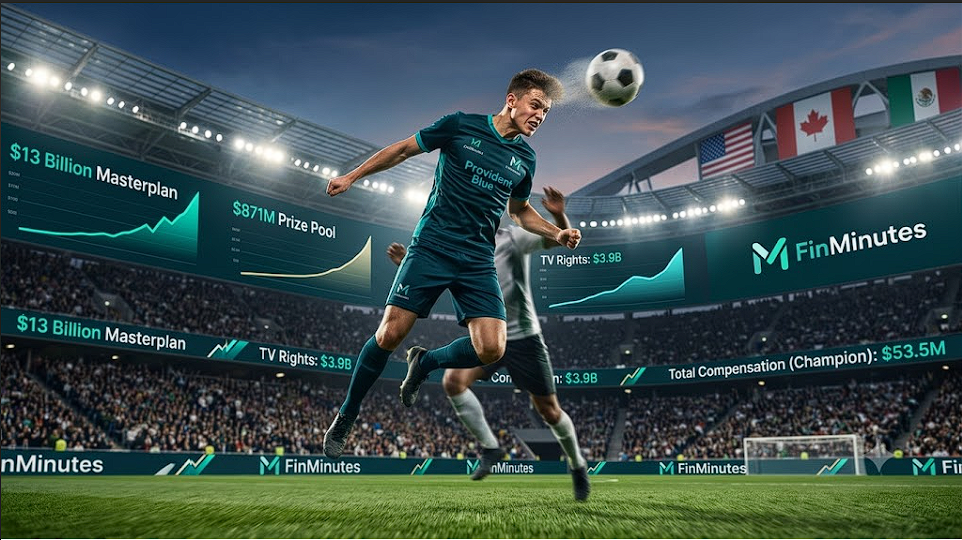
When the 2026 FIFA World Cup kicked off across the United States, Canada, and Mexico, the football would be the easy part. Behind the 104 matches, 48 nations, and roughly six billion viewers sits a financial machine unlike anything the sport or arguably any recurring sporting event, has ever assembled.
The economics of global football have quietly shifted. The era of host nations swallowing catastrophic debt to build single-use mega-stadiums is giving way to a leaner, more ruthless commercial model. For the 2023–2026 cycle, FIFA rebuilt its revenue engine around one decisive lever: expansion. More teams, more matches, more inventory to sell.
In this first instalment of our World Cup Finance Series, we open up FIFA’s balance sheet. We break down the roughly $13 billion revenue cycle, the record $871 million paid out to teams, the cost of staging the tournament, and, crucially, why the eye-watering “economic impact” numbers you’ll see quoted everywhere deserve a healthy dose of scepticism.
All figures below are drawn from FIFA’s official 2023–2026 budget documents, FIFA Council media releases, and independent analyses, reconciled to the revised numbers confirmed at FIFA’s April 2026 Council meeting in Vancouver. Where estimates conflict or remain contested, we say so.
1. The Revenue Engine: How FIFA Gets to $13 Billion
To grasp the scale of 2026, you first have to understand FIFA’s four-year rhythm. The organisation runs on a cyclical model in which the overwhelming majority of revenue lands in the year of the men’s FIFA World Cup.
FIFA’s original budget for the 2023–2026 cycle projected around $11 billion in revenue. That target has since been revised upward, most recently to roughly $13 billion, a figure now widely cited across FIFA’s own communications and major financial press. Importantly, that cycle total also includes revenue from the expanded 2025 Club World Cup, so it is not attributable to the FIFA World Cup alone.
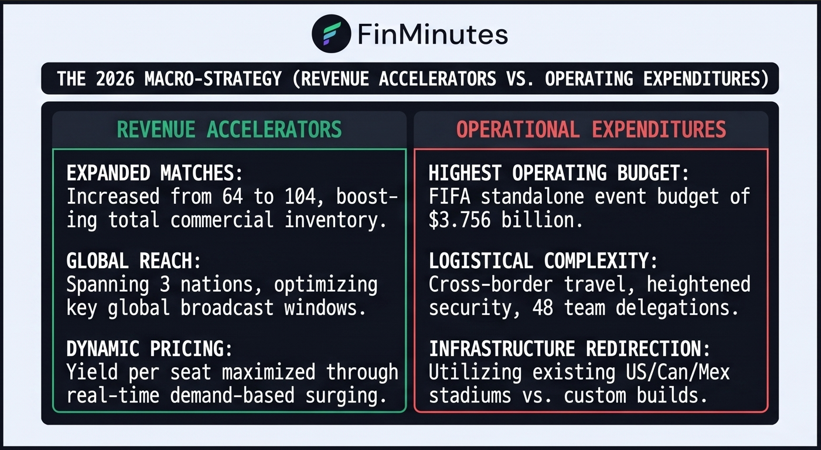
Set against the previous cycle, which culminated in Qatar 2022 and generated about $7.5 billion, the jump is roughly 72% cycle-on-cycle, the most dramatic in the tournament’s history. The single biggest driver is the decision to expand the World Cup from 32 to 48 teams, lifting the match count from 64 to 104 and instantly creating 40 additional units of premium global inventory to sell.
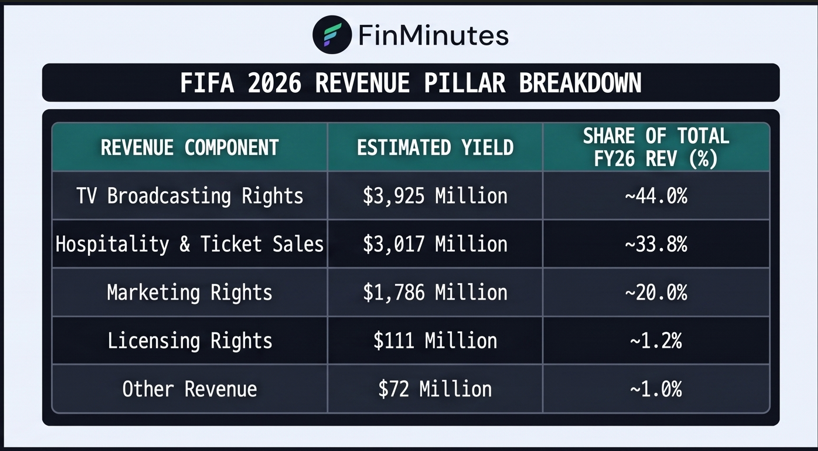
For the 2026 FIFA World Cup itself, FIFA has budgeted approximately $8.9 billion in tournament-specific revenue. Here is where it comes from.
The 2026 Revenue Breakdown
Television and broadcasting rights (~$3.925 billion). Media rights remain FIFA’s undisputed cash cow. Hosting in North American time zones aligns kick-offs with lucrative Americas broadcast windows while staying accessible to European audiences. Streaming is now a serious distribution channel too; FIFA awarded Brazilian rights to the digital broadcaster CazéTV, which will carry matches on YouTube.
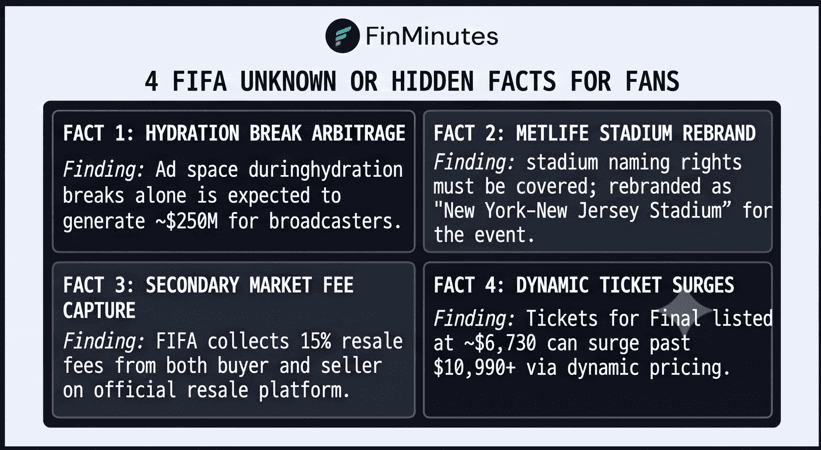
Hospitality and ticketing. The match-day experience is the second-largest pillar. FIFA moved away from the outsourced hospitality “rights fee” model, bringing packages in-house to capture more margin, and introduced demand-based (“dynamic”) ticket pricing that lets seat prices rise with the market, a controversial but yield-maximising choice.
Marketing and sponsorship rights (~$1.786 billion for the tournament). Across the full cycle, FIFA’s marketing-rights budget runs materially higher, reflecting new global partnerships and dedicated women’s football and gaming/esports packages.
Licensing rights. Merchandising, video games, and apparel royalties provide a smaller but high-margin, low-overhead stream.
A note on labels: FIFA’s published budget mixes cycle-wide totals with single-year figures, and secondary sources often blur the two. Treat any single line item as an approximation of a moving budget rather than an audited final number.
2. The Record Prize Pool: $871 Million, and How It Moves
If top-line revenue grabs headlines, the money flowing back to national federations is what actually sustains the global game. For the 2026 FIFA World Cup, FIFA has assembled the largest team-distribution pool in the history of team sports, but the number got there in two steps, and that matters.
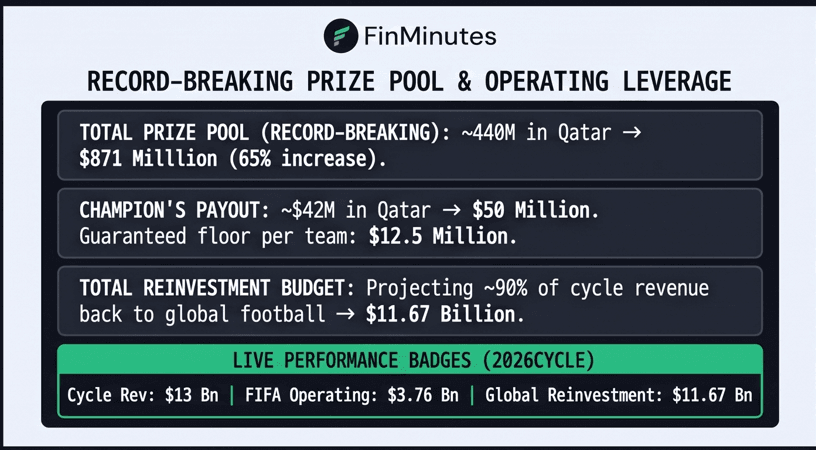
In December 2025, FIFA announced a financial contribution of $727 million. Then, at its 36th Council meeting in Vancouver in April 2026, it raised the package by a further ~15% to a record $871 million, citing higher-than-expected commercial revenue and the added travel costs of a three-nation tournament. The current, correct headline figure is therefore $871 million total distribution, up from $440 million at Qatar 2022.
Of that $871 million, $655 million is ring-fenced as performance-based prize money, roughly a 50% jump over Qatar’s $440 million performance pool.
The Floor: What Every Team Is Guaranteed
The financial risk of simply qualifying has been all but eliminated. Every one of the 48 participating nations is guaranteed a minimum of $12.5 million, comprising:
- $10 million in qualification money, and
- $2.5 million in preparation funding (raised from $1.5 million after the Vancouver vote).
Even a team that loses all three group games and exits at the bottom of its group walks away with that $12.5 million baseline, before adding the $9 million group-stage performance payment. For developing football nations, that is a generational capital injection: liquidity to fund youth academies, coaching, and facilities that outlast the tournament by decades.
The Ceiling: Paying to Win
The nation that lifts the trophy in July 2026 earns a record $50 million in performance prize money, $8 million more than the $42 million Argentina received for winning in 2022, the largest single-tournament dollar increase for a champion in World Cup history. Including the $2.5 million preparation fee paid to every team, the champion’s total take reaches roughly $52.5 million.
Stage-by-stage performance prize money (2026)
| Stage | Performance payout | Teams |
|---|---|---|
| Group-stage exit | $9 million | 16 |
| Round of 32 exit | $11 million | 16 |
| Round of 16 exit | $15 million | 8 |
| Quarter-final exit | $19 million | 4 |
| Fourth place | $27 million | 1 |
| Third place | $29 million | 1 |
| Runner-up | $33 million | 1 |
| Champion | $50 million | 1 |
Figures are pure performance payouts per finishing position and exclude the separate $10 million qualification and $2.5 million preparation payments. Prize money is paid to national associations, not directly to players; federations decide the player share, typically 20–30%.
One structural change worth flagging for the finance-minded: the 48-team format introduced an entirely new Round of 32 knockout tier, adding 16 high-stakes elimination games, and with them, a new payout band and a fresh block of broadcast inventory.
3. The Cost of the Spectacle
Generating billions requires spending them. The 2026 World Cup is the most expensive edition in FIFA’s history to operate, driven by the logistics of spanning three enormous countries and coordinating 48 delegations.
FIFA’s event budget for staging the 2026 World Cup runs to roughly $3.8 billion, of which analysts attribute on the order of $1.1 billion to operations and around $1 billion to prize money, the balance covering security, cross-border travel, technology, and the in-house hospitality model. Notably, FIFA trimmed its 2026 operating budget by more than $100 million in its latest revision, a reminder that even here the numbers are being actively managed.
There is also a cost line that rarely makes the highlight reel: the FIFA Club Benefits Programme, through which FIFA compensates clubs for releasing players to national teams (and for injury risk during the tournament). For 2026, this sits at around $355 million, separate from the $871 million paid to national associations, pushing FIFA’s total World-Cup-related outlay past $1.2 billion once club compensation is included.
Reinvestment: The Not-for-Profit Mandate
FIFA is legally a not-for-profit, which obliges it to funnel commercial yields back into the sport. The vehicle is FIFA Forward, and its latest iteration commits roughly $2.25 billion across the cycle to member associations and confederations. Supporters frame this as the lifeblood of smaller federations; critics counter that broad-based distribution is also a highly effective tool for maintaining the administrative status quo. Both things can be true.
4. The Sponsorship Gold Rush
You cannot read the macro-economics of the FIFA World Cup without looking at the brands underwriting it. FIFA has effectively sold out its 2026 sponsorship inventory, and marketing revenues are tracking toward records. One analysis of advertiser spending globally around the tournament puts the figure near $10.5 billion, spending that, by some estimates, surpasses what brands pour into a full NFL regular season.
At the top of FIFA’s own hierarchy sit the FIFA Partners, who receive exclusive visibility across FIFA events. The current roster blends legacy names with aggressive new entrants:
- Aramco: the Saudi state oil giant, as a global energy partner.
- Coca-Cola: long-standing beverage partner.
- Hyundai–Kia: official mobility partner.
- Qatar Airways: official airline partner.
- Visa: official payment-technology partner.
- Lenovo: technology partner.
The composition tells its own story: sovereign-linked capital (Aramco, Qatar Airways) sitting alongside global consumer and technology brands, each buying a slice of the largest shared cultural moment on earth.
5. Host-Nation Economics: The End of the “White Elephant”, and a Reality Check
The most financially interesting subplot of 2026 is what it means for the host economies of the US, Canada, and Mexico.
Historically, hosting has been a hazardous bet. Brazil (2014) and Russia (2018) sank billions into stadiums that decayed into “white elephants” almost immediately. Qatar 2022 took it to an extreme, with widely cited estimates of around $200 billion+ in spending, though that figure reflects a decade of national infrastructure (metros, hotels, an entire district), not World Cup operating costs, and should always be quoted with that caveat.
The 2026 FIFA World Cup deliberately breaks the pattern. Awarding the tournament to North America was, at its core, a financial decision: the three nations already own world-class NFL and soccer stadiums plus mature hotel and transit infrastructure. Because they don’t need to build single-use venues, capital outlay is minimised, improving the odds of genuinely net-positive economic output.
Where the Big Numbers Deserve Scrutiny
Here is where a finance desk has to be honest, because this is where most coverage isn’t.
The most authoritative projection comes from a joint FIFA–World Trade Organisation study (modelled by independent consultancy OpenEconomics). It estimates the 2026 World Cup will contribute roughly $40.9 billion to global GDP and support about 824,000 full-time-equivalent jobs worldwide.
For the US specifically, it projects $30.5 billion in gross output, $17.2 billion in GDP, and ~185,000 jobs, with around 6.5 million spectators across the three countries. (You may also see a combined “$47 billion US output” figure, which bundles the 2026 World Cup with the 2025 Club World Cup, so don’t confuse it with the World Cup alone. Likewise, a widely circulated “$80 billion” headline conflates separate studies and should be treated with caution.)
Those are big, attractive numbers. Economists also contest them, and a credible finance analysis has to say so plainly. Independent experts, including sports economist Victor Matheson, caution that pre-event impact estimates frequently read more like promotional material than rigorous analysis. The standard objections:
- The substitution effect. Money locals spend on the World Cup is often redirected from other domestic consumption, not net-new.
- Crowding-out. Regular tourists and business travellers avoid congested, expensive host cities, offsetting the visitor influx.
- Leakage. The vast majority of the ~6 billion global viewers never set foot in a host country; their beer and merchandise spending registers in their economies, not the hosts’.
For context, $17.2 billion is roughly 0.05% of US GDP, real money, but a rounding error at the national scale. And early signals urge caution: a survey of more than 200 hotels across US host cities found nearly 80% reporting bookings below initial forecasts, citing visa friction, geopolitical tension, and steep prices. Canada’s Parliamentary Budget Officer, meanwhile, pegs government hosting support at around C$1.066 billion for just 13 matches, a reminder that public costs are concrete while the benefits are projected.
The honest takeaway: the 2026 model is genuinely less financially reckless than its predecessors, and the host economies will see real, concentrated gains in specific cities. But treat the headline “tens of billions” impact figures as directional marketing estimates, not audited outcomes, because that is exactly what they are.
The Bottom Line
The 2026 World Cup is, first and foremost, a commercial triumph for FIFA: ~$8.9 billion in tournament revenue, a $13 billion cycle, a record $871 million returned to teams, and a sponsorship book that’s essentially sold out. The expansion to 48 teams didn’t just add football; it manufactured a step-change in sellable inventory, and FIFA monetised every unit of it.
For the host nations, the story is more nuanced than the press releases suggest: a smarter, cheaper hosting model layered over economic-impact projections that deserve a sceptic’s eye. As always, the interesting money is in the details, and in who bears the costs versus who books the revenue.
In Part 2 of our FIFA World Cup Finance Series, we move from FIFA’s balance sheet to the ground: the localised economics of the 16 host cities, the mechanics (and backlash) of dynamic ticket pricing, and the hidden costs of stadium rebranding, including why venues like MetLife Stadium must temporarily shed their commercial names for the tournament.
Frequently Asked Questions
What is the total revenue projected for the 2026 World Cup cycle?
FIFA’s revised budget targets roughly $13 billion for the 2023–2026 commercial cycle (up from an original $11 billion projection, and inclusive of the 2025 Club World Cup). The 2026 FIFA World Cup itself accounts for approximately $8.9 billion of that.
How much does the 2026 FIFA World Cup winner receive?
The champion earns $50 million in performance prize money, an $8 million increase over the $42 million Argentina received in 2022. Including the $2.5 million preparation fee, the winner’s total reaches about $52.5 million.
What is the minimum a team earns just for qualifying for the 2026 FIFA World Cup?
Every one of the 48 nations is guaranteed at least $12.5 million ($10 million qualification + $2.5 million preparation), before any performance prize money, meaning even a group-stage exit yields $12.5 million plus the $9 million group-stage payout.
Why is the 2026 World Cup event generating so much more money than previous editions?
The expansion from 32 to 48 teams lifted the match count from 64 to 104, creating far more broadcasting, sponsorship, hospitality, and ticketing inventory, and adding an entirely new Round of 32 knockout tier. Broadcast rights alone are budgeted at $3.925 billion.
Are the “$40 billion economic impact” figures reliable?
Treat them cautiously. The FIFA–WTO study projects ~$40.9 billion in global GDP contribution and ~$17.2 billion for the US, but independent economists argue such pre-event estimates overstate net gains by ignoring substitution effects, crowding-out, and spending leakage. They are directional projections, not audited results.
FinMinutes publishes independent financial intelligence for informational and educational purposes only. This article is analysis, not investment advice. Figures are sourced from FIFA’s official budget documents and Council releases and are current as of the tournament’s opening; where sources conflict, we have noted the discrepancy.




Leave a Reply