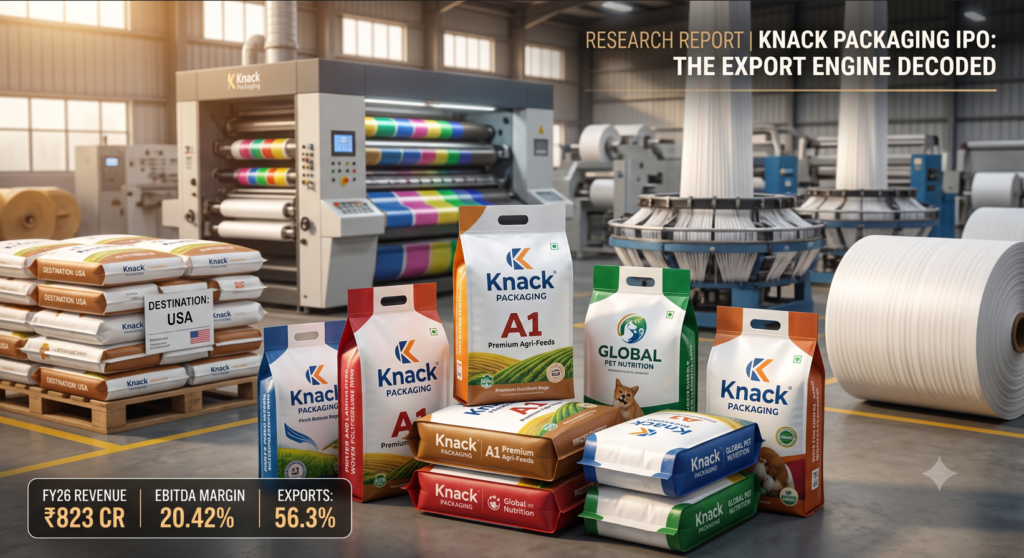
Knack Packaging IPO Review: The initial public offering (IPO) of Knack Packaging Limited has officially hit the primary markets, drawing a massive influx of retail and institutional capital. While retail participants often chase the grey market premium (GMP) and subscription momentum, an institutional-grade assessment requires looking past the surface-level hype. To understand the true underlying value and the structural vulnerabilities of this ₹439.50 Crore book-built issue, we must dissect the Draft Red Herring Prospectus (DRHP).
This is not a generic overview of issue dates or lot sizes. This is the FinMinutes institutional breakdown of Knack Packaging’s operational moat, its aggressive balance sheet de-leveraging, and the forensic red flags buried deep within its statutory filings.
Knack Packaging Business Engine: More Than Just Packaging
Knack Packaging is not a standard plastics converter. The company has positioned itself as a highly specialised, vertically integrated provider of flexible bulk packaging solutions. The core of their product portfolio relies on Printed and Laminated Woven Polypropylene (PLWPP) bags, PLWPP Pinch Bottom Bags, and PE/PP bags.
The Product Moat and Revenue Drivers–
The company’s revenue is overwhelmingly driven by its core product manufacturing, which accounted for 98.08% of its total revenue from operations (₹8,076.56 million) in Fiscal 2026. Drilling down into the product mix reveals a strategic shift toward specialised variants:
- Standard PLWPP Bags: This remains the volume anchor, contributing ₹5,925.52 million, or 73.37% of the total product revenue in FY26.
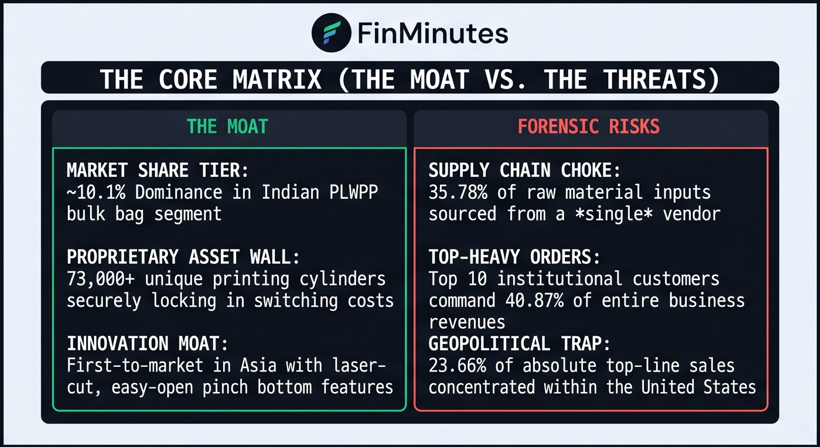
- PLWPP Pinch Bottom Bags: Representing the premium tier of their offerings, pinch bottom bags generated ₹1,636.76 million in revenue, accounting for 20.27% of total product revenue. These bags are engineered with laser-cut and easy-open features, catering to high-end consumer and industrial brands that require tamper-evident, leak-proof sealing and six-sided structural printing.
The Design and Cylinder Infrastructure:
A highly underrated aspect of Knack’s business model is its proprietary design and printing infrastructure. The company does not simply manufacture the raw bags; it provides end-to-end design and cylinder development services. As of May 31, 2026, Knack Packaging manages an inventory of over 73,000 printing cylinders. These cylinders have been developed for a staggering 1,950+ customers across 13,379 unique Stock Keeping Units (SKUs).
This infrastructure acts as a massive customer retention tool. When a brand’s specific artwork and physical printing cylinders are housed within Knack’s dedicated 92,065.47 sq. ft. warehouse, the switching costs for that customer to move to a competing manufacturer increase dramatically. Notably, 43.08% of these cylinders (73,363 units) are owned directly by Knack Packaging, granting them significant leverage in repeat-order negotiations.
The Global Export Engine
While Knack operates four manufacturing facilities concentrated entirely in Gujarat, its revenue base is heavily globalised. The company is a definitive export engine, leveraging India’s labour and manufacturing cost arbitrage to serve international markets.
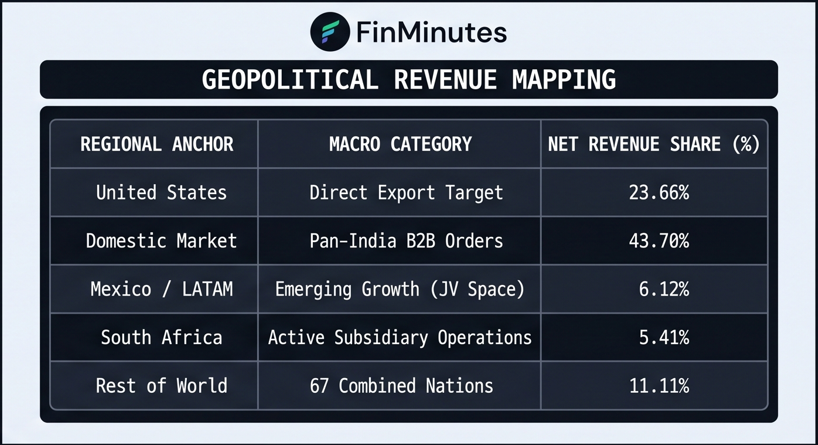
In Fiscal 2026, exports contributed ₹4,635.77 million, representing 56.30% of the total revenue from operations. The company currently ships its packaging solutions to 71 countries across six continents. The export footprint is wide, but the revenue generation is highly concentrated at the top:
- The United States: The US market is the absolute anchor of Knack’s international operations, bringing in ₹1,948.25 million in FY26. This single country accounts for 23.66% of the company’s total global revenue.
- Mexico and South Africa: These two nations serve as the next largest export hubs, generating ₹503.77 million (6.12%) and ₹445.65 million (5.41%) respectively in FY26.
- Emerging Markets: The company also maintains a strong foothold in developing markets, with Sudan contributing ₹322.98 million (3.92%) and Haiti contributing ₹157.87 million (1.92%) in FY26.
To further cement its international presence, Knack Packaging has recently established a 50:50 Joint Venture in Mexico named Sayem Knack S.A. de C.V., partnering with Bessher Holding S.A.P.I. de C.V. This strategic manoeuvre is designed to capture localised demand in the Americas and reduce the logistical friction of trans-Pacific shipping.
Financial Trajectory: Rapid De-leveraging and Growth
The institutional appeal of the Knack Packaging IPO lies heavily in its clean, rapidly improving balance sheet. Over the last three fiscal years, the company has managed to scale its top-line revenue while simultaneously crushing its debt burdens.
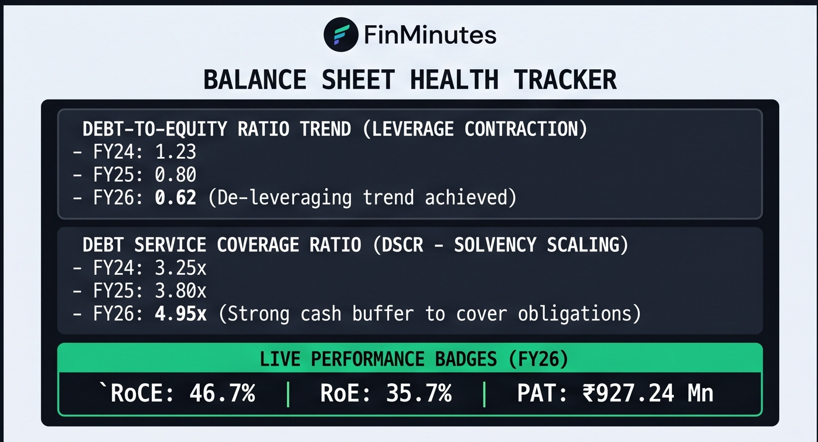
Top-Line and Bottom-Line Expansion Knack has demonstrated consistent, aggressive growth. Total revenue from operations expanded from ₹6,545.59 million in FY24 to ₹8,234.34 million in FY26. This top-line growth has translated directly into bottom-line profitability, with the Profit After Tax (PAT) surging from ₹459.77 million in FY24 to an impressive ₹927.24 million in FY26.
The De-leveraging Narrative, One of the most compelling metrics in the DRHP is the company’s debt management. Despite requiring significant capital for capacity expansion, Knack has systematically reduced its leverage.
- The Debt-to-Equity Ratio has plummeted from a highly leveraged 1.23 in FY24 to a very comfortable 0.62 in FY26.
- The Debt Service Coverage Ratio (DSCR): a critical indicator of operational liquidity, has expanded from 3.25 in FY24 to a robust 4.95 in FY26. A DSCR of nearly 5x indicates that the company generates operating profits far in excess of what is required to service its interest and principal repayment obligations.
It is important to note that the company relies heavily on short-term debt to fund its operations. Out of the ₹1,924.70 million in total borrowings recorded in FY26, a massive ₹1,530.05 million is classified as current (short-term) borrowings. This structure is typical for businesses with intensive working capital requirements that rely on financing inventory and receivables.
Smart Threats: The Forensic Red Flags
A true terminal-grade analysis requires looking past the revenue growth to identify the structural vulnerabilities hidden in the footnotes. Here are the specific, material threats extracted directly from the Knack Packaging DRHP:
1. Severe Supply Chain and Customer Concentration: The company operates without the safety net of long-term contracts, purchasing raw materials and fulfilling customer orders entirely on a spot basis.
- The Supplier Choke Point: Knack is dangerously reliant on a handful of vendors for its raw materials (primarily Polypropylene Granules, LDPE Granules, and BOPP Films). In FY26, their single largest supplier accounted for an overwhelming 35.78% (₹1,807.63 million) of all raw material purchases. The top 5 suppliers combined dictate 73.49% of the company’s entire supply chain. Any pricing dispute, logistical failure, or insolvency involving these key vendors could instantly halt manufacturing operations.
- The Customer Dependency: The revenue side carries a similar concentration risk. In FY26, the company’s single largest customer generated 16.73% (₹1,377.27 million) of total sales. The top 10 customers collectively account for 40.87% of all revenue. Losing just one of these major institutional accounts to a competitor would result in a severe, immediate contraction in profitability.
2. The USA Geopolitical Risk: While exporting to 71 countries implies diversification, the reality is that the company is disproportionately tethered to the United States. With 23.66% of its FY26 revenue originating from the US, Knack is highly exposed to American macroeconomic conditions. Any unfavourable shifts in US trade policies, the imposition of tariffs on Indian packaging imports, or a localised recession could instantly impair nearly a quarter of the company’s top line. Furthermore, this exposure brings significant foreign currency exchange rate risks, as an appreciating Indian Rupee against the USD would erode their export margins.
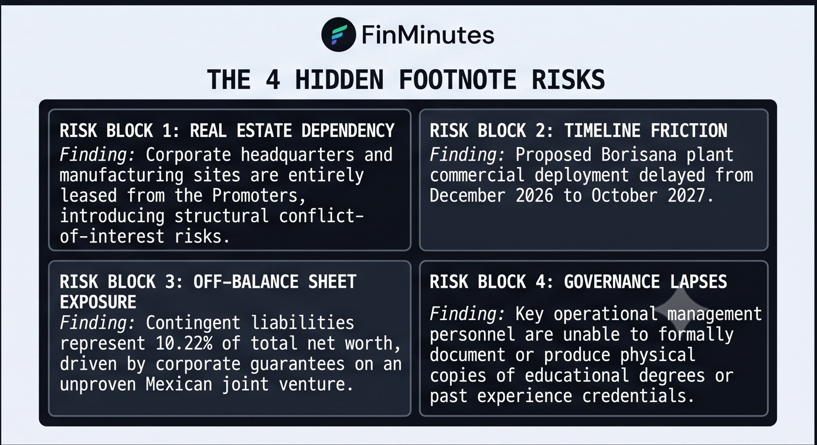
3. Promoter-Leased Infrastructure Vulnerability: A striking operational vulnerability is the ownership structure of Knack’s real estate. The company’s Registered and Corporate Office, Administrative Office, Marketing Office, and multiple critical manufacturing facilities (Unit-1, Unit-2, and Unit-4) are not owned by the company. Instead, they are situated on land leased directly from the Promoters and members of the Promoter Group.
While the DRHP states these leases are negotiated at arm’s length, the reality is that this creates an inherent conflict of interest. Many of these lease agreements are short-term (e.g., 11 months and 29 days) to avoid registration requirements under the Registration Act. If relations sour, or if the Promoters choose not to renew these agreements on commercially viable terms, the company could be forced into highly disruptive and capital-intensive factory relocations.
4. Project Delays and Capex Revisions: The primary object of this ₹380.00 Crore Fresh Issue is to fund a new manufacturing facility at Borisana. However, the execution of this project is already showing signs of friction. The estimated project cost has been aggressively revised downward from the initially stated ₹5,148.94 million to ₹4,561.16 million (a reduction of ₹587.78 million) due to the substitution of imported machinery with indigenous alternatives and the deferment of high-end equipment purchases.
More concerning for growth investors is the timeline slippage. The estimated commercial production date has been pushed back from December 2026 to October 2027. Any further delays in equipment procurement (with ₹2,848.55 million in plant and machinery orders yet to be placed) will severely delay the realisation of anticipated revenues from this new facility.
5. Working Capital Stretch: Knack Packaging operates in a highly working-capital-intensive environment. As the company has expanded its export footprint, its collection cycles have lengthened. Export sales typically demand 60 to 90 days of credit, compared to 30 to 60 days for domestic clients. Consequently, the company’s Working Capital Days have stretched from 74.13 days in FY24 to 87.05 days in FY26. This stretch is reflected on the balance sheet, with a massive ₹1,382.99 million currently locked up in Trade Receivables and ₹1,193.23 million held in Inventory as of March 31, 2026. If global liquidity tightens and international customers delay payments, this receivables load could force the company to take on additional short-term debt, pressuring their operational cash flows.
6. Off-Balance Sheet Contingent Liabilities Investors must account for the ₹314.84 million in contingent liabilities listed in the DRHP, which represents a significant 10.22% of the company’s net worth as of FY26. The lion’s share of this exposure (₹220.93 million) comes from corporate guarantees extended on behalf of their Mexican Joint Venture, Sayem Knack S.A. de C.V.. Because this JV is newly established and lacks an operating track record, any default by the Mexican entity would trigger these guarantees, forcing the Indian parent company to absorb the financial hit.
7. Missing Key Managerial Credentials In a peculiar disclosure for a company heading into the public markets, several Key Managerial Personnel (KMPs) and Senior Management Personnel (SMPs) are unable to produce their educational degrees or past experience certificates. This includes an Independent Director (Deepti Sharma) and senior staff members like Manishkumar Ram Prasad Gurjar and Patel Suryakant Vitthalbhai. The book running lead managers have had to rely entirely on self-certified curriculum vitae and basic marksheets to verify their backgrounds. While this does not directly impact the manufacturing line, it highlights a lapse in basic corporate governance and record-keeping standards that institutional investors generally expect from listed entities.
The FinMinutes Verdict
Knack Packaging Limited presents a classic dual-narrative investment case. On one hand, the company is a highly profitable, rapidly de-leveraging export powerhouse. Their integration of premium features like laser-cut pinch bottoms, combined with an enormous proprietary cylinder inventory, establishes a legitimate competitive moat that has driven their Return on Capital Employed to an exceptional 46.7%.
However, the forensic analysis reveals that this profitability rests on a fragile foundation of extreme supplier concentration, heavy reliance on the US market, and critical infrastructure that is entirely leased from the Promoters themselves. With the Borisana expansion project already facing cost revisions and a 10-month timeline delay, execution risk remains the primary hurdle for the next 18 months. Investors must weigh the stellar historical margins against the structural vulnerabilities inherent in their supply chain and working capital dynamics.
Disclaimer: This intelligence briefing is derived exclusively from the Draft Red Herring Prospectus filed with SEBI and is provided for educational and analytical purposes only. FinMinutes does not provide investment advice or buy/sell recommendations.



Leave a Reply