SME IPO vs Mainboard IPO: At first glance, an SME IPO and a mainboard IPO look identical: a company sells shares to the public and lists on an exchange. But underneath, they are governed by different rules, aimed at different companies, and suited to very different investors. Getting these differences wrong is how people end up locking ₹2 lakh into a stock they can barely sell.
This page lays out every meaningful difference, capital, ticket size, vetting, liquidity, and risk, so you know exactly what you are stepping into.
New to the segment? Start with What Is an SME IPO? Then come back here for the comparison.
SME IPO vs Mainboard IPO: The Quick Comparison Table
| Feature | SME IPO | Mainboard IPO |
|---|---|---|
| Platform | NSE Emerge / BSE SME | NSE / BSE mainboard |
| Company size (post-issue capital) | Up to ₹25 crore | Above ₹25 crore |
| Minimum application (from 1 Jul 2025) | Above ₹2 lakh, min. 2 lots | Around ₹15,000 (1 lot) |
| Who vets the prospectus | The exchange (NSE/BSE) | SEBI directly |
| Track record required | 3 years of operations | Stricter profitability/size norms |
| Profitability required | Not mandatory | Effectively required (higher bar) |
| Market making | Mandatory for 3 years | Not required |
| Liquidity | Low, market-maker dependent | High |
| Disclosure depth | Lighter | Extensive |
| Typical investor | Serious, well-capitalised | Broad retail participation |
| Risk level | Higher | Lower (relatively) |
1. Company Size: Who Lists Where
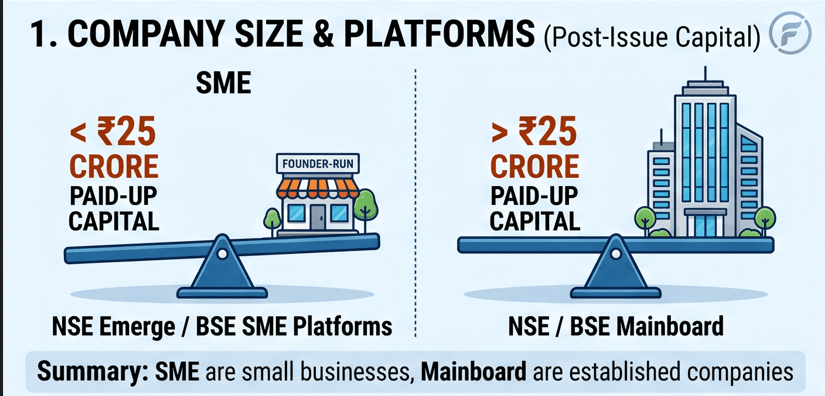
The dividing line is post-issue paid-up capital.
- A company with post-issue paid-up capital up to ₹25 crore uses the SME platform.
- A company above ₹25 crore must list on the mainboard.
This is why SME companies are, by definition, small. They are often founder-run, regionally focused, and in a single line of business. Mainboard companies are larger, more diversified, and usually more established.
The practical implication: an SME IPO is a bet on a small business that may still be proving its model. A mainboard IPO is usually a bet on an established company entering a new phase.
2. The Ticket Size Gap (The Big One)
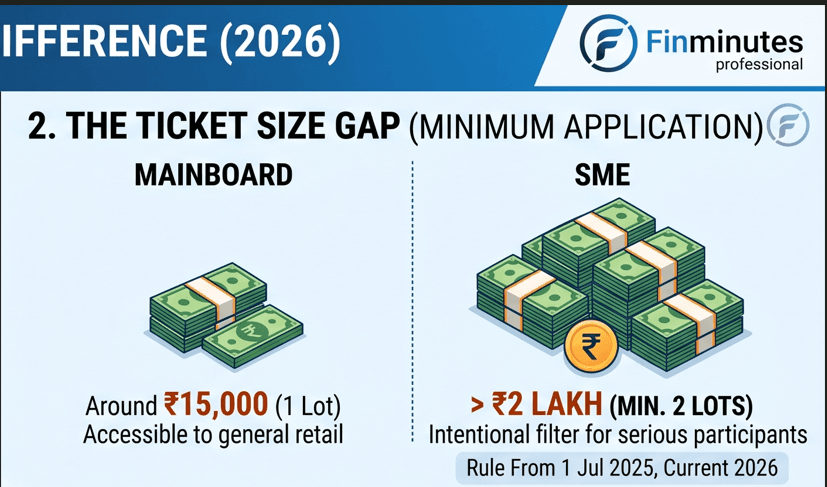
This is the difference most investors feel immediately.
- Mainboard IPO: minimum application is roughly ₹15,000, one lot. Accessible to almost anyone.
- SME IPO (from 1 July 2025): minimum application is above ₹2 lakh, and you must apply for a minimum of two lots. This applies across all investor categories.
In real terms, an SME application today usually needs ₹2–3 lakh, depending on the price band. That is more than ten times the mainboard minimum.
This gap is intentional. The exchanges raised the SME threshold specifically to filter out speculative retail money chasing quick listing gains. The result is a segment where every participant has meaningful capital committed, which changes the character of who is applying alongside you.
3. Who Vets the Prospectus, And Why It Matters to You
This is the difference that should most change your behaviour, and almost nobody talks about it.
- Mainboard: the DRHP is vetted directly by SEBI, the market regulator.
- SME: the DRHP is primarily vetted by the exchange itself (NSE or BSE), not SEBI directly.
The consequence is simple and serious: in the SME segment, the due diligence burden shifts onto you. The lighter regulatory review means red flags are less likely to be caught before the offer reaches you. Related-party transactions, promoter concentration, aggressive accounting, and revenue-dependency risks are exactly the things that a lighter vetting process can miss.
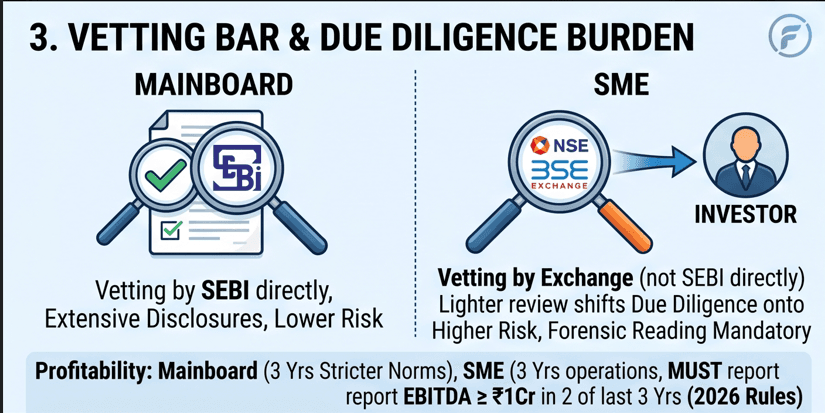
This is the core reason a forensic reading of an SME filing is not optional; it is the entire game. When we analyse an SME IPO at FinMinutes, we treat the filing as if no one else has checked it, because, to a large degree, no one has.
4. Track Record and Profitability
- SME: the company must have at least three years of operations and audited financials for those years. Crucially, it does not have to be profitable. Early-stage and loss-making companies can list.
- Mainboard: the bar is significantly higher in terms of size, profitability, and financial history.
So an SME IPO can put a genuinely unproven business in front of you with a clean-looking prospectus. Three years of operations is not three years of proven, profitable operations, an important distinction when you are committing ₹2 lakh.
5. Liquidity and Market Making
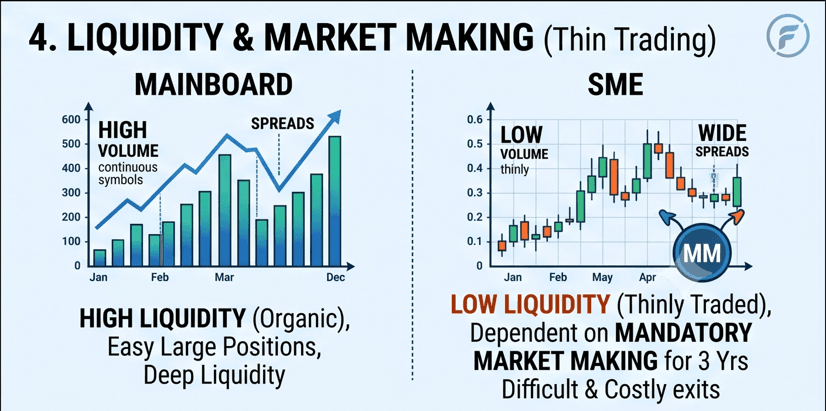
- Mainboard stocks trade with deep liquidity. You can buy or sell thousands of shares without materially moving the price.
- SME stocks are thinly traded. To provide baseline liquidity, SEBI mandates a market maker for at least three years after listing, a designated entity that continuously offers to buy and sell the shares.
Here is the subtlety: market making is both a protection and a dependency. It keeps the stock tradeable, but it also means liquidity is partly manufactured rather than organic. Spreads can be wide, and exiting a large position can be difficult and costly, a risk we cover in depth in our SME risks guide.
6. Governance, Lock-Ins, and Protections
Both segments impose promoter lock-ins and governance norms, but the SME framework has been tightened notably since 2024–25:
- Promoter contribution: at least 20% of post-issue capital, locked in for at least three years.
- Minimum public shareholding: at least 25% post-listing.
- Full underwriting with the merchant banker underwriting at least 15%.
- Stricter related-party-transaction rules align SME companies more closely with mainboard standards.
These reforms have made the SME platform more credible than it once was, but they do not change the fundamental reality of investing in small, illiquid companies.
7. The Migration Path
One feature unique to the SME journey: a successful SME-listed company can, over time, migrate to the mainboard once it meets the size and compliance thresholds. For long-term investors, this migration can be a value-unlocking event, as a mainboard listing typically brings greater liquidity, wider analyst coverage, and index eligibility.
This is part of what makes the SME segment interesting: you are potentially getting in early on a company before it graduates to the big league. But “potentially” is doing a lot of work in that sentence; most SME companies never migrate, and some do not survive.
The 2026 Update: A Harder Path to Graduation
Historically, migrating from the SME platform to the Mainboard was relatively simple, leading to a flood of migrations. However, to protect Mainboard integrity, SEBI and the exchanges implemented draconian new migration thresholds effective late 2025/2026.
Today, an SME cannot just “age out” onto the Mainboard; it must prove massive financial scale. To migrate, an SME must now demonstrate:
- Stark Profitability: An average operating profit (EBITDA) of ₹15 crore over the preceding three years, with a strict minimum of ₹10 crore in each of those three years. (Previously, they only needed to show positive profit).
- Wider Ownership: A minimum of 1,000 public shareholders (drastically up from the old rule of 250).
- Market Cap & Liquidity: A minimum market capitalisation of ₹100 crore, alongside strict secondary market liquidity requirements (e.g., shares must have traded on at least 80% of trading days in the last six months).
The Takeaway: Do not invest in an SME IPO purely on the assumption it will easily migrate to the Mainboard. The regulatory gatekeepers have made graduation a privilege reserved only for truly scaled businesses.
So Which Is Right for You?
Choose mainboard IPOs if you want accessibility, liquidity, and the reassurance of direct SEBI vetting, and if you are investing smaller amounts.
Consider SME IPOs only if you have ₹2 lakh+ per application to commit, you are prepared to do your own forensic due diligence because the regulator’s review is lighter, and you genuinely understand the liquidity and exit risks.
The SME segment is not “the mainboard for small companies.” It is a structurally different, higher-risk market with a higher entry price and a heavier personal-responsibility burden. Treated with that respect, it can be rewarding. Treated casually, it is where a lot of retail money has quietly disappeared.
Frequently Asked Questions (FAQs)
Can I buy or sell just one share of an SME IPO after it lists?
No. Unlike Mainboard stocks, where you can trade single shares, SME stocks are structurally locked into “lot sizes” even in the secondary market. If the lot size is 1,000 shares, you can only buy or sell in multiples of 1,000. This is a deliberate design to keep institutional-level ticket sizes intact post-listing, but it creates severe liquidity risks for individual investors who may struggle to find a buyer for a full block.
Why is the minimum investment for an SME IPO so much higher than a Mainboard IPO?
Effective July 2025, the minimum application for an SME IPO was raised to above ₹2 lakh (requiring a minimum of two lots). Regulators engineered this massive gap compared to the ~₹15,000 Mainboard minimum specifically to deter casual, speculative retail investors. The high financial barrier ensures that only serious investors with higher risk capital participate in the less-regulated, lower-liquidity SME space.
Does SEBI check and approve SME IPO prospectuses?
No, SEBI does not directly vet SME IPO draft prospectuses (DRHPs). For Mainboard IPOs, SEBI conducts rigorous forensic vetting. For SME IPOs, the regulatory authority delegates this responsibility primarily to the exchanges (NSE Emerge or BSE SME). Because the regulatory safety net is much lighter, investors must perform their own due diligence.
What happens if an SME company never meets the criteria to migrate to the Mainboard?
It simply remains listed on the SME platform (NSE Emerge or BSE SME) indefinitely. There is no regulatory requirement forcing a company to migrate. It will continue to trade in fixed lot sizes and rely on market makers for liquidity.
Are SME companies required to be profitable before their IPO?
While the rules have tightened recently (requiring an operating profit of ₹1 crore in two of the preceding three years), the profitability bar is still vastly lower than the Mainboard. Genuinely early-stage businesses can list on the SME platform, making it a higher-risk venture capital-style investment compared to the established dividend-paying giants on the Mainboard.
Where to Go Next
- How to Apply for an SME IPO: Step-by-Step (2026) → the exact process under the new ₹2 lakh, two-lot rules.
- The Real Risks of SME IPOs → liquidity, market makers, and why the listing-gain averages mislead.
- What Is an SME IPO? The fundamentals, if you skipped them.
FinMinutes publishes independent financial intelligence for educational purposes only. This is not investment advice. Rules reflect the framework effective 1 July 2025 and are current as of 2026; always read the full offer document and verify the latest requirements before applying.