How to apply for SME IPO: Applying for an SME IPO is mechanically similar to a mainboard IPO, but with one very large difference in your bank balance. Since 1 July 2025, you need above ₹2 lakh and must apply for a minimum of two lots. This guide walks you through the entire process, step by step, including the parts where people actually get stuck.
If you don’t yet understand what you’re applying for, read What Is an SME IPO? and SME IPO vs Mainboard first. Never apply to an SME IPO on GMP buzz alone.
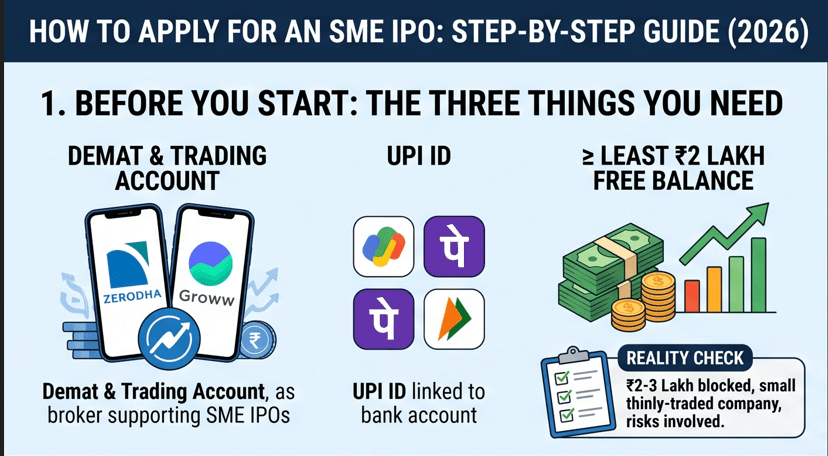
Before You Start: The Three Things You Need
- A demat and trading account with a broker that supports SME IPO applications (most major brokers do, Zerodha, Groww, Angel One, Upstox, 5paisa, ICICI Direct, HDFC Sky, and others).
- A UPI ID linked to the bank account you’ll pay from, the application uses a UPI mandate to block funds.
- At least ₹2 lakh of free balance in that bank account. Under the post-July-2025 rules, the minimum bid is two lots valued above ₹2 lakh, so your account must have that amount available to be blocked.
Reality check before you continue: applying for an SME IPO means blocking ₹2–3 lakh of your money. If you get allotted, that money buys shares in a small, thinly-traded company that you may not be able to exit quickly. Make sure this is money you can afford to commit and potentially have at risk. This is not a ₹15,000 mainboard flutter.
Investor Eligibility: Who Can Actually Apply in 2026?
Before discussing the application process step by step, let us clarify the exact eligibility criteria required to even enter an SME IPO today. Following the recent SEBI clampdowns, applying is no longer a casual affair:
- The Capital Threshold: You must apply for a minimum of two lots, and the total application value must strictly exceed ₹2 lakh. The traditional “Retail Individual Investor” category effectively no longer exists for SMEs. You are bidding in the Non-Institutional Investor (NII) quota.
- The Payment Gateway Cap: The NPCI limits UPI IPO mandates to a strict ₹5 lakh limit. If your bid is under ₹5 lakh, UPI works perfectly. If your bid exceeds ₹5 lakh, you are legally required to use your bank’s Net-Banking ASBA portal.
- The Single-PAN Rule: You can only submit one application per Permanent Account Number (PAN). Submitting multiple applications from different brokers under the same PAN will result in all of your bids being rejected.
- Valid Demat Account Matching: You must have an active demat account, and the name on the bank account used for the ASBA block must perfectly match the primary name on the demat account.
How to apply for SME IPO: The Application Process
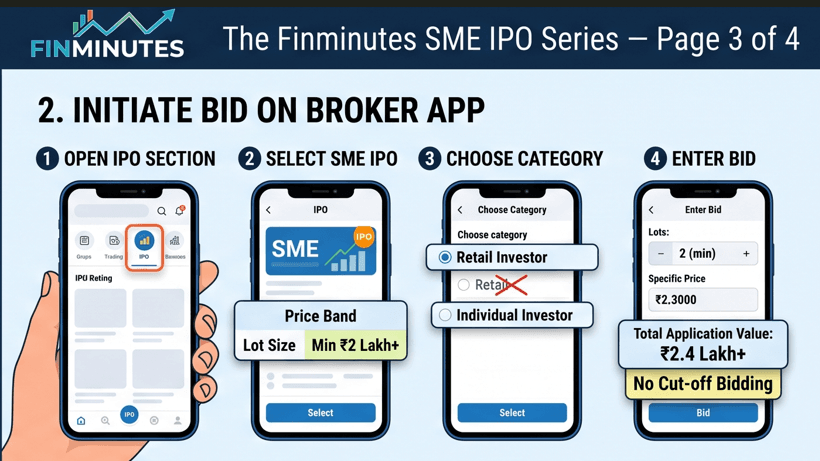
The exact taps differ by broker, but the underlying flow is identical because every broker uses the same ASBA-over-UPI system. Here is the universal sequence:
Step 1: Open the IPO section in your broker app
Log in and find the “IPO” section (usually under Investments, Products, or a dedicated IPO tab). Open SME IPOs are listed alongside mainboard ones, often tagged “SME.”
Step 2: Select the SME IPO and tap “Apply”
Choose the specific IPO. You’ll see the price band, lot size, the minimum application amount, and the open/close dates. Confirm it says SME and note the ₹2 lakh+ minimum.
Step 3: Choose your category
Under the new rules, individual investors apply as “Individual Investor” (this replaced the old “Retail Individual Investor” category). Select the category that applies to you. The minimum bid is two lots across all categories.
Step 4: Enter your bid
- Enter the number of lots (minimum two).
- Enter your bid price. Important: cut-off price bidding is no longer available for SME IPOs since July 2025; you must enter a specific price within the band. To maximise your chance of a valid bid at a fair price, most investors bid at the upper end of the price band (the price at which the issue is most likely to be finalised).
- The app will show your total application value and confirm it is above ₹2 lakh.
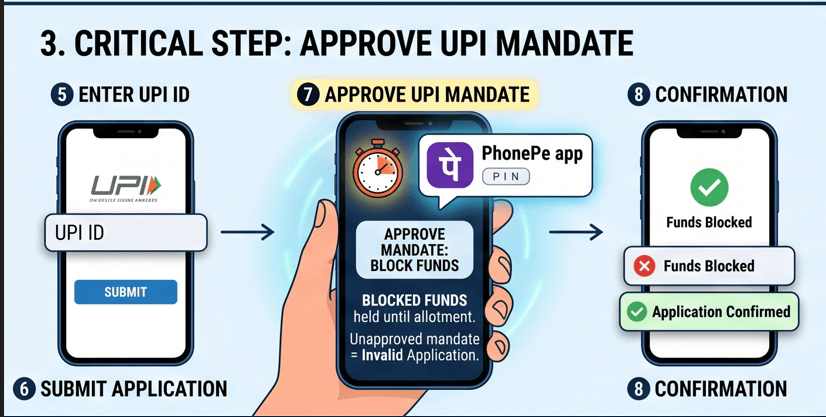
Step 5: Enter your UPI ID
Type the UPI ID linked to the bank account holding your funds. Double-check it; a typo here is the single most common reason applications fail.
Step 6: Submit the application
Review everything and submit. The application is now sent, but it is not complete yet. This is where most first-timers make their mistake.
Step 7: Approve the UPI mandate (the step people miss)
Within a short window, you’ll receive a mandate request notification in your UPI app (Google Pay, PhonePe, BHIM, Paytm, or your bank’s app). You must open your UPI app and approve this mandate, entering your UPI PIN.
- Approving the mandate blocks the application amount in your account (it is not debited yet, just held).
- If you do not approve the mandate before the deadline, your application is invalid, even though the broker showed it as “submitted.”
- The blocked amount stays blocked until allotment. If you don’t get shares, it is released back to you.
This is the No. 1 failure point. Set a reminder to check your UPI app immediately after submitting, and again before the mandate cut-off. An unapproved mandate means you did not actually apply.
Step 8: Confirmation
Once the mandate is approved, you’ll see the funds blocked in your bank account and the application confirmed in your broker app. You’re done, now you wait for allotment.
Broker-by-Broker Notes
The flow above is the same everywhere, but a few specifics vary:
- Zerodha (Kite/Console): IPO applications are made via the Console web portal or app; mandate approval is via your UPI app as above.
- Groww: fully in-app; the SME IPO appears in the IPO section with a clear “SME” label.
- Angel One, Upstox, 5paisa: in-app IPO sections; ensure your UPI ID is pre-verified to avoid mandate delays.
- Bank brokers (ICICI Direct, HDFC Sky, etc.): Some offer net-banking ASBA in addition to UPI, where the amount is blocked directly through your bank login rather than a UPI mandate. If your application value is very large, net-banking ASBA can be more reliable than UPI (some UPI apps cap mandate amounts).
Note: Some brokers or UPI apps place a cap on the mandate amount they’ll process. Because SME applications exceed ₹2 lakh, confirm your UPI app supports a mandate of that size, or use net-banking ASBA through a bank broker instead.
Key Timing Rules to Respect
- Bidding closes at 4:00 PM on the last day for all categories.
- Downward modification and cancellation of bids is not allowed under the new rules, so bid deliberately. You can typically revise upward, but you cannot reduce or cancel.
- Approve your mandate before its cut-off, which is usually a few hours to a day after bidding, but always confirm the specific deadline shown.
After You Apply: What Happens Next
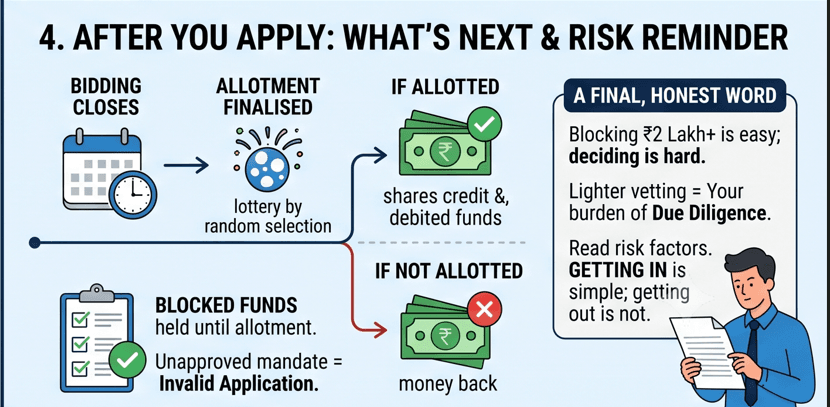
- Bidding closes, and the total subscription is known (how many times the issue was oversubscribed).
- Allotment is finalised. For oversubscribed issues, allotment is done by lottery at the lot level, so applying does not guarantee shares.
- If allotted: shares are credited to your demat account, and the blocked amount is debited.
- If not allotted, the blocked amount is released back to your account.
- Listing day: the shares begin trading on NSE Emerge or BSE SME.
We cover allotment odds and how the lottery actually works in our allotment guide. The short version: more separate PAN-linked applications (e.g., across family members with their own demat accounts) increase your collective chance, but multiple applications on the same PAN are rejected. And with cut-off pricing removed, the old “bid at cut-off to improve odds” tactic no longer exists.
A Final, Honest Word
The application process is easy. The decision is not. Blocking ₹2 lakh+ is the easy part; knowing whether the company deserves it is the hard part, and it’s where the exchange’s lighter vetting puts the burden on you.
Before you tap “Apply,” make sure you have actually read the risk factors and understood how you would exit if the investment goes wrong. In a segment this illiquid, getting in is simple; getting out is not.
Frequently Asked Questions (FAQs)
What are the eligibility criteria for an individual to apply for an SME IPO?
To apply for an SME IPO in 2026, an investor must possess an active demat account linked to their PAN, apply for a minimum of two lots (valued strictly above ₹2 lakh), and ensure the application is funded from a bank account in their own name. Bids under ₹5 lakh can use UPI mandates; bids over ₹5 lakh must use Net-Banking ASBA. Multiple applications using the same PAN will be rejected.
Can I sell part of my SME IPO allotment if I need cash?
No. SME shares trade strictly in pre-defined lot sizes even after they list on the secondary market. If your allotment was for 2,000 shares (which equals two lots of 1,000), you can only sell in multiples of 1,000. You cannot sell 500 shares to free up partial cash.
What happens if there are no buyers when I want to sell my SME shares?
This is the primary liquidity risk of SME investing. If organic buyers dry up, you must rely on the mandated Market Maker to buy your shares. However, in a severe downturn, the stock may hit its lower circuit limit, preventing the execution of your sell order until the next trading session or until demand returns.
Are SME promoters allowed to sell their shares immediately after listing?
No. To protect public investors, SEBI enforces strict lock-in periods. As of the 2025/2026 regulatory updates, SME promoters must lock in at least 20% of their post-issue capital for a strict 5-year period (up from the previous 3 years). Any excess promoter holding is subject to a phased release, preventing them from dumping shares and crashing the price on listing day.
Why shouldn’t I just follow the Grey Market Premium (GMP) for SME IPOs?
Because the SME free float is so small, GMP can be easily manipulated by a handful of operators executing small, unofficial trades to create artificial hype. A high GMP on an SME IPO does not guarantee listing gains, and relying on it without reading the company’s financial fundamentals often leads to buying into a “pump and dump” scenario.
Where to Go Next
- The Real Risks of SME IPOs: read this before you apply, not after.
- ← SME IPO vs Mainboard IPO: the full comparison.
- ← What Is an SME IPO?: The Fundamentals.
FinMinutes publishes independent financial intelligence for educational purposes only. This is not investment advice, and we do not recommend applying to any specific IPO. Application rules reflect the framework effective 1 July 2025 and are current as of 2026; always verify the latest process in your broker app and read the full offer document before applying.