
Kusumgar IPO represents a highly specialised opportunity within the Indian engineered fabrics and technical textiles space. As the company transitions from a privately held entity, historically anchored by its Promoters, into a publicly traded corporation, institutional and retail investors alike require a granular dissection of its financial health, structural risks, and valuation metrics.
This analysis by Finminutes is an institutional-grade deep dive focusing strictly on the general IPO architecture, financial forensics extracted directly from the Red Herring Prospectus (RHP), balance sheet solvency, cash flow dynamics, and audit qualifications.
1. Kusumgar IPO: Executive Summary & IPO Architecture
Kusumgar Limited operates in a highly technical and capital-intensive sector, manufacturing woven, coated, and laminated synthetic fabrics (engineered fabrics) for aerospace, defence, industrial, automotive, and outdoor lifestyle applications.
The Offer Structure
The Kusumgar IPO is uniquely structured as an Offer for Sale (OFS) only. This means that the company itself will not receive any capital infusion from the public market; rather, the existing promoters are monetising a portion of their holdings.
| IPO Parameter | Details |
| IPO Opening Date | July 8, 2026 |
| IPO Closing Date | July 10, 2026 |
| Price Band | ₹398 to ₹419 per Equity Share |
| Face Value | ₹1 per Equity Share |
| Total Issue Size | ₹650.00 Crores (1,55,00,000 Equity Shares) |
| Fresh Issue | Nil (0%) |
| Offer for Sale (OFS) | ₹650.00 Crores |
| Employee Discount | ₹39 per share |
| Retail Minimum Lot | 35 Shares (₹14,665 at upper band) |
| Listing Exchanges | BSE, NSE |
| Tentative Listing Date | July 15, 2026 |
Selling Shareholders in the Kusumgar IPO OFS:
The OFS comprises selling by the core promoter group:
- Siddharth Yogesh Kusumgar: Up to ₹4,200 million.
- Sapna Siddharth Kusumgar: Up to ₹2,000 million.
- Siddharth Yogesh Kusumgar HUF: Up to ₹300 million.
Allotment Matrix: Kusumgar Limited has structured the allocation to ensure robust institutional participation, reserving up to 50% for Qualified Institutional Buyers (QIBs), a minimum of 15% for Non-Institutional Investors (HNIs), and a minimum of 35% for the Retail category. An employee reservation portion of up to ₹35 million has also been carved out.
2. Income Statement Forensics: Growth, Stagnation, and Reversals
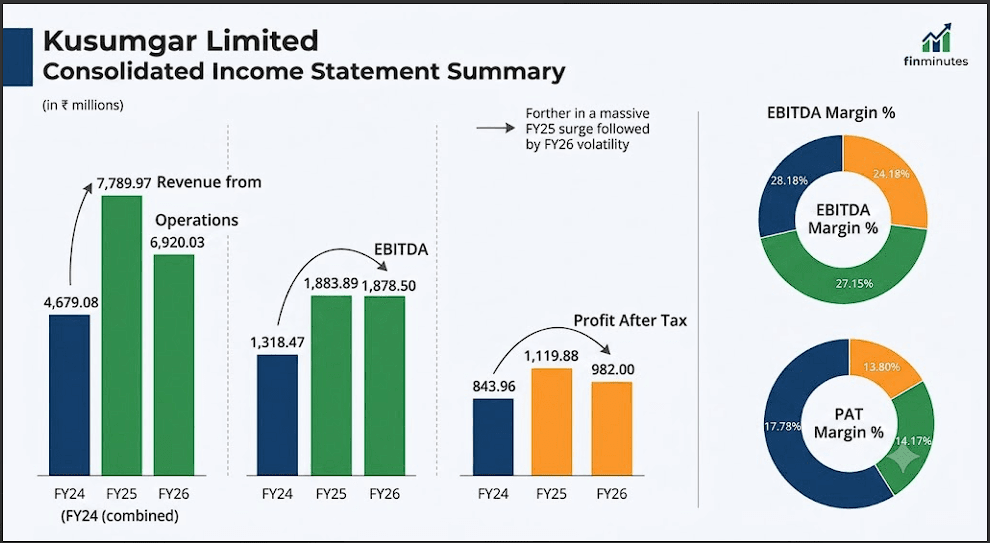
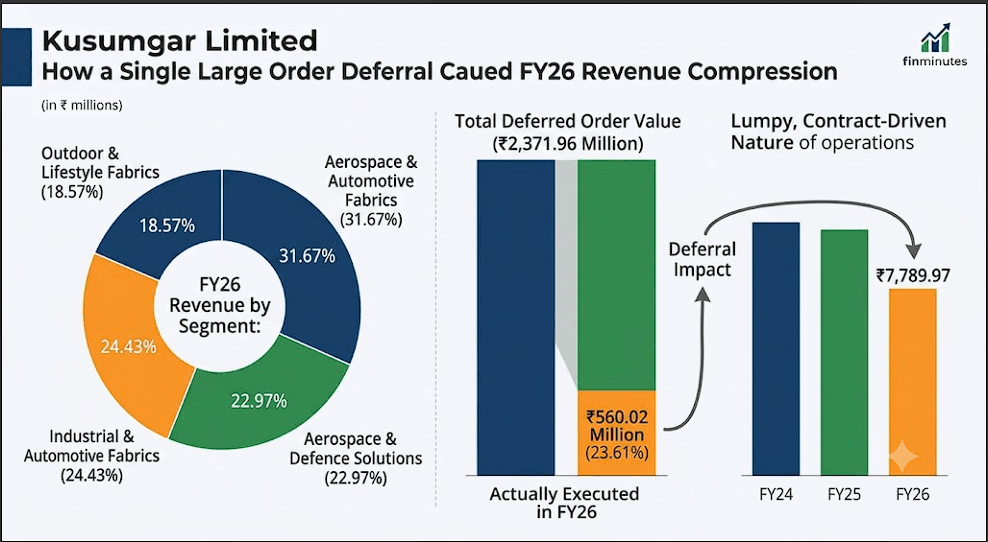
A forensic examination of Kusumgar’s Restated Statement of Profit and Loss reveals a volatile growth trajectory. While the company experienced explosive growth between FY24 and FY25, it faced immediate revenue compression in FY26, highlighting the lumpy, contract-driven nature of its defence and aerospace business.
Topline Revenue Dynamics
- FY 2024 (Combined): ₹4,679.08 million.
- FY 2025 (Consolidated): ₹7,789.97 million (A massive 66.49% Year-over-Year surge).
- FY 2026 (Consolidated): ₹6,920.03 million (An 11.17% Year-over-Year decline).
The primary catalyst for the FY25 surge was a massive, singular order for Combat Free Fall (CFF) parachute systems within the Aerospace and Defence Solutions segment. However, the failure to secure a recurring order of similar magnitude, combined with the deferral of contract performance on a new ₹2,371.96 million order (where only 23.61% was executed in FY26), caused the FY26 topline contraction.
Cost of Materials and Inventory Adjustments
For an engineered fabrics manufacturer, the Cost of Materials Consumed is the most critical expense line item.
- FY24: ₹2,002.86 million.
- FY25: ₹3,713.71 million.
- FY26: ₹3,081.66 million.
As a percentage of total expenses, the cost of materials consumed (adjusted for changes in inventories) accounted for 49.24% in FY24, spiked to 56.33% in FY25, and cooled to 44.43% in FY26. Notably, the company heavily relies on imported raw materials (such as synthetic yarn and polyurethane resin).
In FY26, imported materials constituted 38.91% of the total raw material costs, with a significant 19.37% originating specifically from Taiwan. This heavy reliance on specific foreign corridors exposes the company to extreme foreign-exchange and geopolitical supply-chain risks.
Operating Expenses & Employee Costs
- Employee Benefits Expense: Expanded aggressively from ₹414.85 million in FY24 to ₹881.86 million in FY26. This represents an increase from 8.87% of operational revenue in FY24 to 12.74% in FY26. The company noted an attrition rate of 22.15% in FY26, which forces consistent upward pressure on wage inflation and replacement costs.
- Depreciation & Amortisation: Steadily climbed from ₹170.97 million (FY24) to ₹466.89 million (FY26), reflecting historical capital expenditures and capacity building.
Profitability and Earnings Per Share (EPS)
- Profit After Tax (PAT): FY24 saw a PAT of ₹843.96 million. This peaked at ₹1,119.88 million in FY25, before contracting to ₹982.00 million in FY26.
- Diluted EPS: Translated to ₹8.32 in FY24, ₹10.81 in FY25, and ₹9.31 in FY26.
3. Margin Profile & Volatility Analysis
A true test of manufacturing resilience is the ability to maintain margins despite topline volatility. Kusumgar’s margin profile indicates pricing pressure and operating leverage sensitivity.
EBITDA Margin Restructuring
- FY24 EBITDA Margin: 28.18%.
- FY25 EBITDA Margin: 24.18%.
- FY26 EBITDA Margin: 27.15%.
Despite the massive revenue jump in FY25, the EBITDA margin compressed by roughly 400 basis points. This suggests that the large parachute system contracts secured in FY25 were likely executed at lower gross margins or involved aggressive price discounting to win the volume. In FY26, as the revenue dropped, the EBITDA margin artificially recovered to 27.15%, likely due to a shift back to higher-margin, lower-volume stock-keeping units (SKUs).
PAT Margin
- FY24 PAT Margin: 17.78%.
- FY25 PAT Margin: 14.17%.
- FY26 PAT Margin: 13.80%.
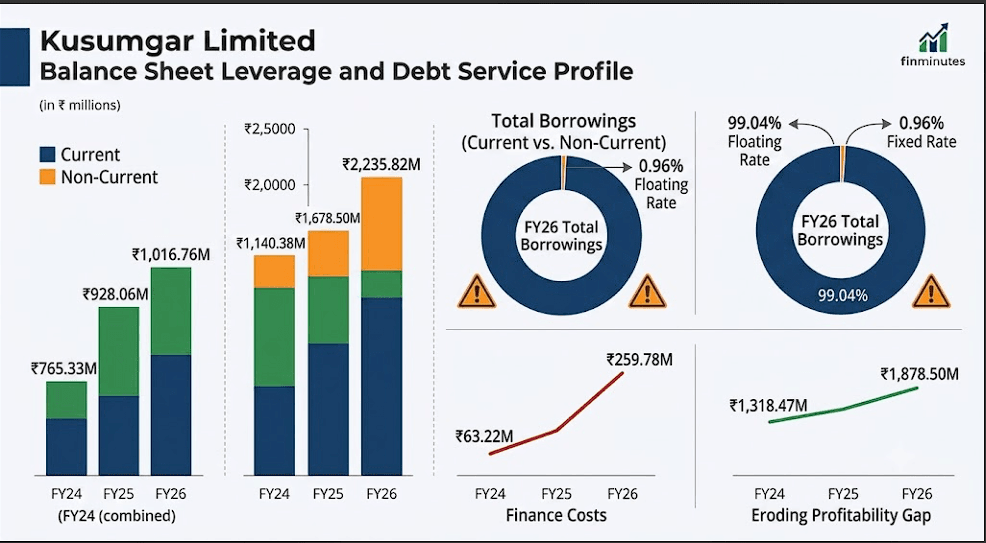
The continuous deterioration of the PAT margin (dropping from 17.78% to 13.80% over three years) is a red flag. This net margin erosion is directly attributable to the explosive growth in Finance Costs, which skyrocketed from ₹63.22 million in FY24 to ₹259.78 million in FY26, eating directly into the bottom line.
4. Balance Sheet Health, Liquidity, and Solvency
Kusumgar’s balance sheet has undergone a massive expansion, largely fueled by aggressive working capital financing and debt layering.
Asset Base Expansion
Total Assets expanded from ₹5,847.41 million in FY24 to ₹9,050.72 million in FY26.
- Property, Plant, and Equipment (PPE): Grew from ₹1,367.20 million in FY24 to ₹2,356.68 million in FY26.
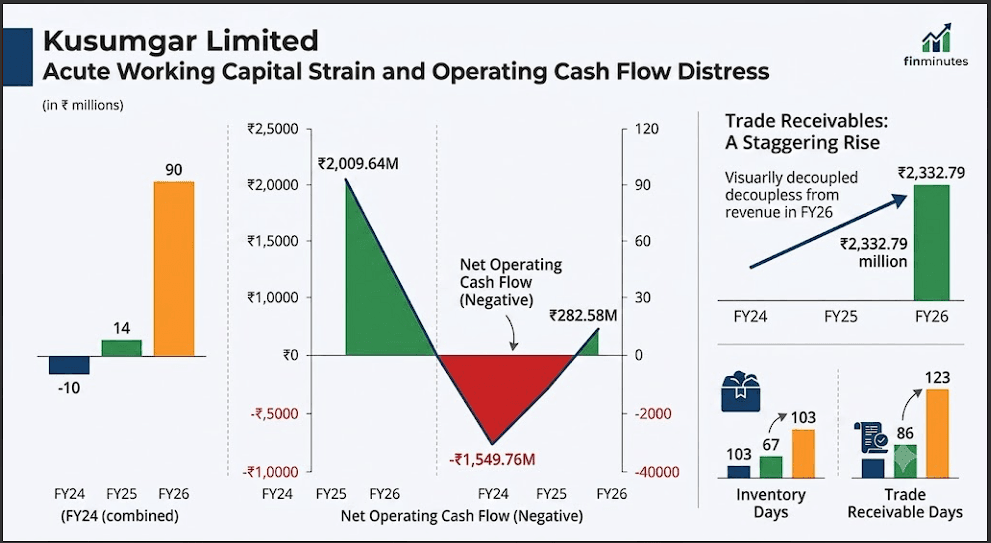
- Inventory Accumulation: Inventories surged to ₹1,948.58 million by FY26. The Inventory Days metric deteriorated from 64 days in FY25 to 103 days in FY26, indicating slower inventory turnover and potential overstocking of finished goods intended for subsequent quarter sales.
Trade Receivables: The Liquidity Trap
The most alarming metric on Kusumgar’s balance sheet is the explosion in Trade Receivables.
- FY24: ₹422.39 million.
- FY25: ₹561.10 million.
- FY26: ₹2,332.79 million.
Trade Receivables grew by an astounding 315% between FY25 and FY26, completely disproportionate to the revenue decline in the same period. Consequently, Trade Receivable Days blew out from 26 days in FY25 to 123 days in FY26. The management attributes this to bulk sales of CFF parachute systems being booked at the very end of Q4 FY26. However, institutional investors must heavily discount this, as such elongated receivables severely strain short-term liquidity and increase the risk of bad debts in the defence procurement cycle.
Debt and Solvency Profile
To fund this massive working capital requirement, the company has heavily leveraged its balance sheet.
- Short-Term Borrowings (Current): Increased from ₹417.28 million in FY24 to ₹1,384.63 million in FY26.
- Long-Term Borrowings (Non-Current): Grew from ₹348.05 million in FY24 to ₹851.19 million in FY26.
Total borrowings stand at roughly ₹2,235.82 million. Crucially, the RHP discloses that 99.04% of total borrowings are subject to floating interest rates. In a macro environment where the RBI might hold or hike repo rates to combat inflation, this exposes Kusumgar to immediate, unhedged interest rate shocks. The company’s Net Debt to EBITDA ratio stands as a vital monitoring metric going forward.
5. Cash Flow Dynamics & Working Capital Strain
The statement of cash flows is the ultimate truth-teller regarding a company’s operational viability, and Kusumgar’s cash flows paint a picture of severe working capital distress.
| Cash Flow Parameter | FY 2024 | FY 2025 | FY 2026 |
| Net Cash from Operating Activities | ₹2,009.64 million | -₹1,549.76 million | ₹282.58 million |
| Net Cash from Investing Activities | -₹1,995.80 million | ₹20.62 million | -₹1,026.59 million |
| Net Cash from Financing Activities | ₹211.84 million | ₹1,507.49 million | ₹697.47 million |
In FY25, despite booking peak revenues and peak EBITDA, the company suffered a Negative Operating Cash Flow of ₹1,549.76 million. This means the core business consumed cash rather than generating it, entirely due to capital being trapped in working capital requirements (inventory buildup and receivables).
To survive this operational cash burn, the Kusumgar was forced to lean heavily on Financing Activities, generating ₹1,507.49 million in FY25 strictly through the aggressive drawdown of fresh borrowings. While Operating Cash Flow turned marginally positive (₹282.58 million) in FY26, it remains dangerously thin relative to the ₹982.00 million in reported net profit, indicating poor cash-conversion efficiency.
Furthermore, the Net Working Capital absolute figure inverted dramatically from a healthy negative ₹51.18 million in FY24 to a bloated ₹2,782.32 million in FY26. The overall Working Capital Cycle expanded from -10 days in FY24 to a staggering 90 days in FY26. This structural shift requires the company to constantly seek short-term debt to bridge the gap between paying suppliers and receiving cash from government/defence clients.
6. Audit Trails, Contingent Liabilities, and Red Flags
An institutional review of the RHP reveals several non-standard disclosures, audit qualifications, and legal headwinds that retail investors frequently overlook.
CARO 2020 Qualifications & Fund Diversion
The Statutory Auditor flagged a highly critical issue under the Companies (Auditor’s Report) Order (CARO) for FY25. The audit revealed that ₹657.27 million raised on a short-term basis was utilised for long-term purposes. Using short-term working capital loans to fund long-term capital expenditure is a classic asset-liability mismatch.
The Kusumgar management blamed this “temporary mismatch” on urgent capital expenditure requirements and delayed government approvals for mortgage creations. While promoters infused immediate funds to remedy this, it reflects poorly on the company’s historical treasury management and internal financial controls.
Covenant Breaches
The RHP notes that in FY25, Kusumgar breached a financial covenant associated with a ₹1 billion loan facility. The loan required maintaining a current ratio of 1.33, which the company failed to meet. While the lender issued a waiver, technical defaults of this nature indicate severe balance sheet stress.
Missing Audit Trails (Rule 11(g) Non-Compliance)
For FY24 and the entirety of FY25, the company’s accounting software failed to maintain the mandatory audit trail (edit log) feature at the database level, violating Rule 11(g) of the Companies (Audit and Auditors) Rules. The statutory auditor explicitly noted an inability to verify if direct data changes were made without logging. A lack of an immutable audit trail severely diminishes the absolute reliability of historical financial reporting.
Section 9 Insolvency Litigation
On December 6, 2025, an operational creditor, Collage Design Private Limited, filed a petition under Section 9 of the Insolvency and Bankruptcy Code (IBC) before the NCLT Mumbai, claiming an unpaid default of ₹22.30 million. While not yet admitted, the threat of Corporate Insolvency Resolution Process (CIRP) initiation over a relatively small operational debt is a significant reputational and operational red flag.
Contingent Liabilities
As of March 31, 2026, the company held contingent liabilities totalling ₹1,089.70 million (representing a massive 21.67% of the total Net Worth). This is overwhelmingly comprised of Bank Guarantees (₹1,038.77 million) issued in connection with government defence contracts. If any major defence contract is cancelled or disputed, the encashment of these guarantees would instantly devastate the company’s liquidity.
7. Valuation Parameters at the Upper Band & GMP Indication
At the upper price band of ₹419 per share, the total market capitalisation of Kusumgar Limited is expected to be substantially high. Based on the FY26 Diluted EPS of ₹9.31, the company is demanding a Price-to-Earnings (P/E) multiple of approximately 45x.
While the company competes with listed peers like Garware Technical Fibres and SRF, a 45x multiple leaves virtually no margin of safety for a business experiencing declining revenues (FY26), severe working capital blockages, and an over-reliance on lumpy defence contracts.
Grey Market Premium (GMP) Sentiment
Despite the fundamentally stretched balance sheet and cash flow risks, Dalal Street’s speculative appetite for defence and specialised manufacturing themes remains red-hot. As of July 8, 2026, the Grey Market Premium (GMP) for the Kusumgar IPO is hovering around ₹159 per share.
- Base Price: ₹419
- GMP: ₹159
- Estimated Listing Price: ~₹578
- Estimated Listing Pop: ~38%
This GMP indicates that the IPO is likely to see heavy subscription numbers, particularly from HNIs and Retail investors chasing listing gains. However, long-term institutional holders will likely remain cautious until the company proves it can convert its massive trade receivables back into cash and stabilise its EBITDA margins without breaching debt covenants.
8. Conclusion
Kusumgar Limited presents a classic dichotomy in the modern Indian IPO market. On the surface, it operates in a highly lucrative, high-barrier-to-entry sector (Aerospace and Defence fabrics) with a wide moat of technical expertise.
However, peeling back the layers of the Red Herring Prospectus exposes severe financial friction. The company is bleeding cash at the operating level during its highest growth phases, failing to maintain working capital discipline, utilising short-term debt for long-term capex, and suffering from basic accounting audit trail non-compliance. As a 100% Offer for Sale, none of the ₹650 Crores raised will go toward fixing this stressed balance sheet; every rupee exits the firm into the promoters’ accounts.
Investors must carefully weigh the allure of India’s defense-manufacturing super-cycle against Kusumgar’s highly levered, cash-poor financial reality.



Leave a Reply