
Kusumgar Ltd IPO has stepped into the public domain amidst an environment of intense speculative fervour. While retail portfolios are rapidly bidding up the allocation, institutional asset management requires a distinct, clinical perspective. Fulfilling the mandate of the Finminutes IPO Terminal Strategy, this deep dive shifts our lens from pure balance sheet mathematics (analysed in Part 1) directly into the operational anatomy, global trade risks, structural supply dependencies, and macroeconomic realities outlined in the company’s Red Herring Prospectus (RHP).
To build an objective investment case, this institutional analysis explores the industrial architecture of Kusumgar Limited, matching raw manufacturing capabilities against a volatile geopolitical backdrop.
1. Kusumgar Ltd IPO: Live Market Framework
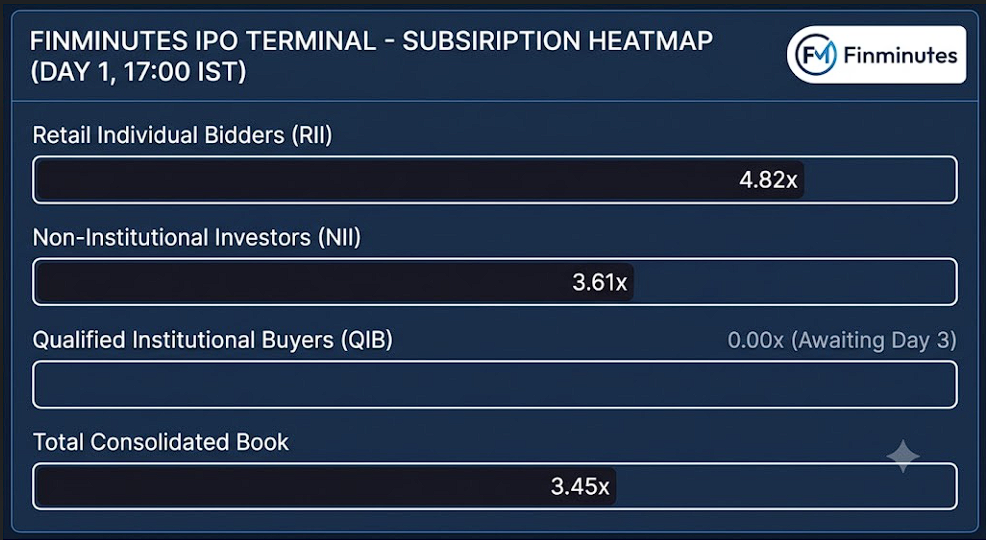
As of the evening of Day 1 (July 8, 2026), market tracking platforms show that the ₹650.00 crore initial public offering has achieved a total subscription rate of 3.45 times.
Finminutes IPO Terminal - Subscription Heatmap (Day 1, 17:00 IST)
===================================================================
Retail Individual Bidders (RII):   ■■■■■■■■■■■■■■■■■■■■■ 4.82x
Non-Institutional Investors (NII): ■■■■■■■■■■■■■■■■ 3.61x
Qualified Institutional Buyers (QIB):                  0.00x (Awaiting Day 3)
-------------------------------------------------------------------
Total Consolidated Book:           ■■■■■■■■■■■■■ 3.45x
===================================================================
Kusumgar Ltd GMP: This early momentum is heavily skewed toward retail and high-net-worth individual (HNI) allocations, driving an unofficial Grey Market Premium (GMP) of ₹166 to ₹168 per share for the Kusumgar Ltd IPO. Measured against the upper price bound of ₹419, the grey market implies an opening value of approximately ₹585, pointing to a speculative listing premium of ~40%.
However, seasoned market participants recognise that immediate listing premiums can mask structural underlying risks. A thorough review of the operational and industry overview sections of the RHP is necessary to separate market narrative from long-term corporate viability.
2. Corporate Architecture & Segment Analysis
Kusumgar Ltd operates as a highly specialised, vertically integrated player in the technical textiles domain, focusing primarily on engineered synthetic fabrics. Unlike standard textile mills, the production of engineered fabrics involves creating high-performance woven, coated, and laminated matrices designed for harsh environments, structural stress, and tactical defence deployment.
The enterprise partitions its commercial operations into four core market segments.
Segment Breakdown & Financial Contributions
                     FY26 Segmental Revenue Contribution
                     ----------------------------------
      Aerospace & Defence Fabrics    [███████████████] 31.67%
      Industrial & Automotive Fabrics [████████████]   24.43%
      Aerospace & Defence Solutions   [███████████]    22.97%
      Outdoor & Lifestyle Fabrics     [█████████]      18.57%
      Other Supplemental Sales        [█]               2.36%
A. Aerospace and Defence Fabrics (31.67% / ₹2,136.99 million)
This division represents the core technological base of the firm, specialising in custom woven matrices engineered from ultra-high-molecular-weight polyethene (UHMWPE), high-tenacity nylon, and aramid fibres. These textiles serve as the raw material substrate for body armour, specialised military tents, vehicle camouflage systems, and containment gear.
While historically the primary driver of earnings, this segment suffered a notable contraction from its FY25 revenue high of ₹3,700.92 million. The RHP reveals that this decline was caused by the expiration of a single large, non-recurring domestic order that yielded ₹2,045.75 million in FY25 but dropped to just ₹286.16 million in FY26, highlighting the lumpy revenue patterns inherent in large contract procurement.
B. Industrial and Automotive Fabrics (24.43% / ₹1,648.60 million)
Catering to the business-to-business (B2B) corporate ecosystem, this segment produces mechanical rubber goods (MRG), filtration media, high-tensile base fabrics for conveyor belts, and automotive components like airbag fabrics and tyre cord substrates. This segment has demonstrated steady, incremental scaling, growing from ₹1,113.86 million in FY24 to ₹1,648.60 million in FY26, providing a partial buffer against unpredictable defence tender cycles.
C. Aerospace and Defence Solutions (22.97% / ₹1,550.17 million)
Representing a strategic shift from raw fabric manufacturing to downstream value addition, this division handles fully assembled tactical end-products. Its primary revenue driver is Combat Free Fall (CFF) parachute systems, a line introduced in FY25 that accounted for ₹2,219.02 million in segment revenue during its launch year.
In FY26, this division faced logistical hurdles. Kusumgar Ltd booked a major defence order valued at ₹2,371.96 million, but was only able to execute 23.61% (₹560.02 million) of the contract value due to the client’s shifting operational requirements. The remaining balance of ₹1,811.94 million is deferred into FY27, underscoring the risk of execution delays in government-linked supply chains.
D. Outdoor and Lifestyle Fabrics (18.57% / ₹1,253.15 million)
This commercial segment focuses on high-performance consumer apparel applications, including parachute nylon for consumer goods, specialised tents, and weather-resistant sportswear fabrics. The division has expanded over the three-year tracking period, climbing from ₹291.65 million in FY24 to ₹1,253.15 million in FY26. This expansion is tied to the company’s relationship with major global consumer brands, operating through tier-1 manufacturing fabricators.
3. Manufacturing Footprint: Geographic Concentration Risks
A key structural feature of Kusumgar’s operations is its complete reliance on a singular geographical zone for its production infrastructure.
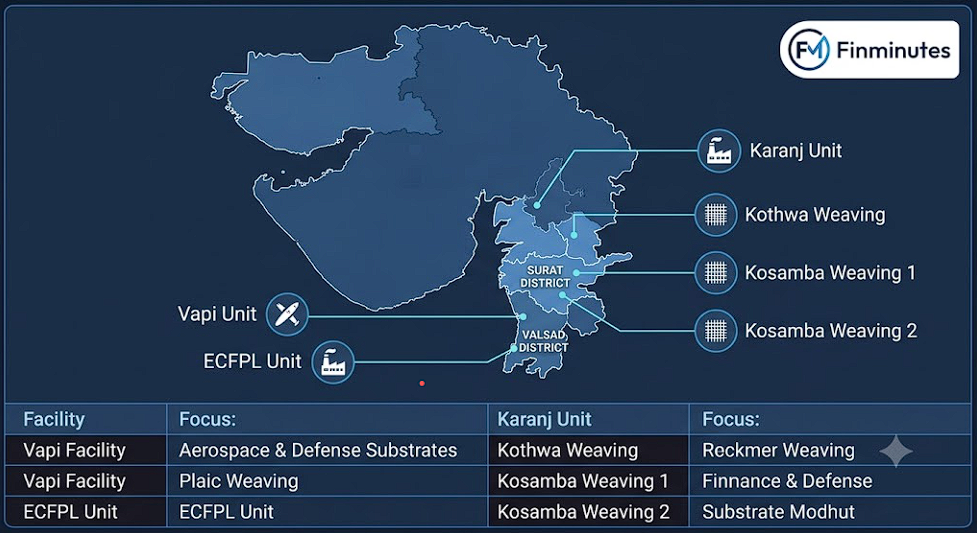
                     KUSUMGAR LIMITED - FACILITY MAP
+-------------------------------------------------------------------------+
| STATE OF GUJARAT, INDIA                                                 |
|                                                                         |
|   [SURAT DISTRICT]                                                      |
|   ├── Karanj Unit        --> CFF Parachutes, Industrial & Auto Fabrics  |
|   ├── Kothwa Weaving     --> Industrial, Outdoor & Lifestyle Fabrics     |
|   ├── Kosamba Weaving 1  --> Aerospace, Defense & Automotive Fabrics    |
|   └── Kosamba Weaving 2  --> Coated Synthetic Matrices & Outdoor SKUs   |
|                                                                         |
|   [VALSAD DISTRICT]                                                     |
|   ├── Vapi Unit          --> Aerospace & Defense Substrates             |
|   └── ECFPL Unit         --> Engineered Coated Fabrics & Lamination     |
+-------------------------------------------------------------------------+
Kusumgar Ltd manages six distinct production centres, all located in Gujarat.
| Production Unit | Location | Primary Process Focus & Market Segments Served |
| Vapi Facility | Valsad District, Gujarat | High-tenacity preparatory processes and weaving specialised for Aerospace & Defence Fabrics; Industrial & Automotive lines. |
| Karanj Facility | Surat District, Gujarat | Final downstream assembly for Aerospace & Defence Solutions (CFF systems), plus specialised Industrial and Outdoor Lifestyle lines. |
| Kothwa Weaving Unit | Surat District, Gujarat (Shahlon Textile Park) | Dedicated contract weaving loops for Industrial, Automotive, Outdoor, and Lifestyle product lines. |
| Kosamba Weaving 1 | Surat District, Gujarat (Fairdeal Textile Park) | Primary texturising and high-speed weaving blocks for Aerospace, Defence, Industrial, and Automotive applications. |
| Kosamba Weaving 2 | Surat District, Gujarat (Fairdeal Textile Park) | Multi-layered polymer coating setups specialised for high-GSM Outdoor and Lifestyle applications. |
| ECFPL Unit | Valsad District, Gujarat (Village Khadki) | Specialised lamination and engineered coated fabrics catering to heavy Industrial and Outdoor Lifestyle clients. |
Operational Vulnerability of Geographic Clustering
While clustering all six facilities within the Surat-Valsad manufacturing corridor provides logistical advantages, such as shared technical personnel and streamlined movement of semi-finished goods, it creates significant localised risks. Disruptions in regional utilities, climate shocks, or industrial unrest in the Gujarat manufacturing belt could immediately affect the company’s entire production pipeline.
The RHP acknowledges that the company has not run formal supply disruption stress tests since April 1, 2023, leaving its ability to handle a prolonged local infrastructure breakdown unverified.
4. Supply Chain Diagnostics: Sourcing Volatility & The Taiwan Dependency
An institutional assessment of Kusumgar’s operational sustainability requires a detailed review of its raw material supply chains. The company faces supply vulnerabilities on both the vendor and geopolitical fronts.
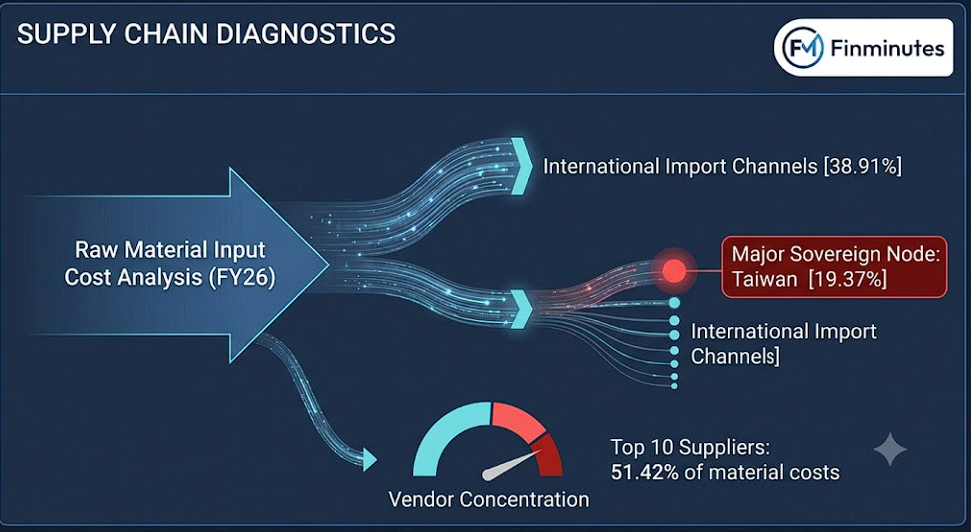
                  Raw Material Input Cost Analysis (FY26)
                  --------------------------------------
         Domestic Indian Procurement   [██████████████████] 61.09%
         International Import Channels  [████████████]       38.91%
         --------------------------------------------------
         * Major Sovereign Node: Taiwan [██████]              19.37%
High Vendor Concentration
Kusumgar Ltd relies on spot procurement via individual purchase orders rather than long-term, fixed-price supply agreements. In FY26, Kusumgar’s top 10 suppliers accounted for 51.42% of its total material costs, down from a high of 66.16% in FY24 but still presenting a significant concentration risk. If a tier-1 supplier fails to deliver specialised synthetic yarns or proprietary lamination films, production schedules could face immediate delays.
Geopolitical Sourcing Risks
The production of high-grade technical textiles requires raw inputs that meet rigorous international specifications, such as ultra-pure polyurethane resins and fabric lamination films. Because domestic alternatives are often limited, Kusumgar imports 38.91% of its raw materials.
A key point of focus for analysts is that Taiwan alone supplied 19.37% of Kusumgar’s total raw materials in FY26 (amounting to ₹596.94 million). This concentrated exposure to a geographically sensitive region means that any trade friction, maritime shipping delays, or geopolitical escalation in the Taiwan Strait could disrupt the company’s access to critical raw inputs, potentially stalling key defence manufacturing pipelines.
5. Client Dynamics: The Vulnerability of Tender-Driven Revenue
Kusumgar’s revenue pipeline features high customer concentration and a lack of long-term commercial commitments.
                     Institutional Client Concentration (FY26)
                     ----------------------------------------
            Top Single Customer Revenue [███]                11.13%
            Top 5 Customers Combined    [█████████████]      45.38%
            Top 10 Customers Combined   [██████████████████] 59.52%
As detailed in the RHP, the company’s top 10 clients accounted for 59.52% of total revenue in FY26, while the top five generated 45.38%. Crucially, Kusumgar operates without long-term sales framework contracts. Sales are driven by rolling purchase orders and cyclical tender bids from private defence integrators and government entities.
This structure introduces clear operational risks:
- Inventory Obsolescence: Kusumgar carries the operational burden of manufacturing and storing highly specialised, custom-designed fabric configurations based on provisional client schedules. If a client delays or cancels a production run, the company has limited recourse and faces potential overstocking and inventory markdown risks.
- Volatile Revenue Streams: The absence of long-term volume commitments means the company’s client base can shift significantly from year to year, creating unpredictable topline volatility as seen in the revenue contraction between FY25 and FY26.
- Anonymity and Private Labels: Except for Decathlon Sports India Private Limited, the company’s major clients chose not to consent to their names being disclosed in the prospectus, clouding visibility on corporate client relationships.
6. Industry Macro Analysis: Global Trade Hurdles & Tariff Risks
The global technical textiles sector is capital-intensive, driven by research outlays, and highly sensitive to international trade policy. According to the commissioned 1Lattice Report cited in the RHP, Kusumgar’s growth strategy is directly exposed to shifting international trade barriers.
                Evolution of US Import Tariffs on Indian Fabrics
                ------------------------------------------------
         Baseline Historical Tariff Rate    [████]       14.00%
         Late 2025 Retaliatory Emergency Peak [██████████████] 50.00%
         Current Post-Section 122 Framework [██████████]  20.00% - 40.00%
The US Trade Barrier Challenge
The US market presents a complex regulatory landscape for Indian engineered fabric exporters.
- Historical Surcharges: Historically, Indian technical textile exports entered the US under standard Most Favoured Nation (MFN) tariffs of roughly 14%. In late August 2025, changes in US trade policy pushed overall duties on various Indian goods up to an effective rate of 50%.
- The Section 122 Shift: Following legal challenges to emergency trade measures, the US implemented a new framework under Section 122 of the U.S. Trade Act of 1974 in February 2026, adding a uniform 10% surcharge on baseline figures. Currently, Indian engineered fabric exports are subject to US tariffs ranging from 20% to 40%, depending on the specific SKU configuration. This tariff pressure contributed to a 7.50% drop in Kusumgar’s direct US revenue during FY26.
- The Section 301 Threat: A major regulatory headwind is emerging from the Office of the United States Trade Representative (USTR). Under a Section 301 investigation concerning forced labour enforcement metrics across 60 nations, the USTR has proposed an additional 12.5% ad valorem tariff specifically targeting Indian textile shipments. While an import-balancing mechanism has been suggested, the potential implementation of this surcharge threatens to compress margins on Western export lines.
Input Cost Pressures
The 1Lattice Report highlights that the core chemical inputs for technical textiles, including polyester, polypropylene, and nylon matrices, are directly linked to global petrochemical and crude oil price curves. This structural link means that global energy market volatility can quickly impact the company’s operating costs, and passing these cost increases along to clients often involves a significant time lag.
7. Synthesis: The Operational & Financial Intersection
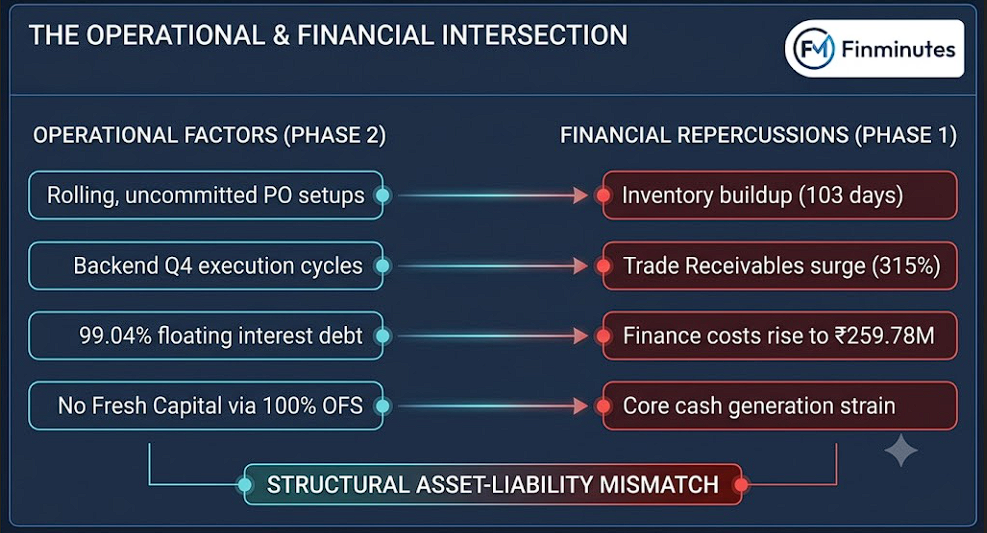
To build a definitive institutional assessment, we must analyse how Phase 1’s financial data connects with Phase 2’s operational realities. This intersection reveals several structural challenges that complicate the company’s growth narrative.
+------------------------------------+     +-----------------------------------+
|    OPERATIONAL FACTOR (Phase 2)    |     |    FINANCIAL REPERCUSSION (Phase 1)|
+------------------------------------+     +-----------------------------------+
| • Rolling, uncommitted PO setups   | --> | • Inventory buildup (103 days)    |
| • Backend Q4 execution cycles     | --> | • Trade Receivables surge (315%)  |
| • 99.04% floating interest debt    | --> | • Finance costs rise to ₹259.78M  |
| • No Fresh Capital via 100% OFS    | --> | • Core cash generation strain     |
+------------------------------------+     +-----------------------------------+
|                  STRUCTURAL ASSET-LIABILITY MISMATCH                         |
|   (Using ₹657.27 Million short-term debt loops for fixed capex runs)      |
+------------------------------------------------------------------------------+
The Working Capital Elongation
Our operational analysis shows that Kusumgar lacks long-term customer volume commitments and faces execution delays on large contracts, such as the deferred ₹2,371.96 million parachute order. This explains the sudden deterioration of the company’s financial metrics in FY26, where the total working capital cycle stretched to 90 days, and trade receivables climbed to ₹2,332.79 million.
Because Kusumgar lacks firm contractual leverage, it must absorb significant inventory costs and accept prolonged collection cycles from large defence contractors and government buyers.
Debt Vulnerability and Capex Funding
With a working capital cycle that demands significant cash, Kusumgar has leaned heavily on debt. Total borrowings reached ₹2,235.82 million in FY26, with 99.04% floating rate exposure. This reliance on flexible financing leaves the company exposed to interest rate volatility, driving its finance costs up to ₹259.78 million and compressing its net profit margins.
Furthermore, the auditor’s finding that the company used ₹657.27 million in short-term funds to finance long-term capital expenditure underscores a historical willingness to accept asset-liability mismatches to fund asset growth.
The OFS Dilemma
Kusumgar Ltd IPO is seeking a valuation multiple of roughly 45x P/E at the upper price band of ₹419. However, because the offering is entirely an Offer for Sale (OFS), the ₹650.00 crore in gross proceeds will exit to the selling promoters rather than reinforcing the company’s internal liquidity or drawing down its floating debt.
8. Finminutes Operational Benchmarking Matrix
To place the company within its broader industrial peer group, the Finminutes Terminal evaluates Kusumgar Limited against its main listed operational competitors in the Indian technical textiles landscape, including Garware Technical Fibres and SRF Limited.
| Operational Metric | Kusumgar Limited | Garware Technical Fibres | SRF Limited (Technical Textiles Wing) |
| Primary Segment Focus | Aerospace, Defence, and Specialised Lamination Fabrics. | Aquaculture, Marine Cordage, and Geotextile Networks. | Nylon Tire Cord Fabrics, Belting Substrates, and Industrial Yarn Blocks. |
| Pricing Power & Moat | High technical specialisation across 1,000+ SKUs, but exposed to spot tender cycles. | Strong consumer brand recall and high recurring institutional replacement demand. | Large industrial scale and deep vertical chemical integration, though cyclical. |
| Working Capital Risk | High: Trade Receivables Days reached 123 days in FY26 due to backend-loaded billing. | Moderate; predictable collections from commercial maritime and agricultural sectors. | Low to Moderate; standardised corporate invoicing cycles. |
| Supply Chain Concentration | High risk; 19.37% raw material dependency on Taiwan; 51.42% top 10 supplier reliance. | Low; diversified global and domestic polymer sourcing channels. | Low; captive domestic production of base chemical materials. |
| Export Profile Risks | High vulnerability to Western tariff changes (20%-40% US surcharges). | Balanced; international logistics costs are key, but tariff exposure is low. | Moderate; globally diversified chemical and material distribution channels. |
Technical Textile Peer Matrix
Select a risk or operational category to compare the peer group.
| Company | Market Segment & Focus |
|---|
9. Final Investor Conclusion & Verdict
Kusumgar Limited presents an interesting case study in the Indian technical textiles sector. The company has built a genuine operational moat around specialised technical fabric manufacturing, positioning itself within the high-barrier defence supply chain. Its extensive library of custom SKUs, downstream capabilities like Combat Free Fall parachute assemblies, and entry-level defence clearances give it a strong foundation to benefit from local procurement trends.
However, the Red Herring Prospectus highlights several structural vulnerabilities that merit caution. The business model is highly dependent on lumpy, tender-driven orders without long-term volume guarantees, leaving it exposed to abrupt revenue shifts. Its supply chain faces clear geographic and political concentration risks, notably through its reliance on Taiwanese raw material inputs and exposure to shifting US trade policies.
When combined with the financial friction detailed in Part 1, including significant trade receivables buildup, tight short-term liquidity, accounting trail gaps, and an asset-liability mismatch flag from auditors, the operational risks become more pronounced. The fact that the ₹650.00 crore issue is entirely an Offer for Sale (OFS) means the company’s capital structure will not receive fresh funding to address these balance sheet pressures.
Institutional Suitability
- Short-Term/Momentum Outlook (Tactical): The robust Day 1 subscription rate of 3.45x and strong Grey Market Premium (₹168) suggest the IPO is positioned for a solid listing debut, driven by market interest in defence-linked assets. For investors seeking short-term listing allocation gains, the issue offers clear near-term momentum.
- Long-Term Capital Outlook (Strategic): At an implied P/E multiple of ~45x on FY26 earnings, the valuation leaves a thin margin of safety. Fundamental, long-term investors may want to wait for post-listing quarterly results to confirm that the company can stabilise its revenue trajectory, improve its cash-conversion efficiency, and reduce its reliance on concentrated import channels before building a core position.
Finminutes terminal classification rating: Speculative Hold for Listing Gains; Awaiting Cash Conversion Stabilisation for Long-Term Commitment.
Disclaimer: This analysis is for informational purposes only, based on disclosures within the Red Herring Prospectus of Kusumgar Limited. It does not constitute formal financial advice. Investment in equities involves risk; consult an authorised financial advisor before allocating capital.




Leave a Reply