EPF & VPF Wealth Architect
Plan your retirement corpus with Salary Step-Up, Inflation Adjustments & ₹2.5L Tax Limits.
Pro Tip: Increase the 12% contribution below to activate the Voluntary Provident Fund (VPF).
Minimum statutory limit is 12%.
Interest generated on your contributions exceeding ₹2.5 Lakhs/year is fully taxable.
| Year | Your Deposit | Employer Share | Balance |
|---|
Understanding Your EPF & VPF
The Statutory EPS Split
Out of your employer's 12% contribution, a fixed 8.33% is systematically redirected into the Employee Pension Scheme (EPS). This portion is legally capped at a monthly wage ceiling of ₹15,000 (meaning a max of ₹1,250/month), while the remaining balance goes into your primary compounding EPF corpus.
The VPF Yield Advantage
If you choose to increase your contribution percentage beyond the mandatory 12%, the excess capital flows into the Voluntary Provident Fund (VPF). It earns the exact same premium 8.25% interest rate as your mandatory EPF, making it one of the highest-yielding risk-free fixed-income instruments in India.
The ₹2.5 Lakh Taxation Threshold
While EPF traditionally enjoys tax-exempt status, contributions exceeding ₹2.5 Lakhs in a single financial year enter a separate taxable bucket. The interest generated on this excess principal is taxed annually at your regular personal income tax slab rate.
Lock-in and Liquidity Rules
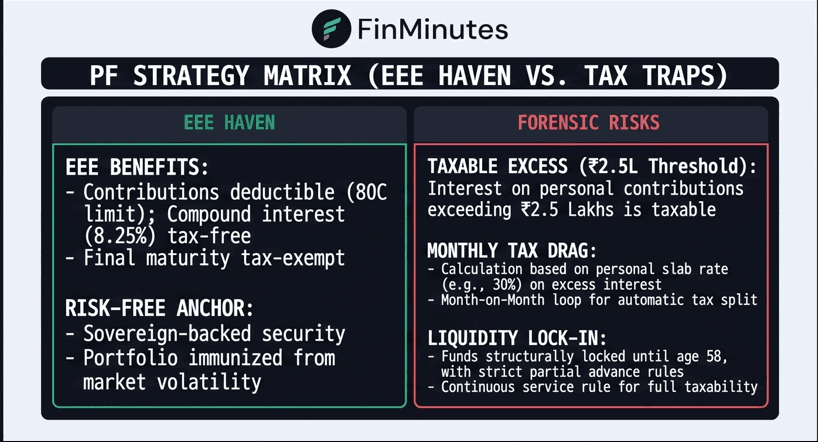
Your EPF/VPF accumulation is structurally locked until retirement (age 58). However, the EPFO permits partial non-refundable advances for critical life events—such as housing purchase, marriage, or medical emergencies—after specific tenure thresholds are satisfied.
EPF and VPF Calculator: For decades, the Employees’ Provident Fund (EPF) has served as the silent wealth engine for India’s salaried class. However, recent macroeconomic shifts, volatile equity markets, and sweeping changes to fixed-income taxation have fundamentally altered how retail and institutional investors view traditional retirement accounts. With the government ratifying a robust 8.25% interest rate for FY 2025-26, the provident fund framework remains one of the few remaining bastions of high-yield, risk-free compounding.
Yet, maximising this asset class is no longer as simple as letting your HR department deduct a flat percentage from your paycheck. The introduction of the ₹2.5 Lakh taxation threshold on annual contributions, the complex stripping of the Employee Pension Scheme (EPS), and the psychological trap of inflation have made retirement planning a highly mathematical exercise.
This is exactly why we built the FinMinutes EPF and VPF Calculator: The Wealth Architect. This is not a generic calculator; it is an institutional-grade terminal designed to model dynamic salary increments, accurately split statutory pension limits, and execute complex tax-slab deductions on excess contributions.
Before you run your numbers through the terminal, it is critical to understand the precise mechanics of how your money is distributed, compounded, and taxed. Here is the definitive FinMinutes deep-dive into the rules, regulations, and strategies governing your EPF and Voluntary Provident Fund (VPF), and effectively use our EPF and VPF Calculator
1. The Anatomy of EPF: Understanding the 12% Rule
The Employees’ Provident Fund is a mandatory retirement savings scheme governed by the Employees’ Provident Fund Organisation (EPFO). By law, if you are a salaried employee in an organisation with 20 or more staff members, a specific portion of your income must be directed into this fund.
The foundational mathematics of the EPF mandate are anchored to a 12% deduction:
- The Employee Share: Exactly 12% of your monthly Basic Salary plus Dearness Allowance (DA) is deducted from your paycheck and deposited directly into your EPF account.
- The Employer Share: Your employer is mandated to match this contribution, depositing an equivalent 12% on your behalf.
However, a critical misconception among retail investors is that the entire 24% (your 12% plus your employer’s 12%) goes into the high-compounding EPF bucket. This is mathematically incorrect. While your entire 12% contribution lands in your EPF account to earn the 8.25% interest, your employer’s 12% match is legally fractured into two separate destinations.
2. The EPS Split Decoded: Where Does the Employer Share Actually Go?
To accurately project your retirement wealth, you must understand the mechanics of the Employee Pension Scheme (EPS). Introduced to provide a safety net of regular pension payouts after age 58, the EPS is funded entirely by siphoning off a portion of your employer’s contribution.
The EPFO mandates that 8.33% of your employer’s total 12% match must be redirected into the EPS. But there is a massive statutory ceiling that dictates exactly how much capital this represents.
The ₹15,000 Statutory Wage Ceiling
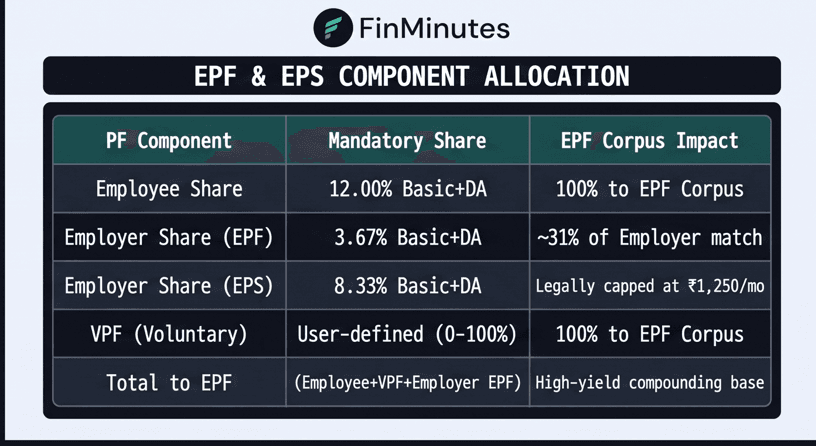
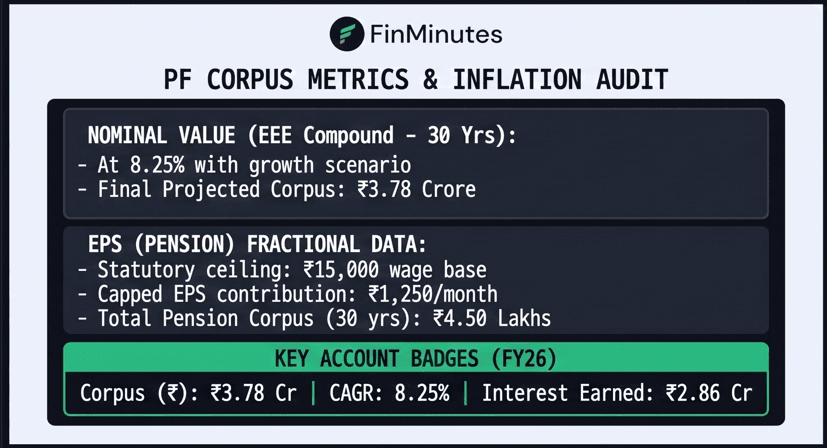
The government caps the maximum wage on which the EPS contribution can be calculated at ₹15,000 per month. This means, regardless of whether your basic salary is ₹50,000 or ₹5,00,000, the 8.33% EPS deduction is calculated strictly on a maximum base of ₹15,000.
Let us run the exact math:
- Maximum EPS Wage Base: ₹15,000
- Statutory EPS Deduction: 8.33%
- Maximum Monthly Pension Contribution: ₹1,250
Therefore, a maximum of ₹1,250 is stripped out of your employer’s monthly contribution and parked in a non-interest-bearing pension pool. The remaining balance (Employer’s total 12% contribution minus the ₹1,250 EPS deduction) is then deposited into your primary EPF account, where it joins your money to compound at the prevailing 8.25% interest rate.
The FinMinutes Wealth Architect automatically handles this highly specific fractional math, ensuring your projected compounding corpus is never artificially inflated by the diverted pension funds.
3. Voluntary Provident Fund (VPF): The Hidden Alpha
If the standard 12% deduction feels insufficient for your retirement goals, the statutory framework offers a powerful mechanism to scale your risk-free capital: The Voluntary Provident Fund (VPF).
VPF allows salaried employees to voluntarily increase their monthly provident fund contribution beyond the mandatory 12% baseline. You can choose to contribute 15%, 30%, or even up to 100% of your Basic Salary + DA into this fund.
Why Institutional Money Respects VPF
In a landscape where standard bank fixed deposits (FDs) offer roughly 7.0% to 7.5% (fully taxable at your slab rate, dragging the net yield down to around 5% for top-bracket earners), the VPF stands out as an absolute anomaly.
- VPF contributions earn the exact same premium interest rate as the mandatory EPF (currently 8.25%).
- It carries zero market risk and is backed by the sovereign guarantee of the Government of India.
- It serves as a superior asset allocation tool for the debt portion of your portfolio, immunising a portion of your wealth against the volatility of equities while outperforming traditional inflation benchmarks.
However, the government realised that High Net Worth Individuals (HNIs) were parking massive amounts of untaxed capital into the VPF to harvest risk-free alpha. To counter this, they introduced a structural speed bump: the ₹2.5 Lakh taxation threshold.
4. The ₹2.5 Lakh Taxation Trap: What Changed in the Budget?
For decades, the provident fund operated on a pure Exempt-Exempt-Exempt (EEE) taxation model. Your contributions were tax-deductible (under Section 80C), the interest earned was completely tax-free, and the final maturity withdrawal was tax-exempt.
To prevent the disproportionate accumulation of tax-free wealth by high-income earners, recent Union Budgets fundamentally altered the EEE status for high contributors.
The New Rule of Taxation
If your total provident fund contribution (your mandatory 12% EPF plus any additional VPF you inject) exceeds ₹2,50,000 in a single financial year, the interest generated on the excess amount becomes fully taxable at your applicable personal income tax slab rate.
Note: If your employer does not contribute to your EPF (a rare scenario for standard salaried workers), this threshold is elevated to ₹5,00,000.
How the FinMinutes Engine Handles the Split
When your annual contribution breaches the ₹2.5 Lakh mark, the EPFO essentially creates two separate ledger accounts for you:
- The Tax-Free Corpus: Contains all contributions up to ₹2.5 Lakhs and the tax-free interest generated on them.
- The Taxable Corpus: Contains all contributions exceeding ₹2.5 Lakhs. The 8.25% interest generated specifically on this excess bucket is taxed every year.
This is where generic calculators fail and where the FinMinutes Wealth Architect proves its institutional value. Our tool runs a dynamic, month-by-month loop. The exact month your cumulative deposits cross ₹2.5 Lakhs, the algorithm splits the capital, applies your selected tax slab (e.g., 30%) strictly to the interest of the overflow capital, and deducts the tax liability before compounding the balance into the next year.
5. How to Leverage the FinMinutes EPF and VPF Calculator: The Wealth Architect
We engineered this terminal to replace standard spreadsheet modelling. To extract the maximum value from the tool, it is important to understand the parameters you are controlling.
Step-by-Step Parameter Guide
- Monthly Basic Salary + DA: Enter your current monthly basic pay. Do not enter your in-hand or gross salary, as EPF math strictly relies on the Basic + Dearness Allowance components.
- Employee Contribution (EPF + VPF): The tool defaults to the statutory minimum of 12%. If you wish to model the impact of VPF, increase this percentage. The engine will instantly recalculate the compounding effect while monitoring the ₹2.5 Lakh tax threshold.
- Annual Salary Hike (Growth): Retirement planning without accounting for career growth is fundamentally flawed. This step-up parameter automatically increases your basic salary by the specified percentage (e.g., 8%) every 12 months. This triggers higher monthly EPF inflows and accelerates the timeline to hitting the tax threshold.
- Tax Slab Bracket: Because VPF interest over the ₹2.5L limit is taxable, you must select your current income tax bracket. The tool will calculate the exact monetary drag this tax liability has on your final retirement corpus.
- Inflation Rate Selector: This is the most crucial psychological check in the tool. A ₹4 Crore maturity balance in 30 years suffers heavily from “money illusion.” By toggling the inflation rate to 4-7%, the tool reverse-calculates the terminal corpus to show you exactly what your future wealth is worth in today’s purchasing power.
The Excel Data Export in Finminutes EPF and VPF Calculator
For users requiring deeper portfolio integration, the tool features a one-click CSV export. This allows you to instantly download the complete month-by-month compounding schedule, your exact employer split ratios, and the localised tax deductions directly into your own Excel models for holistic net-worth tracking.
6. Liquidity, Lock-ins, and Withdrawal Regulations
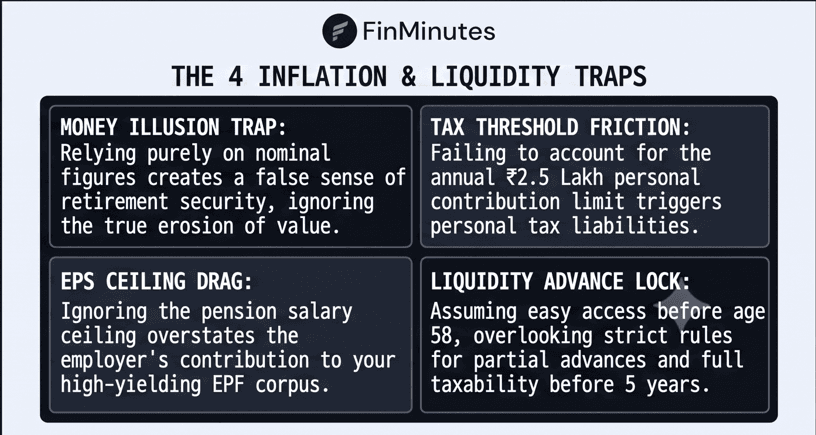
The primary drawback of the EPF/VPF framework is liquidity. This is a structural retirement product, and the government intentionally makes it difficult to access the capital prematurely to ensure you have a safety net at age 58. However, life is unpredictable, and the EPFO provides specific release valves for partial, non-refundable advances.
Conditions for Early Withdrawal (Advances)
You do not need to wait until age 58 to access portions of your capital, provided you meet strict criteria:
- Housing and Real Estate: You can withdraw up to 36 months of basic salary for the purchase or construction of a house, or to repay a home loan, provided you have completed a minimum of 5 years of continued service.
- Medical Emergencies: For major surgical operations or critical illnesses (for yourself or immediate family), you can withdraw up to 6 months of basic salary or your entire employee share, whichever is lower. There is no minimum service tenure required for medical advances.
- Marriage and Education: You can withdraw up to 50% of your employee share for your own marriage, the marriage of your children/siblings, or for the post-matriculation education of your children, provided you have completed 7 years of service.
- Unemployment: If you lose your job and remain unemployed for more than one month, you are permitted to withdraw 75% of your total corpus. If unemployment extends beyond two months, you can withdraw the remaining 25% and close the account entirely.
Tax Implications of Early Withdrawal
If you withdraw your EPF corpus before completing 5 years of continuous service, the entire withdrawal amount becomes fully taxable. The amount previously claimed under Section 80C deductions will be added back to your taxable income for the year of withdrawal. Furthermore, if the withdrawal amount exceeds ₹50,000 before the 5-year mark, a Tax Deducted at Source (TDS) of 10% is applied (or 30% if a PAN card is not furnished).
Always attempt to transfer your EPF account to your new employer when switching jobs rather than withdrawing the capital, to preserve continuous service tenure and the power of compound interest.
7. Strategic Structuring for the Modern Investor
Building a retirement corpus is an exercise in asset allocation. While equity mutual funds and index terminals provide the aggressive growth required to outpace inflation, a robust portfolio demands a stable, risk-free anchor.
The EPF, supplemented strategically by the VPF, provides an 8.25% sovereign-backed yield that traditional debt markets simply cannot match in a post-tax environment.
Key Differences Between EPF and PPF
Many ask what the primary difference is between EPF and PPF, and stay confused. Here is the definitive answer to solve your confusion. While both are popular, government-backed retirement vehicles that offer tax advantages, they operate under entirely different structures. Here is how they compare: EPF vs PPF
| Feature | Public Provident Fund (PPF) | Employees’ Provident Fund (EPF) |
| Nature of Scheme | A voluntary, long-term savings scheme open to any Indian resident individual. | A mandatory retirement savings scheme designed strictly for salaried employees in EPF-registered organisations. |
| Contribution Rules | You decide how much to invest, with a minimum of ₹500 and a maximum of ₹1.5 lakh per year. | Automatically deducted from your paycheck at 12% of your basic salary, plus a matching contribution from your employer. |
| Interest Rate | Fixed by the government and reviewed quarterly (currently 7.1% p.a.). | Declared annually by the EPFO, and typically trends slightly higher than the PPF rate. |
| Tax Benefits | Enjoys pure EEE (Exempt-Exempt-Exempt) status, meaning contributions, interest earned, and final maturity withdrawals are completely tax-free. | Also EEE, but subject to specific conditions (e.g., interest becomes taxable if your personal contribution exceeds certain limits). |
| Lock-in Period | A strict 15-year lock-in, which can be extended in blocks of 5 years. | Generally locked in until your retirement or a change in employment. |
| Withdrawal Flexibility | Partial withdrawals are allowed only after 6 years, with full access at maturity. | Permits partial, non-refundable advances for specific needs like home purchases, education, or medical emergencies. |
| Control | Highly flexible; you manage the account, the deposit timing, and the frequency yourself. | Low flexibility; it is structurally linked to your payroll and administered by your employer. |
The FinMinutes Verdict
Use the Wealth Architect above not just to stare at a massive future number, but to stress-test your financial reality. Play with the inflation toggle. See how quickly a 10% annual salary hike pushes you into the taxable VPF bracket. Export the data and run it against your Nifty 50 equity models.
By understanding the math behind the EPS strip and the taxation crossover, you transition from passively accepting payroll deductions to actively engineering your terminal wealth.
Disclaimer: The FinMinutes EPF & VPF Wealth Architect is a financial modelling tool designed for educational and planning purposes based on the current prevailing EPFO regulations and the 8.25% interest rate for FY26. It does not constitute personalised financial advice. Tax laws and interest rates are subject to statutory amendments. Always consult a SEBI-registered Investment Adviser or a certified tax professional before making significant asset allocation decisions.