
Ultimate Lifecycle Planner | v5.4
Accurate 12.5% LTCG Engine • Inflation Adjusted • Expense Ratios
Wealth Trajectory
Cashflow Split
Sustainability Heatmap
Years your money lasts vs Market Volatility.
Plan Risk Meter
Safety score (500 Monte Carlo simulations).
Formulas & Methodology
1. SIP Growth: Maturity = Σ [SIP * (1+r)^n]
2. Taxation (LTCG): Dynamic gain-ratio method. Tax = (Realized Gain - ₹1.25L Exemption) * 12.5%.
3. Monte Carlo: 500 simulations with 12% random volatility.
| Yr | Age | Phase | Cashflow | Charges | Tax | Balance |
|---|
Financial freedom isn’t about luck; it’s about engineering. Most investors in India treat their finances like a collection of random puzzle pieces, a random SIP here, a tax-saving fund there, and a vague hope that it all adds up to a comfortable retirement.
But hope is not a strategy. Goal Based Investment is. Welcome to the FinMinutes Ultimate SIP and SWP Calculator, the only financial tool designed to map your entire lifecycle.
Whether you are planning for FIRE (Financial Independence, Retire Early), a traditional retirement, or a legacy fund for your children, this tool connects the two most critical phases of wealth: Accumulating it (via SIP) and Distributing it (via SWP).
This guide will walk you through exactly how to use this powerful engine to stress-test your financial goals against the three silent killers of wealth: Inflation, Taxation, and Market Volatility.
What are Goal Based Investments? (And Why You Need It)
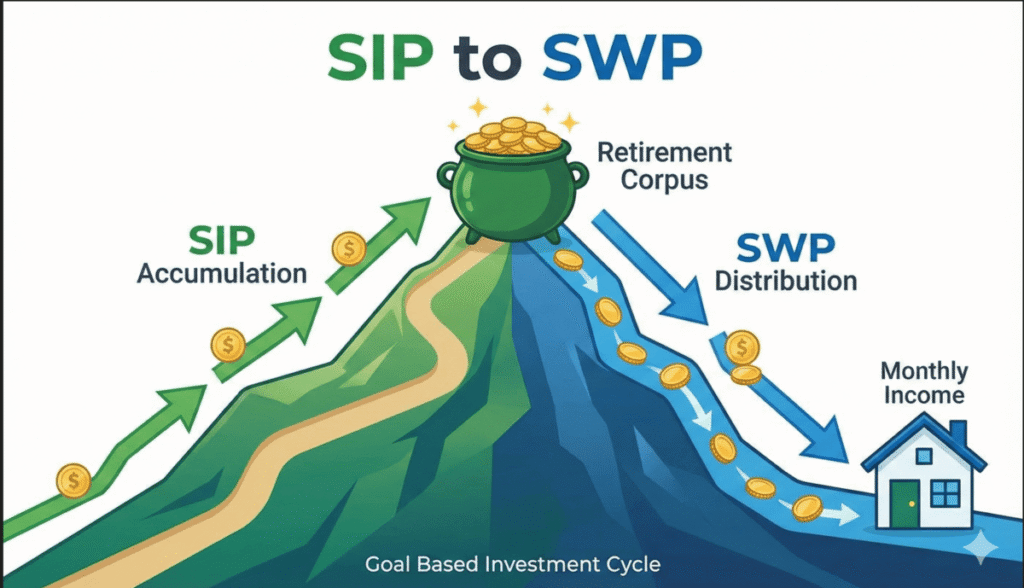
In the crowded world of finance, “Goal Based Investments” is a separate keyword for a reason; it shifts the focus from returns to requirements.
Traditional investing asks: “Which mutual fund gave the highest return last year?” Goal-based investing asks: “How much money do I need in 2045 to maintain my current lifestyle, and what SIP amount will get me there?”
Our SIP and SWP Calculator is built on this philosophy. It doesn’t just crunch numbers; it visualises your journey up and down the “Wealth Mountain.”
The Two Phases of a Financial Goal
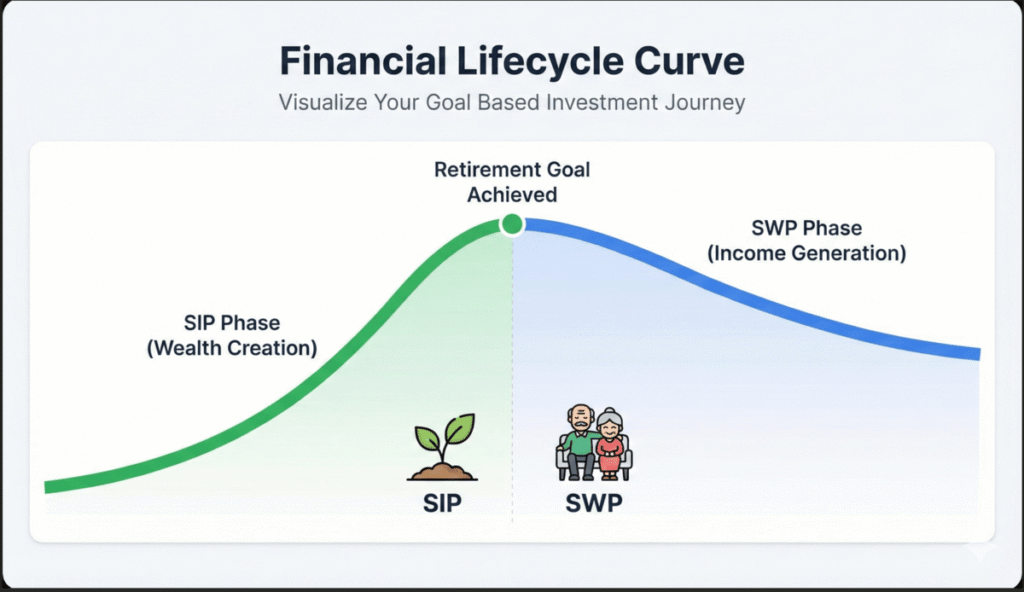
Every long-term financial goal has a lifecycle comprising two distinct phases:
- The Ascent (Accumulation Phase): This is where you work for your money. You use a Systematic Investment Plan (SIP) to build a corpus. The goal here is growth.
- The Descent (Distribution Phase): This is where your money works for you. You use a Systematic Withdrawal Plan (SWP) to generate a monthly “pension” from your accumulated corpus. The goal here is sustainability.
Most free calculators online only handle one phase. They tell you how much you’ll save, but not how long it will last. Our SIP and SWP calculator seamlessly bridges this gap, allowing you to transition from SIP to SWP in a single, unified simulation.
How SIP and SWP Work Together
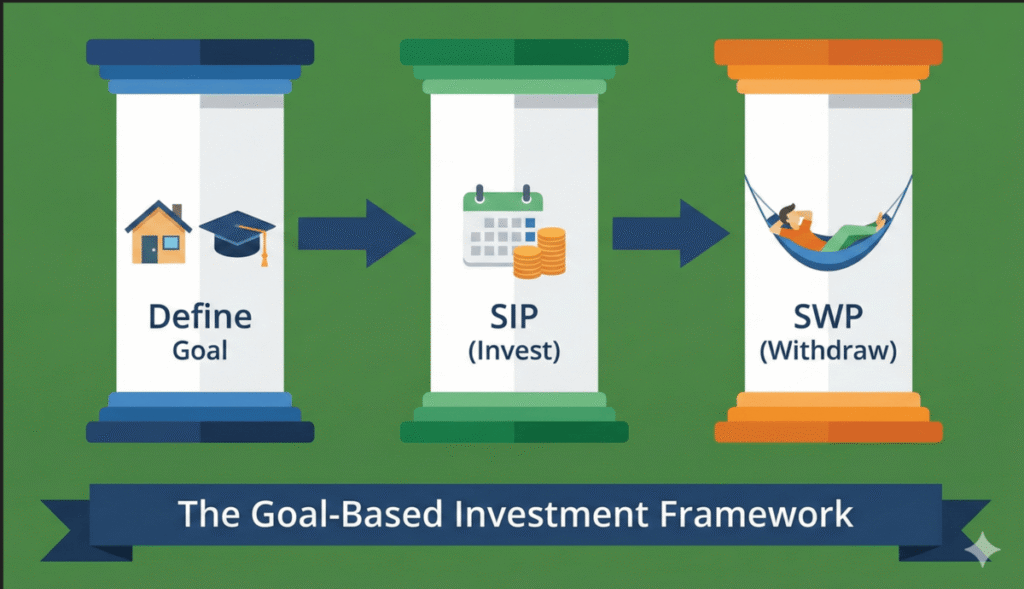
To master this tool, you need to understand the mechanics under the hood.
SIP (Systematic Investment Plan): The Wealth Builder
A SIP is the most disciplined way to handle market volatility. By investing a fixed amount every month, you leverage Rupee Cost Averaging, buying more units when markets are down and fewer when they are up.
- The Power of Step-Up SIP: This is the tool’s “secret weapon.” Most people assume their SIP amount will stay flat for 20 years. In reality, your income grows. If you start a SIP of ₹20,000 and increase it by just 10% every year (Step-Up), your final corpus can be nearly double that of a flat SIP. Our calculator lets you toggle this to see the massive difference.
SWP (Systematic Withdrawal Plan): The Income Generator
SWP is the reverse of SIP. Instead of buying units, you instruct the mutual fund house to sell a fixed value of units every month and credit your bank account.
- Why SWP over Dividends? Dividends are unpredictable and taxable at your slab rate. SWP gives you a predictable cash flow and is far more tax-efficient (more on this in the “Tax” section).
- The Inflation Trap: If you retire today needing ₹50,000/month, you will need nearly ₹1.6 Lakhs/month in 20 years to buy the same groceries. Our tool includes a Withdrawal Step-Up feature to simulate this reality check.
The Silent Killers of Wealth (And How We at Finminutes Fix Them)
Why do most retirement plans fail? Because standard calculators ignore the friction costs of the real world. This SIP and SWP Calculator is “Advanced” because it accounts for the three leaks in your bucket.
1. The Expense Ratio Drag
Every mutual fund charges a fee called the Expense Ratio (typically 0.5% to 2.0% per annum). Over a 30-year lifecycle, a 1% fee can eat up 20% to 30% of your total corpus.
- Our Solution: Finminutes SIP and SWP calculator allows you to input the exact Expense Ratio. We deduct this fee daily from your compounding growth, giving you the “Net” corpus value, not the gross theoretical one.
2. The New Taxation Rules (LTCG 12.5%)
As per the latest Union Budget, Long Term Capital Gains (LTCG) on equity mutual funds are taxed at 12.5% for gains exceeding ₹1.25 Lakhs in a financial year.
- The Problem: Most calculators assume every rupee you withdraw is taxable. This is wrong. When you run an SWP, you are withdrawing a mix of your Principal (already taxed) and Capital Gains (taxable).
- Our Solution: We use a smart Gain-to-Cost Ratio algorithm. If your portfolio has doubled in value, 50% of your withdrawal is principal, and 50% is gain. Our goal based investment tool only calculates tax on the gain portion, applies the ₹1.25L exemption, and shows you the post-tax reality.
3. Inflation: The Invisible Thief
Having ₹5 Crores sounds amazing today. But in 25 years, ₹5 Crores might only have the purchasing power of ₹1 Crore today.
- Our Solution: Look at the “Real Value” card in the results section. This metric adjusts your future legacy balance against inflation, showing you what that money is worth in today’s terms. This is critical for realistic Goal Based Investment planning.
How to Use the SIP and SWP Calculator for Specific Goals
This tool comes with Scenario Presets (buttons at the top) to help you plan for specific life stages instantly.
Scenario A: The “FIRE” Plan (Financial Independence, Retire Early)
- The Goal: Retire at 40 and live off your corpus for 40+ years.
- The Strategy: High SIP amount, shorter accumulation phase (10-15 years), and a very long distribution phase.
- What to check: Look at the Risk Meter. FIRE plans are sensitive to market crashes early in retirement. Ensure your Sustainability Score is Green (Safe).
Scenario B: Traditional Retirement (Retire @ 60)
- The Goal: A comfortable, stress-free life after a long career.
- The Strategy: Moderate SIP over a long period (25-30 years), followed by a standard SWP.
- What to check: Toggle the “Inflation” input. Does your corpus last till age 90 even if inflation spikes to 7%?
Scenario C: Safe Play (Conservative)
- The Goal: Capital protection.
- The Strategy: You want to withdraw only the gains and leave the principal untouched for your heirs (Legacy).
- What to check: Look at the “Legacy Balance” card. If this number is increasing over time, it means your SWP rate is lower than your portfolio growth rate, and you are creating generational wealth!
Stress-Testing Your Plan (Advanced Analytics)
A good plan survives a bad market. We have built three visual tools to help you “stress test” your Goal Based Investments.
1. The Sustainability Heatmap
The future is never a straight line. What if the market gives 10% returns instead of 12%? What if you need to withdraw more money for a medical emergency?
- How to read it: The grid shows 25 different futures. The Vertical Axis is Market Return; the Horizontal Axis is Withdrawal Amount.
- The Goal: You want your current plan to land in the Deep Green Zone. If you are in the Yellow or Red zone, you are relying on luck.
2. The Plan Risk Meter (Monte Carlo Simulation)
This is a Wall-Street-grade feature. We simulate 500 parallel universes where market returns fluctuate randomly (volatility).
- Needle in Green: Your plan succeeded in >80% of those universes.
- Needle in Red: Your plan failed frequently when markets crashed.
- The Fix: If the needle is red, check the “Smart Advice” box below the gauge. It will tell you exactly how much to increase your SIP by to fix the plan.
3. “What-If” Scenario Cards in our goal based investment tool
At the bottom of the dashboard, you will see three cards: Bear (-2%), Base, and Bull (+2%).
- This instantly shows you the difference between a pessimistic market and an optimistic one. It helps you set expectations: “Even if the market underperforms by 2%, will I still have food on the table?”
The Math Behind the Magic: Formulas
For the geeks and the trust-seekers, here are the formulas powering the FinMinutes Lifecycle Engine:
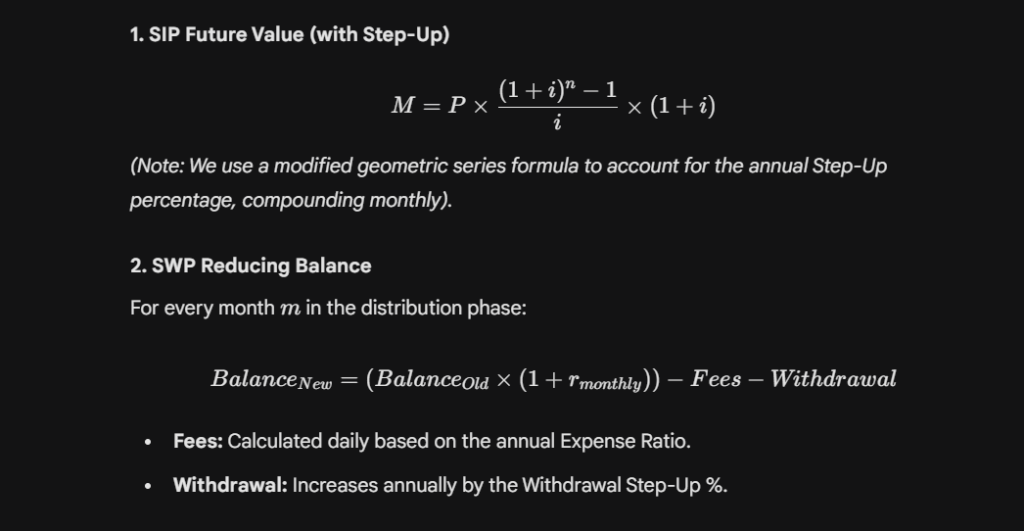

SIP and SWP calculator: FAQs
Is an SWP better than a Fixed Deposit (FD) for monthly income?
Generally, yes. FDs are fully taxable as per your income slab (which can be 30%+). SWP from equity funds is taxed at only 12.5% (LTCG) on the gains, and the principal component is tax-free. Furthermore, FDs struggle to beat inflation, whereas equity-oriented SWPs have the potential to grow your corpus even while you withdraw
Can I use this goal based investment tool for “Target Amount” planning?
Yes. This is the essence of Goal Based Investment. If you know you need ₹5 Crores (Target), enter different SIP amounts in the accumulation section until the “Peak Corpus” card matches your target. Then, check the SWP section to see if that ₹5 Crores is actually enough to sustain your lifestyle.
Why does the Risk Meter say “High Risk” even if my corpus looks big?
The size of the corpus doesn’t matter; the Withdrawal Rate does. If you have ₹1 Crore but withdraw ₹1 Lakh/month (12% annual withdrawal), you will deplete your money in less than 10 years because inflation and market dips will eat it alive. A safe withdrawal rate in India is typically 3% to 4%.
How does the Expense Ratio affect my final goal?
It affects it significantly. A Direct Plan (Expense ratio ~0.5%) vs. a Regular Plan (Expense ratio ~1.5%) can result in a difference of ₹50 Lakhs to ₹1 Crore over 30 years on a decent SIP. Always input the correct expense ratio to see the “net” money you keep.
What is the “Legacy Balance”?
This is the amount left over at the end of your selected tenure (e.g., at age 90). If this number is positive, it means you didn’t run out of money, and this amount can be passed down to your legal heirs. If it is zero, it means you consumed your entire corpus.
Why does the “Real Value” differ from the “Legacy Balance” in our SIP and SWP calculator?
The “Legacy Balance” is the actual number you will see in your bank account in the future (e.g., ₹10 Crores). However, due to inflation, everything will cost more. The “Real Value” adjusts that ₹10 Crores to tell you what it feels like in today’s money (e.g., ₹2 Crores). Always plan based on Real Value.
How accurate is the Tax Calculation in the Finminutes goal based investment tool?
Extremely accurate. Most calculators apply tax on the entire withdrawal. We apply tax only on the gain component of your withdrawal, and we even account for the ₹1.25 Lakh annual exemption introduced in the latest budget. While actual tax filing involves FIFO (First-In-First-Out) logic, which requires specific transaction dates, our “Gain-Ratio” method is the closest mathematical approximation for long-term planning.
What if the Risk Meter shows “High Risk” in the Finminutes goal based investment tool?
Do not panic. You have three levers to pull:
1. Invest More: Increase your SIP amount or Step-Up %.
2. Spend Less: Lower your monthly SWP requirement.
3. Work Longer: Extend your accumulation phase by 2-3 years. The power of compounding works best at the end!
Conclusion
The best time to plant a tree was 20 years ago. The second-best time is now. Use the FinMinutes SIP and SWP Calculator above to stop guessing and start planning. Your future self will thank you.