
Risk Analysis Masterclass India Edition
Comprehensive Guide: Detailed definitions, math, and real-world examples.
The Ultimate Masterclass (India Edition)
In the Indian financial landscape, conversations are dominated by one word: “Returns.” “Which stock will double?” “Which mutual fund gave the highest CAGR?” “Is Crypto the next big thing?” But returns are only half the story. The other half, the one that determines whether you sleep peacefully or panic-sell during a crash, is Risk.
In investing, returns are not gifts; they are the compensation you receive for enduring uncertainty. If you do not understand the risk you are taking, you are not investing; you are gambling.
Welcome to the FinMinutes Risk Analysis Masterclass. This guide is designed to act as the textbook for our interactive Risk Dashboard above. Whether you are a student, a new investor, or managing a large portfolio, this curriculum will take you from the basic concepts of loss to the advanced mathematics of Wall Street, all explained in the Indian context.
Risk Analysis in Investing
🌱 Level 1: The Beginner (Foundations of Investing)
Before we look at complex charts, we must unlearn a common myth: Risk is not just about losing money.
1. What is Financial Risk?
Technically, Risk is the uncertainty of returns. It is the likelihood that the actual outcome will differ from the expected outcome.
- The Low Risk Scenario (Fixed Deposit): You invest ₹1 Lakh in an SBI FD at 7%. You expect ₹1.07 Lakhs after one year. The uncertainty is near zero.
- The High Risk Scenario (Stock Market): You invest ₹1 Lakh in a Nifty 50 fund, expecting a 12% return. In reality, after one year, the market could be up 20%, flat at 0%, or down 15%. That “gap” between expectation and reality is Risk.
The Golden Rule: The Risk-Reward Tradeoff. There is no such thing as a “High Return, Low Risk” product. If a scheme promises you 12% guaranteed returns with zero risk, it is likely a scam.
2. Inflation Risk: The Silent Wealth Destroyer
This is the most dangerous risk because it is invisible. It doesn’t show up as a loss in your bank statement. It shows up at the grocery store. Inflation is the rate at which the price of goods and services rises. In India, long-term inflation is typically around 6%.
- The Savings Trap: Imagine you keep ₹10 Lakhs in a Savings Account earning 3% interest.
- Start of Year: You have ₹10 Lakhs. A car costs ₹10 Lakhs.
- End of Year: Your money grows to ₹10.3 Lakhs. But the car price rises to ₹10.6 Lakhs.
- Result: You have more money, but you are poorer because you can no longer afford the car.
3. Time Horizon Risk (New)
The probability of losing money in the stock market depends almost entirely on Time.
- 1-Day Horizon: It’s a coin toss. The market has a ~50% chance of being red tomorrow.
- 1-Year Horizon: The probability of loss drops to ~25%.
- 15-Year Horizon: Historically, the probability of loss in the Nifty 50 is Zero.
Insight: Time dilutes risk. If you are investing for your child’s education (15 years away), market volatility is your friend (buying opportunity), not your enemy.
4. The Power of Diversification
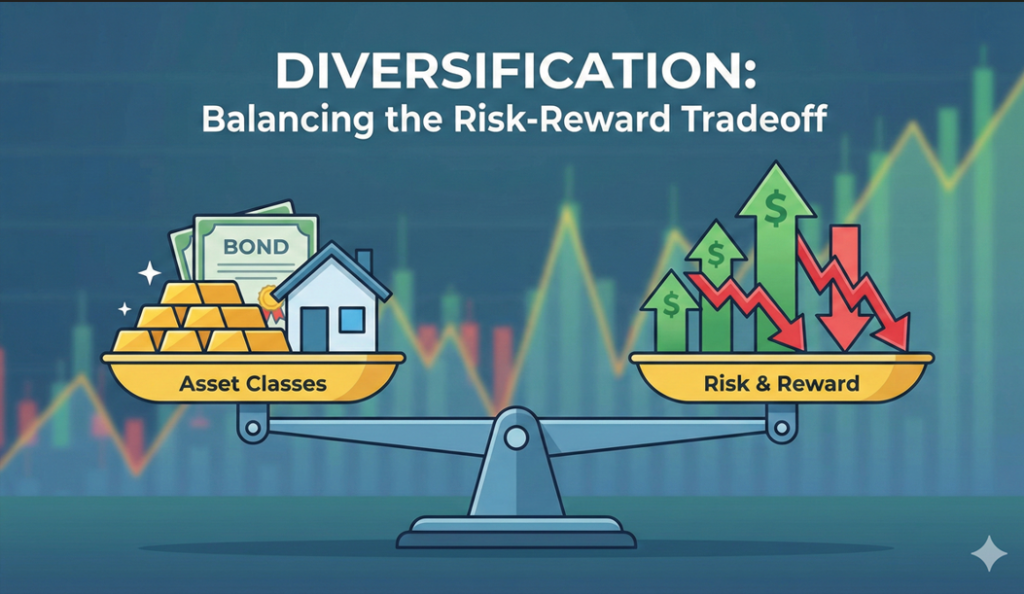
“Don’t put all your eggs in one basket.” Mathematically, this works because different assets react differently to the same event.
- Scenario: A War breaks out.
- Stocks: Crash due to fear.
- Gold: Rises as a “Safe Haven.”
- Bonds: Remain stable.
If you hold a diversified portfolio (Equity + Debt + Gold), the rise in Gold offsets the fall in Stocks, smoothing out your journey.
🚀 Level 2: Intermediate (Market Metrics)
Now let’s decode the specific numbers you see on Mutual Fund Fact Sheets.
1. Standard Deviation (SD): The Volatility Meter
Standard Deviation measures how “wild” the ride is. It calculates how much the returns deviate from the average.
- Fund A (Low SD): Returns range between 8% and 12%. Smooth ride.
- Fund B (High SD): Returns range between -10% and +30%. Rollercoaster ride.
Insight: Smart investors prefer Fund A. Why suffer the stress of volatility if the result is similar? Always look for funds with lower Standard Deviation compared to their peers.
2. Beta (β): Sensitivity to the Market
Beta measures how much a stock or fund moves relative to the Benchmark (usually Nifty 50).
- Beta = 1.0: Moves exactly with the market.
- Beta > 1.0 (High Beta): Aggressive. (e.g., Realty, Metal stocks). If Nifty rises 10%, these rise 15%. But if Nifty falls 10%, these crash 15%.
- Beta < 1.0 (Low Beta): Defensive. (e.g., FMCG, Pharma). If Nifty falls 10%, these might only fall 6%.
Insight: In a Bull Market, you want High Beta to maximise gains. In a Bear Market, you switch to Low Beta to protect capital.
3. Tracking Error (New)
This is critical for Index Fund investors. An Index Fund’s job is to copy the Nifty perfectly.
- Low Tracking Error: The fund follows the index like a shadow.
- High Tracking Error: The fund is deviating from the index (bad execution or high cash holding).
Rule: Always choose the Index Fund with the lowest Tracking Error, even if the Expense Ratio is slightly higher.
4. Interest Rate Risk
Many Indian investors treat Debt Mutual Funds like FDs. This is a mistake. Bond Prices and Interest Rates move in opposite directions.
- Scenario: RBI hikes the Repo Rate.
- Impact: Existing bonds with lower interest rates become less valuable. Bond prices fall. Debt Fund NAVs fall.
Insight: When interest rates are rising (like in 2022), avoid Long-Duration funds (Gilt Funds). Stick to Liquid or Overnight funds.
🧠 Level 3: Expert (Performance Ratios)
Expert investors don’t just ask “How much return did it give?” They ask “How efficient was that return?”
1. Sharpe Ratio: The Efficiency Score
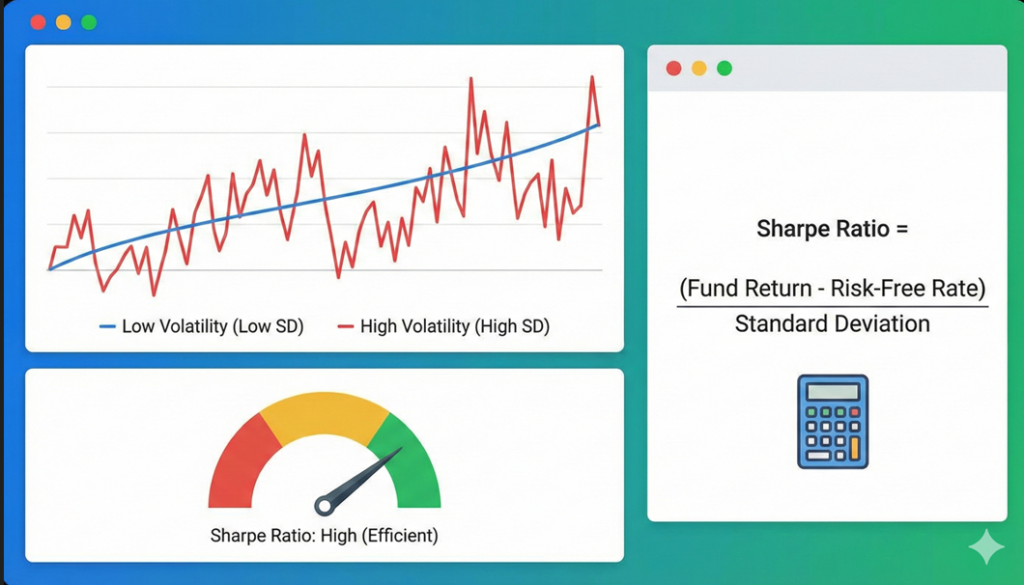
This measures Return per unit of Risk.

- Fund X: 20% Return. High Volatility. Sharpe = 0.5.
- Fund Y: 15% Return. Very Low Volatility. Sharpe = 1.2.
Verdict: Fund Y is better. Even though it gave lower returns, it took much less risk to get there. Always aim for a higher Sharpe Ratio.
2. Sortino Ratio: The “Good” Volatility
Standard Deviation punishes all volatility. But if a stock suddenly jumps UP by 20%, is that bad? No! The Sortino Ratio only punishes Downside Deviation (falling prices). It ignores upside volatility.
Use Case: Excellent for evaluating aggressive funds (Small Caps, Tech Funds) where sudden upward spikes are desirable.
3. Information Ratio (New)
This measures the consistency of a Fund Manager in generating Alpha.
- High Alpha, Low IR: The manager got lucky with a few big bets.
- High Alpha, High IR: The manager has genuine skill and beats the benchmark consistently month after month.
4. Alpha (α): The Manager’s Skill
Alpha measures the “extra” return generated over the benchmark index.
- Calculation:
Total Return = Market Return (Beta) + Skill (Alpha) - If Nifty gave 12% and your fund gave 15%, the Alpha is +3%. This justifies the Expense Ratio you pay.
⚡ Level 4: Pro (Quantitative Analysis)
These tools are used by Hedge Funds and Risk Managers.
1. Value at Risk (VaR)
VaR gives you a probabilistic worst-case scenario.
- Statement: “The 1-Day 95% VaR is ₹10,000.”
- Translation: We are 95% confident that you will NOT lose more than ₹10,000 tomorrow.
- The Trap: It says nothing about the remaining 5% (Black Swan events). On those days, losses can be infinite.
2. R-Squared (R²) (New)
This measures the reliability of Beta. It tells you how much of a fund’s movement is explained by the benchmark index.
- R² = 100: Perfect correlation (Index Fund).
- R² < 70: The fund does its own thing. The “Beta” figure is meaningless here because the fund doesn’t follow the market logic.
3. Correlation Matrix
To build a bulletproof portfolio, combine assets with Negative Correlation (-1).
- Stocks vs Stocks: High Positive Correlation (+0.9). They fall together.
- Stocks vs Gold: Negative Correlation (-0.3). When stocks fall, Gold often rises.
4. Maximum Drawdown (MDD)
This measures the “pain.” It is the percentage drop from the highest peak to the lowest trough.
- The Math of Loss: If your portfolio falls 50%, it must rise 100% just to break even. Funds with lower Drawdowns are mathematically superior because they preserve capital.
🌍 Level 5: Real World (Indian Case Studies)
Theory is useless without reality. Let’s look at how these metrics played out in Indian history.
1. Lehman Brothers Crisis (2008): Global Contagion

In 2008, a US bank collapsed. Many Indians thought, “Our banks are safe; we will decouple.”
- Reality: The Sensex crashed 60%.
- Why: Global liquidity dried up. FIIs sold Indian stocks to cover US losses.
- Lesson: In a global crisis, Correlations go to 1. Diversification within equities fails. Only Gold/USD provided safety.
2. The Covid Crash (2020)
In March 2020, Nifty fell 38% in weeks.
- The Winner: Asset Allocation. While equities bled, Gold was up +10% and Debt was stable. Diversified portfolios fell only ~15%, allowing investors to hold on for the recovery.
3. The Bullion Rally (2024)
After years of stagnation, Gold and Silver rallied 20-40% in 2024 while stocks consolidated in patches.
- Lesson: Asset classes are cyclical. Investors who ignored commodities (Gold/Silver) missed a massive engine of growth during the equity slowdown.
4. The Adani Saga (2023): Concentration Risk
A single report caused Adani stocks to crash 50-70%.
- Impact: Investors with 50% of their portfolio in one group lost fortunes. Mutual Funds with <2% exposure barely noticed.
- Lesson: Never put more than 5% of your wealth in a single company (Unsystematic Risk).
Risk Analysis: FAQs
As a beginner, which risk metric is most important?
Start with Standard Deviation. Compare a fund’s SD to its category average. If a fund gives good returns with lower volatility than its peers, it is a high-quality pick.
Why is tracking error important for passive investors?
If you buy a Nifty Index Fund, you want Nifty returns. If the Nifty gave 15% but your fund gave 14% due to high Tracking Error, you lost 1% wealth for no reason. Over 20 years, that 1% is massive.
Can High Beta be good?
Yes! Traders and aggressive investors love High Beta during a Bull Market because it acts as a turbocharger. It is only “bad” if you cannot handle the crash when the cycle turns.
How does R-Squared help me?
If you are analyzing a specialized fund (like a Tech Fund) and its R-Squared with Nifty 50 is low (e.g., 40), stop looking at its Beta relative to Nifty. It doesn’t follow Nifty. You need to analyze it based on its own sector dynamics. Check Finminutes Risk Analysis masterclass for more details.
Conclusion
Scroll up to the FinMinutes Risk analysis in investing Dashboard. Click through the levels, from Beginner to Real World, and watch the charts bring these concepts to life. Understanding risk is the first step to mastering wealth.