
PPF Wealth Architect
Plan your tax-free corpus with Step-Up & Inflation adjustments.
We automatically cap annual deposits at ₹1.5 Lakhs.
| Year | Deposit | Balance | Withdrawal Limit |
|---|
With Finminutes PPF Calculator, calculate your PPF maturity with monthly deposits, annual step-ups, inflation adjustments, and a full withdrawal schedule with Excel download. Check exact loan eligibility and withdrawal limits for 2026.
The “Boring” Investment That Creates Wealth
In the flashy world of Crypto, Intraday Trading, and Small Cap Mutual Funds, the Public Provident Fund (PPF) feels like a relic from the 1960s. It’s slow. It’s locked for 15 years. It’s “boring.” But ask any seasoned financial advisor where their safety net lies, and the answer is almost always PPF.
Why? Because PPF is the only instrument in India that offers the “Sovereign EEE” Trinity:
- Sovereign Guarantee: Your money is backed by the Government of India. It is safer than any bank FD.
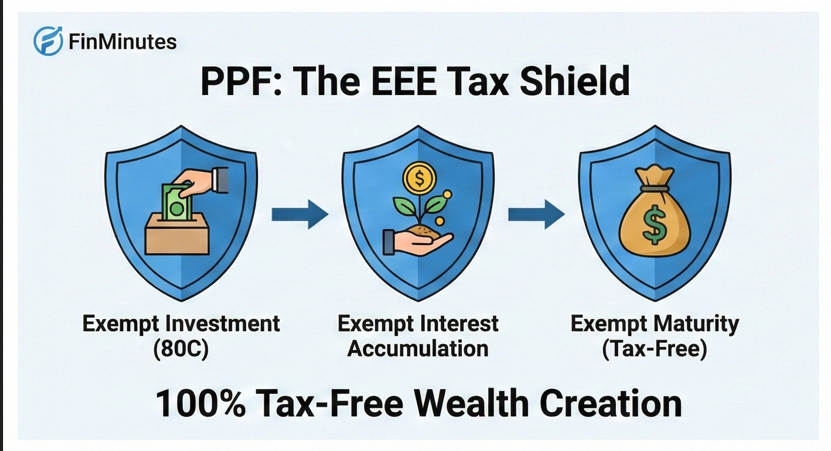
- EEE Tax Status: Exempt at Investment, Exempt at Interest Accrual, Exempt at Withdrawal.
- Inflation-Beating Safety: Historically, PPF rates (currently 7.1%) have hovered above inflation, offering real growth without market volatility.
However, PPF is not as simple as “Invest ₹1.5 Lakhs -> Wait 15 Years.” There are hidden rules about monthly deposit dates (the “5th of the Month” rule). There are complex formulas for partial withdrawals (the “4th Year” rule). And there is the massive potential of account extensions.
Most calculators ignore these nuances. They assume you are a robot investing once a year forever. The FinMinutes PPF Calculator, a Wealth Architect, is different. It is built for real investors who deposit monthly, who increase their investments as they get richer (Step-Up), and who want to know exactly when they can touch their money.
The “5th of the Month” Rule (Crucial for Monthly Investors)
If you search for “PPF Calculator Monthly,” you are likely an investor who treats PPF like a SIP. This is a smart habit, but it comes with a dangerous trap.
The Rule:
Interest in a PPF account is calculated on the lowest balance between the 5th and the last day of the month.
The Scenario:
- Investor A deposits ₹10,000 on the 4th of April.
- Result: This ₹10,000 earns interest for the entire month of April.
- Investor B deposits ₹10,000 on the 6th of April.
- Result: This ₹10,000 earns ZERO interest for April. It only starts earning from May.
The Cost of Delay:
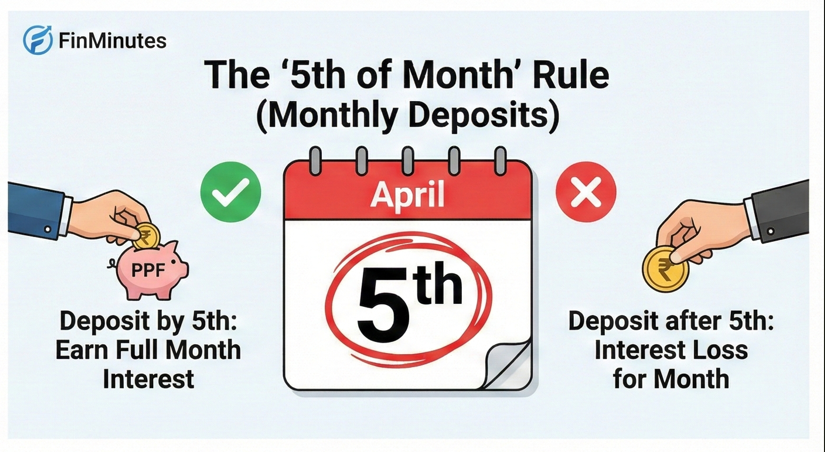
If you delay your SIP by just 2 days every month (paying on the 6th instead of the 4th), you effectively lose 1 month of interest every year. Over 15 years, this small mistake can cost you nearly ₹25,000 to ₹30,000 in lost interest.
Our Tool’s Solution: When you select “Monthly Mode” in the FinMinutes PPF Calculator, we calculate interest assuming you deposit before the 5th. We also show a “Pro-Tip” reminder to ensure you don’t miss this deadline.
Understanding PPF Withdrawal & Loan Rules
One of the biggest fears investors have is the 15-year lock-in. “What if I need money for an emergency?” The good news is, PPF is not as rigid as it seems. It has built-in liquidity options, but the math is tricky.
The PPF rule is: Interest is calculated on the lowest balance between the 5th and the last day of the month, but credited only once at the end of the Financial Year (March 31st).
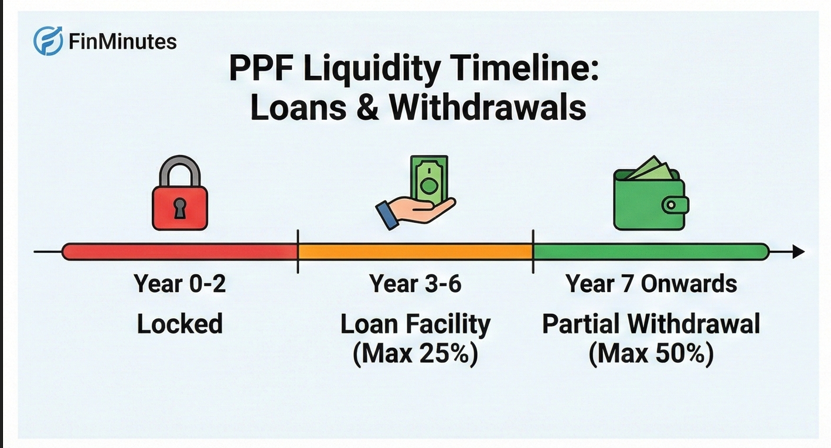
1. Loan Facility (Year 3 to Year 6)
Between the 3rd and 6th financial year, you can take a loan against your PPF.
- Limit: Max 25% of the balance at the end of the 2nd preceding year.
- Example: For a loan in FY 2025-26 (Year 3), the limit is 25% of the balance as of March 31, 2024 (Year 1).
- Interest Rate: Only 1% per annum. (This makes it one of the cheapest loans available).
- Repayment: Must be repaid within 36 months.
2. Partial Withdrawal (Year 7 Onwards)
From the 7th financial year, the “Loan” facility stops, and the “Withdrawal” facility begins. You can withdraw cash without repaying it.
- Limit: Max 50% of the lower of:
- Balance at the end of the 4th preceding year.
- Balance at the end of the preceding year.
- Tax: These withdrawals are 100% tax-free.
Our Tool’s Solution: Don’t use a generic calculator or a pen to figure this out. Just scroll down to the “Liquidity Timeline” table in our PPF calculator. It explicitly lists the “Loan Limit” and “Withdrawal Limit” for every single year of your tenure.
The Power of “Step-Up” Investing
Standard calculators assume you will invest ₹50,000 today and still invest ₹50,000 in the year 2038. That is unrealistic. As your career grows, your ability to save grows.
What is Step-Up?
It means increasing your annual deposit by a fixed percentage (e.g., 5% or 10%).
The Impact:
Let’s say you start with ₹1 Lakh/year.
- Standard (Flat): Corpus = ₹27.1 Lakhs.
- Step-Up (5%): Corpus = ₹35.4 Lakhs.
By simply increasing your deposit by 5% a year (which is barely ₹5,000 extra in Year 2), you end up with ₹8 Lakhs extra. Finminutes PPF Calculator includes a dedicated “Step-Up %” field that automatically caps your deposit at the statutory limit of ₹1.5 Lakhs/year, ensuring the calculation remains realistic and legal.
Extension Rules: The Secret to Massive Wealth
The PPF matures in 15 years. But smart investors don’t close it. They extend it.
The “Block of 5” Rule:
You can extend your PPF account indefinitely in blocks of 5 years.
- With Contribution: You continue depositing fresh money (up to ₹1.5L) and earning interest. Condition: You must submit Form-H within 1 year of maturity.
- Without Contribution: You stop depositing but keep the balance in the account. It continues to earn tax-free interest.
Why Extend?
Compounding works best in the later years.
- Year 1-15: You build the foundation.
- Year 15-20: Your interest starts earning more interest than your fresh deposits.
- Year 20-25: The “Money Machine” mode is fully active.
Our Tool’s Solution: Use the “Extension” dropdown to simulate extending for 20, 25, or even 30 years. Watch how the chart shifts from “Green” (Principal) to mostly “Light Green” (Interest).
Inflation: The Silent Wealth Killer
A corpus of ₹40 Lakhs may sound huge today. But in 15 years, with 6% inflation, ₹40 Lakhs will only buy what ₹17 Lakhs buys today.
If you don’t adjust for inflation, you are planning with “fake money.” The FinMinutes PPF Calculator, a Flagship Wealth Architect, allows you to select an inflation rate (4% to 7%). It then shows a “Real Value” tag below your maturity amount.
- Verdict: This helps you decide if ₹1.5 Lakhs/year is enough or if you need to supplement PPF with Equity Mutual Funds.
PPF vs. ELSS vs. NPS (The Tax-Saving Battle)
Where should your Section 80C money go?
| Feature | PPF (Public Provident Fund) | ELSS (Tax Saving Mutual Fund) | NPS (National Pension System) |
| Risk | Zero (Sovereign) | High (Market Linked) | Moderate (Market + Debt) |
| Returns | 7.1% (Fixed) | ~12-15% (Variable) | ~9-10% (Variable) |
| Lock-in | 15 Years | 3 Years | Until Age 60 |
| Tax on Maturity | Tax Free (EEE) | 12.5% on Gains > ₹1.25L | 60% Tax Free / 40% Annuity |
| Liquidity | Partial after Year 7 | None before 3 Years | Very Restricted |
Conclusion:
- Use PPF for the “Must-Have” safe portion of your portfolio (Debt allocation).
- Use ELSS for wealth creation over 10+ years.
- Use NPS strictly for retirement pension planning.
PPF Calculator Monthly: FAQs
Can I open a PPF account in a private bank?
Yes. HDFC, ICICI, Axis, and even Kotak Mahindra Bank offer PPF accounts. The rules, interest rates, and safety are identical to a Post Office PPF because the backend is the same Government scheme.
What is the minimum and maximum deposit?
Min: ₹500 per financial year.
Max: ₹1.5 Lakhs per financial year.
Penalty: If you miss the ₹500 min, a ₹50 fine is charged.
Can I open a PPF for my minor child?
Yes, as a guardian. However, the combined limit for you + your child is still ₹1.5 Lakhs. You cannot deposit ₹1.5L in your own PPF account and another ₹1.5L in your child’s PPF to claim double tax benefits.
Is the interest rate fixed for 15 years?
No. The interest rate is “floating.” The government reviews and announces it every quarter. However, once credited in your PPF account (on March 31st), that interest becomes part of your principal and cannot be taken back.
Can I close my PPF account early?
Only under special circumstances (like treatment of life-threatening diseases or higher education) after completing 5 financial years. A penalty of 1% less interest is deducted from the date of opening.
What is the latest rate of interest in a PPF account?
For a PPF account, the rates are announced quarterly by the GoI; the current rates are set at 7.1%.
Conclusion: Public Provident Fund, The “Slow and Steady” Winner
PPF is not exciting. It won’t double your money in a year. But it is the financial equivalent of eating your vegetables and going for a jog. It keeps your financial health robust, immune to market crashes, and tax-efficient.
Use the FinMinutes PPF Calculator, a Wealth Architect above, to:
- Check if you are depositing by the 5th (Monthly Mode).
- See how a 5% Step-Up can add lakhs to your corpus.
- Download your 15-year schedule to plan your liquidity.
Start Planning Your Freedom Today.