
NSC "Tax-Smart" Calculator
Calculate Maturity & Track "Hidden" 80C Deductions.
Min: ₹1,000 | Max: No Limit
Compounded Annually. Locked for 5 Years.
| Year | Interest Accrued | 80C Status |
|---|
The "Hidden" Tax Benefit
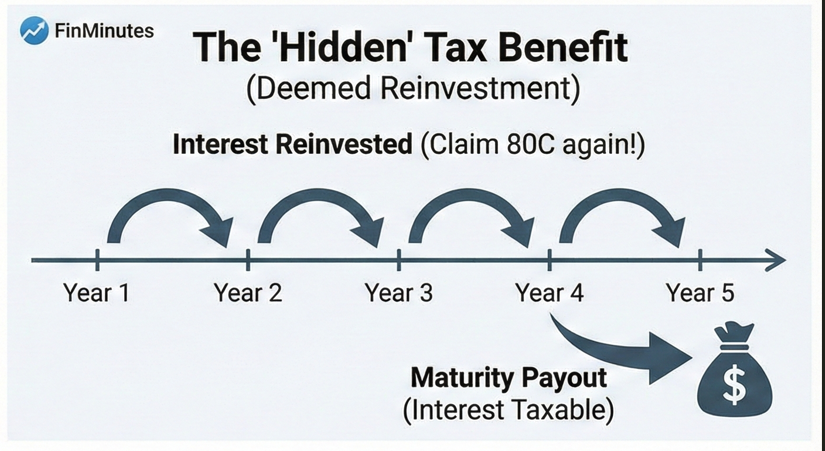
Interest earned in Years 1, 2, 3, & 4 is deemed to be reinvested. You can claim this amount as a deduction under Section 80C in your ITR, effectively making it tax-free (subject to the ₹1.5L limit).
With the Finminutes National Saving Certificate Calculator, calculate NSC maturity with the latest 7.7% interest rate. Discover the “Hidden” 80C tax deduction rule and check real returns after inflation.
Using the National Saving Certificate Calculator for Smart Investments
In the rush to buy ELSS Mutual Funds or open PPF accounts, many Indian investors overlook a quiet yet powerful instrument available at their local Post Office: the National Saving Certificate (NSC). It doesn’t have the glamour of the stock market. It doesn’t have the 15-year commitment of PPF. It sits comfortably in the middle, a safe, 5-year lock-in product that guarantees returns.
But NSC has a “Superpower” that almost no other financial product has. It allows you to claim a tax deduction twice on the same money.
Confused? Most investors know that the Principal invested in NSC is tax-free under Section 80C. But very few know that the Interest earned every year is also tax-free (up to a limit) because of a unique rule called “Deemed Reinvestment.”
If you don’t know how to calculate this, you are likely paying more tax than you need to. The FinMinutes NSC Calculator is a tax-smart tool and is designed to fix this. It doesn’t just show you the maturity amount; it generates a Year-by-Year Tax Schedule, so you know exactly what to claim in your ITR.
National Saving Certificate interest rate
The National Savings Certificate is currently in its VIII Issue (8th Issue). The interest rates are revised quarterly by the Ministry of Finance.
Current Rate:
7.7% p.a.
How is Interest Calculated?
- Compounding: Annually.
- Payout: Unlike Fixed Deposits, NSC does not pay interest into your bank account every year. The interest accumulates in the scheme and is paid only at maturity (after 5 years).
Example: If you invest ₹1,00,000 today:
- Year 1 Interest: ₹7,700 (Added to Principal)
- Year 2 Interest: Calculated on ₹1,07,700 -> ₹8,293
- Maturity (5 Years): You get approximately ₹1,44,903
The “Hidden” Tax Benefit in the NSC Scheme
This is the most critical part of this guide. Read this carefully to save money.
The Problem:
Interest earned on NSC is legally taxable. It is added to your “Income from Other Sources.”
Finminutes National Saving Certificate Calculator
Since the interest is not paid out to you but is added back to the NSC corpus, the Income Tax Act treats this interest as a “Fresh Investment” made by you.
- Rule: Any fresh investment in NSC is eligible for Section 80C deduction.
- Result: The interest you earn in Years 1, 2, 3, and 4 is added to your income (Taxable) but immediately claimed as a deduction (Tax-Free). The net tax effect is ZERO.
The Catch:
This applies only to the first 4 years.
- Year 5 Interest: This interest is paid out to you at maturity. It is not reinvested. Therefore, Year 5 interest is fully taxable as per your slab.
How Our Tool Helps: Scroll down to the “80C Tax Schedule” in the FinMinutes calculator. It clearly labels which years are “Reinvested (Claim 80C)” and which year is “Taxable.” Use this table while filing your ITR.
Who Should Invest in the NSC Scheme?
The NSC scheme isn’t for everyone. Here is the ideal profile:
- The “No-Risk” Investor: You want 100% capital protection. Since NSC is a sovereign instrument, it has zero default risk.
- The “5-Year” Planner: You find the 15-year lock-in of PPF too long, but the 3-year lock-in of ELSS too risky. The 5-year tenure of NSC is the perfect middle ground.
- The “Tax Maximiser”: You have exhausted your Section 80C limit (₹1.5 Lakhs) for this year, but you want a product that will help you fill the limit automatically for the next 4 years (via interest reinvestment). Our NSC Calculator clearly shows it.
NSC vs 5-Year Tax Saver FD
This is the most common comparison. Both are safe, both save tax, and both have a 5-year lock-in. Who wins?
| Feature | National Savings Certificate (NSC) | 5-Year Bank Tax Saver FD |
| Current Rate | 7.7% | ~7.0% – 7.5% |
| Issuer | Govt of India (Sovereign) | Bank (DICGC Insured up to ₹5L) |
| Interest Tax | Tax-Free (via 80C Reinvestment) | Fully Taxable (TDS Deducted) |
| TDS | No TDS Deducted | TDS Deducted if interest > ₹40k |
| Loan Facility | Available (Pledge as Collateral) | Not Available |
Verdict: NSC Wins.
The NSC Scheme offers a higher interest rate and better tax efficiency. In a Bank FD, you have to pay tax on the interest every year. In NSC, you don’t pay tax until maturity (effectively).
Inflation: Is 7.7% Enough?
A return of 7.7% sounds great on paper. But if inflation is running at 6%, your real return is only 1.7%.
- The FinMinutes NSC Calculator Feature: We added an “Inflation Adjustment” toggle to our tool.
- Why use it? If you are saving for a goal 5 years away (e.g., a car or home down payment), you need to know if your maturity amount will actually buy what you need.
- Reality Check: If you invest ₹1 Lakh, you get ₹1.44 Lakhs. But in “today’s money” (at 6% inflation), that ₹1.44 Lakhs is only worth ₹1.08 Lakhs.
How to Buy NSC (Online & Offline)
Gone are the days of standing in long queues at the Post Office.
Option 1: The Offline Way (Physical Certificate)
- Visit any Post Office branch.
- Fill out the Application Form (Form A).
- Submit KYC documents (Aadhaar, PAN) and a photograph.
- Pay via Cash or Cheque.
- Receive your Passbook/Certificate.
Option 2: The Online Way (e-NSC)
If you have a Savings Account with select banks (like SBI) or a Post Office Savings Account with Netbanking enabled:
- Log in to Netbanking.
- Go to “General Services” > “Service Request” > “New Request”.
- Select “NSC/KVP” -> “Open NSC Account”.
- Enter the amount and debit account.
- The e-Receipt acts as your certificate.
Loan Against NSC
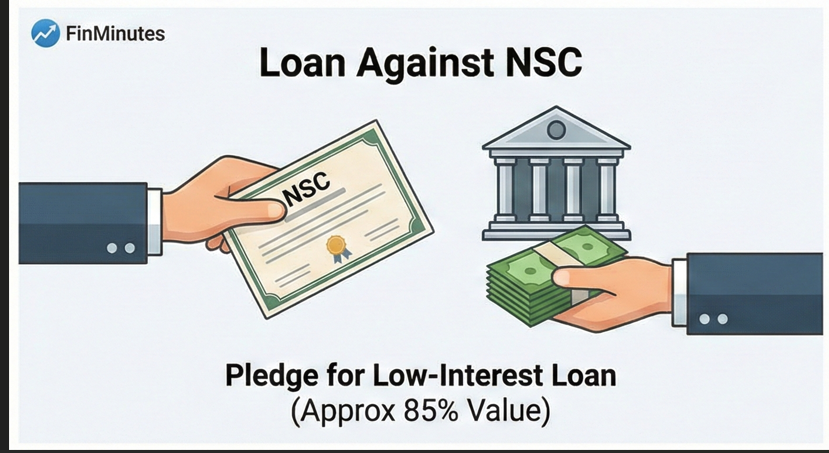
Did you know your NSC paper is as good as cash? If you face a financial emergency during the 5-year lock-in, you don’t have to break the investment (which is usually not allowed anyway).
Pledging NSC: You can pledge your NSC certificate to any Bank or NBFC to get a loan.
- Loan-to-Value (LTV): Banks typically offer 80% to 90% of the face value + accrued interest as a loan.
- Interest Rate: Usually lower than Personal Loan rates.
- Process: The Post Office marks a “Lien” on the certificate in favour of the bank. Once you repay the loan, the Lien is removed.
Our NSC calculator estimates this “Loan Value” for you instantly.
National Saving Certificate: FAQs
Can I withdraw NSC before 5 years?
Generally, NO. NSC has a rigid lock-in. Premature closure is allowed only in three specific cases:
– Death of the holder.
– Forfeiture by a Gazetted Officer (Pledgee).
– Order by a Court of Law.
Is there a maximum limit for deposits in the NSC scheme?
No. You can invest as much as you want. However, the tax benefit under Section 80C is capped at ₹1.5 Lakhs per financial year.
Can NRIs invest in the NSC scheme?
No. Non-Resident Indians are not eligible to purchase NSC. If you become an NRI after purchasing, you can hold it till maturity, but it cannot be repatriated easily.
What happens if I lose my physical certificate?
Don’t panic. You can apply for a Duplicate Certificate at the Post Office by furnishing a bond of indemnity. However, it is safer to hold NSC in electronic (Passbook/Demat) mode to avoid this risk.
How is the interest paid at maturity?
The maturity amount (Principal + Interest) is credited directly to your linked Post Office Savings Account or Bank Account. You can also take a cheque.
Conclusion: National Saving Certificate: The “Sleep Well” Investment
The National Savings Certificate is for the investor who values peace of mind above all else. It doesn’t track the stock market. It doesn’t crash when the economy slows down. It just grows steadily and surely, at 7.7% (current rate).
Use the FinMinutes NSC Calculator to plan your investment.
- Check your maturity value.
- Note down your 80C deductions for the next 4 years.
- Ensure your savings are beating inflation.
Invest Smart. Save Tax.