
KVP "Double Money" Calculator
Check Maturity Date & Inflation Adjusted Real Returns.
Min: ₹1,000 | No Max Limit
Timeline
- - Invested
- - Lock-in Ends (2.5 Yrs)
- - Money Doubles
With Finminutes Kisan Vikas Patra Calculator, calculate exactly when your money doubles in Kisan Vikas Patra (KVP). Our advanced tool checks the maturity date and adjusts for inflation to show the REAL value.
The “Double Money” Obsession
In India, financial literacy often starts with a single, magical phrase: “Paisa Dugna” (Double Money).
For decades, the Kisan Vikas Patra (KVP) has been the poster child of this promise. Issued by the India Post, it guarantees to double your investment, backed by the sovereign power of the Government of India. No market risks, no confusing NAVs, just a simple promise: Give us ₹1 Lakh today, take ₹2 Lakhs later.
But the definition of “later” keeps changing. In the golden days of 2011, KVP doubled its money in just 8 years and 7 months. Today, in 2025, with interest rates stabilising, the wait is longer.
The Big Question: Is it worth locking your money for nearly a decade to double the nominal amount? Or is inflation eating up your “double” profit?
The FinMinutes KVP “Double Money” Calculator is designed to answer this. It doesn’t just give you a maturity date; it gives you a “Reality Check.” By adjusting for inflation, it shows you what that doubled amount will actually buy in the future.
What is Kisan Vikas Patra?
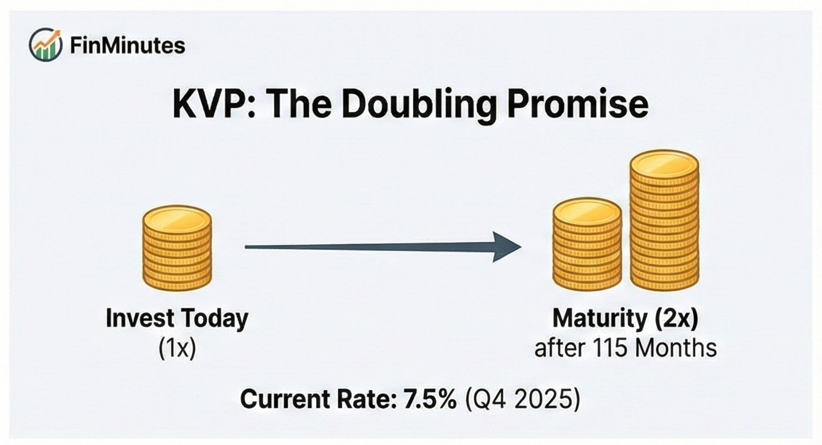
Kisan Vikas Patra is a small savings certificate scheme launched in 1988. Despite the name “Kisan” (Farmer), it is open to everyone (except NRIs and HUFs).
Key Specs (Q4 2024-25)
- Kisan Vikas Patra Interest Rate: 7.5% compounded annually.
- Current Doubling Time: 115 Months (9 Years & 7 Months).
- Minimum Investment: ₹1,000.
- Maximum Investment: No Limit.
- Risk: Zero (Sovereign Guarantee).
Who is it for?
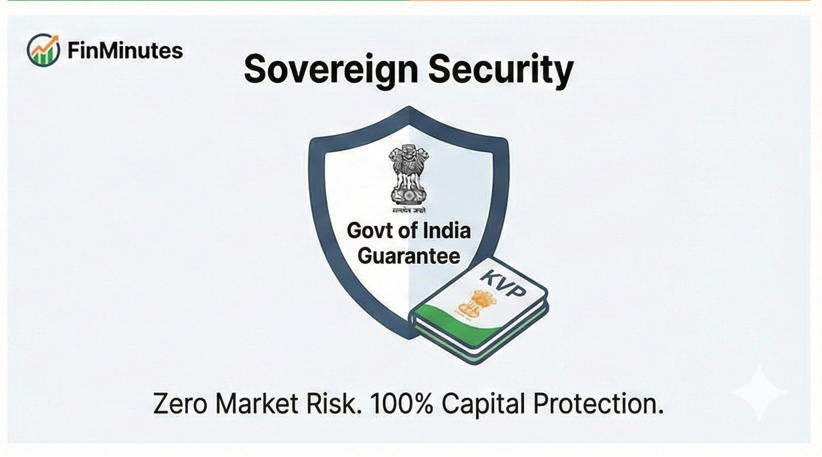
KVP is for the “Fill It, Shut It, Forget It” investor. If you have a lump sum (say, from selling land or a retirement corpus) and you don’t want to track interest rates or renew FDs every year, KVP is your best friend.
The Math Behind the Magic
How does the government decide when the money doubles? It is purely a function of the interest rate.
The Rule of 72 (Approximation)
To estimate doubling time, divide 72 by the interest rate.

Result: 9.6 years is roughly 115.2 months. The government rounds this to 115 months.
The FinMinutes KVP Calculator Precision
Our calculator doesn’t guess. It uses the exact 115-month tenure mandated by the Ministry of Finance.
- Example:
- Invest: ₹1,00,000 on 1st Jan 2025.
- Maturity: ₹2,00,000 on 1st Aug 2034.
The “Inflation Trap”
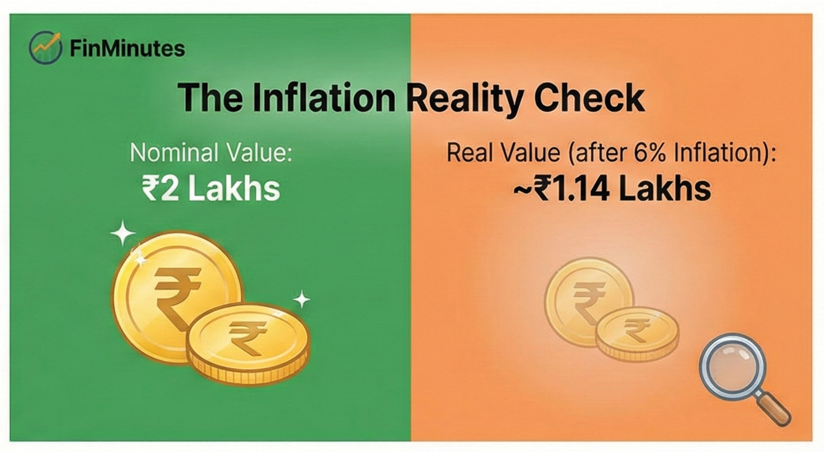
This is the feature that makes our tool unique. Let’s say you invest ₹5 Lakhs today. In 2034, you get ₹10 Lakhs. You feel rich. But wait. If inflation runs at 6% (the average in India), the price of goods will also nearly double in 10 years.
- A car that costs ₹5 Lakhs today might cost ₹9 Lakhs in 2034.
- Your ₹10 Lakhs maturity value will essentially buy the same amount of goods that ₹5 Lakhs buys today.
The “Real Value” Feature: In our calculator, select “Adjust for Inflation? -> 6% (Realistic).” You will see a badge that says: “Value in Today’s Money: ~₹5.7 Lakhs.”
- The Insight: You haven’t really doubled your wealth. You have merely preserved your purchasing power. This is crucial for retirement planning.
Kisan Vikas Patra vs Bank Fixed Deposits
Is KVP better than a standard FD?
| Feature | Kisan Vikas Patra (KVP) | Bank Fixed Deposit (10 Years) |
| Interest Rate | 7.5% | ~6.5% – 7.0% (for non-seniors) |
| Tenure | Flexible (Fixed by doubling time) | Fixed (User selected) |
| Doubling Time | 115 Months | ~125 – 130 Months |
| Safety | Sovereign (Unlimited) | DICGC (Up to ₹5 Lakhs) |
| Premature Exit | Allowed after 2.5 Years | Allowed (with 1% penalty) |
| Pledging | Accepted by all Banks | Accepted (Overdraft) |
Verdict:
- KVP Wins on Interest Rate and Safety (for amounts > ₹5 Lakhs).
- FD Wins on Liquidity (easier to break early) and Senior Citizen rates (Seniors often get 7.5%+ in some banks).
Taxation: The Hidden Cost
This is where KVP falls short compared to PPF or SSY.
- No 80C Benefit: The amount you invest in KVP is NOT tax-deductible.
- Taxable Interest: The interest earned is fully taxable. However, it is paid only at maturity.
- Accrual Basis: Smart investors declare the accrued interest in their ITR every year to avoid a massive tax burden in the final year.
- No TDS: The Post Office does not deduct TDS on KVP payouts. You are responsible for calculating and paying the tax yourself.
Premature Closure Rules
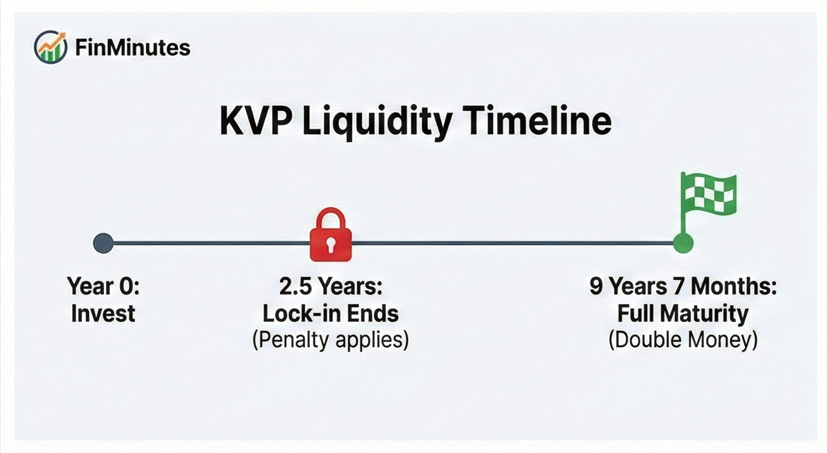
KVP is not a liquid asset. You cannot walk into the Post Office and demand your money back whenever you want.
The “2.5 Year” Rule: You can encash your KVP certificate only after 2 years and 6 months (30 months) from the date of issue.
- Before 2.5 Years: Not allowed (except in case of death or court order).
- After 2.5 Years: Allowed. However, you won’t get the full 7.5% return. There is a penalty table that determines your payout based on how long you held it.
Our KVP calculator includes a visual “Lock-in Timeline” to remind you of this constraint.
How to Invest in KVP
Option 1: Physical Certificate (Passbook)
- Visit any Post Office.
- Fill Form A.
- Submit KYC (Aadhaar, PAN).
- Pay via Cash/Cheque.
- You get a Passbook (Physical certificates are discontinued; it’s all digital/passbook now).
Option 2: Electronic Mode (Bank/Netbanking)
Many top banks (SBI, HDFC, ICICI) allow you to buy KVP online.
- Log in to Netbanking.
- Select “Government Schemes” -> “KVP”.
- Debit your account.
- You get an e-Receipt.
Types of Certificates:
- Single Holder: Issued to an adult.
- Joint A: Payable to both holders jointly or to the survivor.
- Joint B: Payable to either of the holders or the survivor.
Pledging KVP for Loans
One of the biggest advantages of KVP is its acceptance as Collateral.
- If you need a cheap loan, don’t break the KVP.
- Pledge it to a bank.
- Banks offer loans at Interest Rate + 1% or 2% against the KVP value.
- This is cheaper than a Personal Loan (12-15%) and keeps your investment compounding.
Kisan Vikas Patra: FAQs
Can I transfer KVP from one person to another?
Yes, but only under specific conditions:
– From a deceased holder to a legal heir.
– From a holder to a court of law.
– Only once during the entire tenure.
What happens if I lose my KVP Passbook?
You can apply for a duplicate passbook at the Post Office where it was issued. You will need to provide the identity details and a bond of indemnity.
Is KVP good for Senior Citizens?
It is decent, but the SCSS (Senior Citizen Savings Scheme) is better. SCSS offers 8.2% (vs. 7.5% for KVP) and pays quarterly income, which most seniors prefer. Use KVP only if you have exhausted the ₹30 Lakh limit of SCSS.
Does KVP double in 8 years and 7 months?
No. That was the old rate (8.7%) available years ago. At the current 7.5%, it takes 9 years 7 months. Be wary of agents selling you old data. Finminutes KVP Calculator clearly mentions it.
Conclusion: The Patience Test
Kisan Vikas Patra is not for the impatient. It is for the investor who wants to plant a seed and come back a decade later to find a tree.
While it lacks tax benefits, its Sovereign Guarantee and Pledge-ability make it a solid “Anchor” for your portfolio. Use the FinMinutes KVP Calculator to check your dates, but more importantly, use the Inflation Toggle to keep your expectations realistic. Double Safely. Plan Smart.