
Macro Performance Terminal
Institutional-grade intelligence: Growth, Wealth Creation, Risk, and Global Purchasing Power.
Primary (Local)
--%
Primary (USD Adj)
--%
Benchmark
--%
Total Value (Local)
₹--
Net Profit: ₹--
Real Purchasing Power
₹--
Net Profit: ₹--
Benchmark Value
₹--
Net Profit: ₹--
Measuring the hidden USD currency drag for different indices and asset classes vs Nifty 50
When evaluating passive investments like index funds and Exchange Traded Funds (ETFs), investors are often presented with a single, highly visible metric: the absolute historical return. On paper, a 12% Compound Annual Growth Rate (CAGR) from a Nifty 50 index fund looks mathematically identical to a 12% return from an S&P 500 ETF.
But in the realm of macro-investing and true wealth management, context is everything. The real value of your portfolio cannot be determined by a percentage on a brokerage screen. It is dictated entirely by one fundamental question: In what currency will you eventually spend your wealth?
For years, the debate surrounding domestic Indian equities versus diversifying into global US markets has lacked a unified measuring stick. Comparing the Nifty 50 directly to the S&P 500 or the Nasdaq 100 without adjusting for the underlying currency exchange rate (USD/INR) creates an incomplete picture of historical wealth generation. A return is only as strong as the currency it is denominated in.
At FinMinutes, we built the Macro Return Terminal™ to bring institutional-grade transparency to passive investors, Non-Resident Indians (NRIs), and global portfolio allocators. This guide breaks down the mechanics of absolute returns, the silent impact of currency depreciation, and how to accurately backtest your portfolio’s true purchasing power.
The Dual Nature of Portfolio Returns: Matching Liabilities
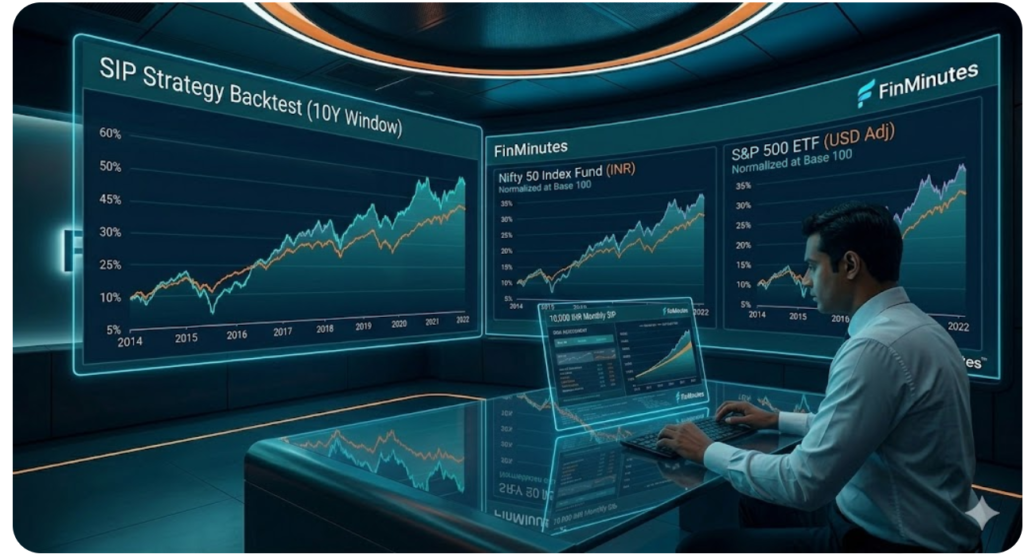
Before we compare domestic and foreign index funds, we must address a common misconception in the financial media. Often, pundits claim that local returns are an “illusion” because of the depreciating Rupee. This is a fear-based narrative that ignores the core principle of financial planning: liability matching. Your true benchmark depends entirely on where your life happens.
1. The Purely Domestic Investor (The INR Benchmark)
If you are an Indian resident whose current expenses, future financial goals, and retirement plans are strictly anchored in Indian Rupees, the absolute return of the Nifty 50 or Sensex is your genuine benchmark. You do not need to panic over the daily fluctuations of the US Dollar or global forex markets.
If your domestic SIP in a Nifty 50 index fund generates a 12% CAGR and comfortably beats local Indian inflation (historically hovering around 5% to 6%), you are successfully compounding real, tangible wealth.
You are expanding your purchasing power for domestic real estate, local education, and Indian goods. For the domestic investor, the FinMinutes Nifty 50 Return Terminal™ serves as a clean, historical comparison tool to track absolute performance and maximum drawdowns across different asset classes, ensuring your wealth outpaces domestic inflation.
2. The NRI and the Globally Diversified Resident (The USD Benchmark)
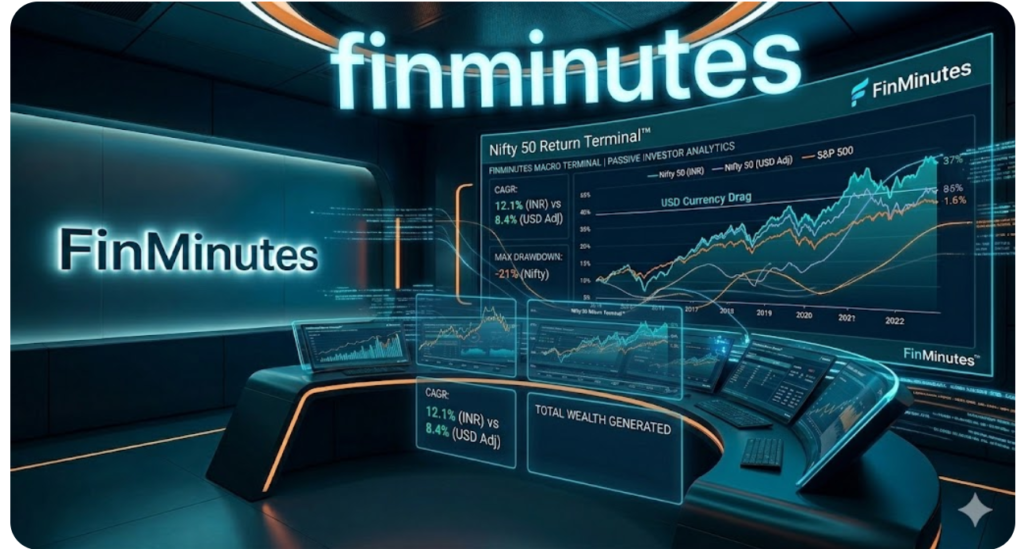
The mathematics of wealth creation change drastically if your liabilities cross international borders. If you fall into any of the following categories, you are heavily exposed to currency risk:
- A Non-Resident Indian (NRI) remitting funds back and forth.
- A foreign institutional or retail investor holding Indian equities.
- A domestic Indian resident planning for foreign expenses, such as international travel, buying property abroad, or funding a child’s foreign university education.
For this group, the local INR return tells only half the story. Historically, the Indian Rupee has depreciated against the US Dollar due to inflation differentials and trade deficits. If a domestic index fund grows by 12% in INR, but the Rupee depreciates by 4% against the Dollar over that same period, your true global purchasing power only increases by roughly 8%.
In this scenario, understanding your USD-adjusted return is not an optional academic exercise; it is a mandatory risk-management metric to ensure you don’t fall short of your international financial goals.
The Mechanics of the “FX Drag”: How Exchange Rates Eat Portfolios
To truly master passive investing, one must understand the silent mechanism of “FX Drag” (Foreign Exchange Drag). It is the invisible tax levied on global purchasing power by a depreciating home currency.
Consider the historical trajectory of the USD/INR exchange rate. Over the last decade, the Rupee has seen structural depreciation against the Dollar, moving from the ₹60 range to well over ₹90. This is a natural macroeconomic phenomenon for a developing, high-growth economy with higher baseline inflation than the United States. However, this macro reality has a micro impact on your ETF portfolio.
The Mathematical Reality
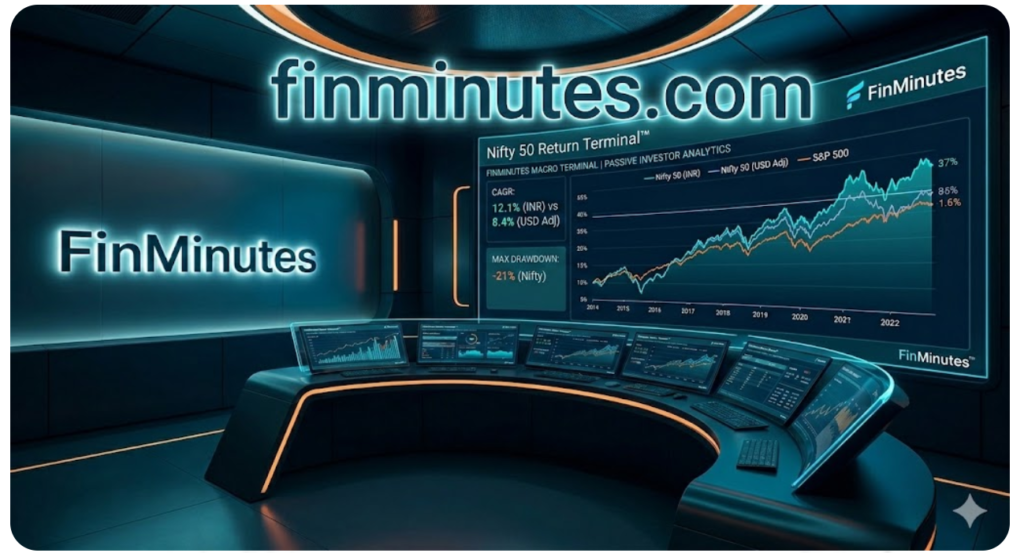
Imagine you invested ₹10,00,000 into a Nifty 50 Index Fund when the exchange rate was exactly ₹65 to $1. Your investment was effectively worth $15,384 in global purchasing power.
Over a specific period, a massive domestic bull run pushes your Nifty 50 portfolio up by a staggering 50%. Your brokerage account proudly displays a total value of ₹15,00,000. You feel wealthy, and in domestic terms, you are.
However, over that same period, the Rupee depreciated to ₹83 to $1. If you were to liquidate that ₹15,00,000 to pay for a US college tuition, it would convert to roughly $18,072.
While your local Rupee wealth grew by an impressive 50%, your global USD wealth only grew by 17.4%. The difference between those two numbers is the FX Drag. It is the silent wealth killer for globally exposed portfolios, and it is the exact metric the Finminutes Nifty 50 Return Terminal™ is engineered to calculate.
Passive Investing: Why Broad Indices Require Broad Analysis
The Indian market is experiencing a massive shift toward passive investing. Retail investors and High Net Worth Individuals (HNIs) alike are realising that consistently beating the market via active stock picking is incredibly difficult over a 10-to-20-year horizon.
As a result, capital is flooding into broad-market Index Funds and ETFs tracking the Nifty 50, Nifty Next 50, and sectoral benchmarks like Nifty IT or Nifty Bank.
Simultaneously, access to global markets has never been easier. Investors can seamlessly allocate capital to US-based funds like the Motilal Oswal S&P 500 Index Fund or the MON100 (tracking the Nasdaq 100).
But this accessibility creates a new problem: Analysis Paralysis. How do you accurately compare the historical performance of an emerging market index (Nifty) against a developed market index (S&P 500) when they operate in entirely different currency regimes?
You cannot compare them using raw absolute returns. A 10% return in a currency with 6% inflation is fundamentally different from a 10% return in a currency with 2% inflation. You must convert them to a common denominator. That is where our terminal steps in.
Calculate Your True Returns: Finminutes Nifty 50 Return Terminal™
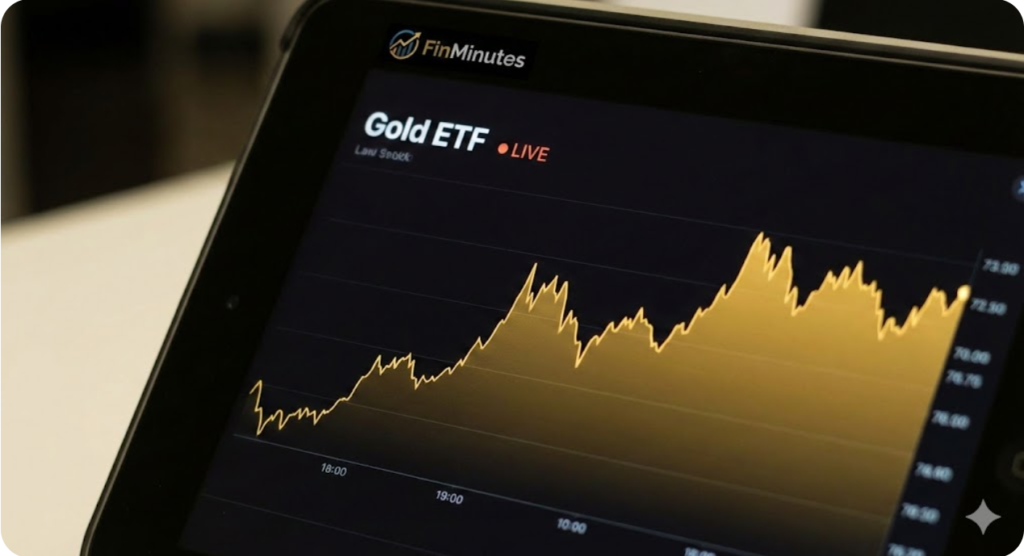
We engineered the Finminutes Nifty 50 Return Terminal™ to strip away the illusion of disparate currencies and provide clear, institutional-grade analytics. The tool pulls historical, end-of-day data for major domestic and global indices, automatically normalising the time-series and calculating the exact impact of the USD/INR exchange rate.
How to use the Terminal:
- Input Capital Invested: Enter a hypothetical lump sum amount to see real Rupee and Dollar wealth generation.
- Select the Primary Asset & Benchmark: Choose domestic favorites (Nifty 50, Sensex) or global heavyweights (S&P 500, Nasdaq 100, Gold).
- Choose the Currency Mode: Select “USD Adjusted” to reveal the true global purchasing power, or “Local Currency Only” if you are a purely domestic investor.
- Analyze the Output: Review the automated insight report, the FX Drag chip, and the synchronized exchange rate chart to see exactly how your money behaved.
Case Study: A Decade of Nifty 50 vs. S&P 500
To illustrate the power of this terminal, let us compare the National Stock Exchange’s flagship Nifty 50 with the US market’s S&P 500 over a standard 10-year investment horizon.
(Note: The exact figures will fluctuate based on the specific end-date of the 10-year rolling window, but the structural trend remains consistent).
When viewing a standard 10-year chart in pure, unadjusted local currencies, the Nifty 50 often shows a steep upward slope. The absolute Compound Annual Growth Rate (CAGR) of the Indian markets frequently outpaces the S&P 500. For a domestic investor, this validates the India growth story, a booming middle class, rapid digitalisation, and a transition toward formal financialization.
However, when you run that same 10-year period through the FinMinutes Terminal using the “USD Adjusted” mode, the visual lines on the chart shift dramatically.
Because the Rupee historically depreciates by an average of 3% to 5% annually against the Dollar, the Nifty’s “adjusted” line flattens out. When priced in Dollars, the gap between the Nifty 50 and the S&P 500 narrows significantly, and during periods of high US tech dominance, the S&P 500 often overtakes the domestic Indian index in terms of true wealth creation.
This data reveals a critical insight for passive investors: High local returns do not automatically guarantee global outperformance. If your portfolio lacks US equity exposure, you are inadvertently making a massive, unhedged bet on the strength of the Indian Rupee.
Beyond CAGR: The Importance of Maximum Drawdown
While CAGR and absolute returns dominate the headlines, professional wealth managers focus just as heavily on risk. The FinMinutes Terminal calculates a metric that is vital for the psychology of passive investing: Max Drawdown (Max DD).
Max Drawdown measures the largest single percentage drop an index experienced from its highest peak to its lowest trough during your selected timeframe. It is the ultimate measure of portfolio pain.
Why does this matter? Because human beings are emotional creatures, not spreadsheets. If an index fund averages a 15% CAGR over ten years, but experiences a 45% Max Drawdown in year four, the average retail investor is highly likely to panic and sell at the exact bottom of the market.
Furthermore, the mathematics of drawdowns are punishing. If an index drops by 50%, it does not require a 50% gain to recover; it requires a 100% gain just to get back to the break-even point.
When you use the terminal to compare the Nifty 50 against the S&P 500 or Gold, pay close attention to the red “Max DD” chip. Emerging markets like India historically carry higher volatility than developed markets.
An investor must decide if they have the psychological risk tolerance to endure a deeper Nifty drawdown in pursuit of higher local returns, or if they prefer the relatively lower historical drawdowns of the S&P 500 or the ultimate safe-haven stability of Gold during macro crises.
The FinMinutes Verdict: Structuring a Resilient Portfolio
The great “India vs US” debate is not about declaring a single winner; it is about recognising the inherent strengths and weaknesses of different currency regimes and market structures.
For the purely domestic Indian earner, the Nifty 50 remains an unparalleled engine for compounding local wealth and crushing domestic inflation. But for the global citizen, the NRI, or the family with international aspirations, holding a portfolio consisting of 100% domestic equities is a severe macro risk. The silent erosion of the FX Drag can turn a decade of disciplined SIPs into a frustrating shortfall when it comes time to pay a foreign tuition bill.
The solution is not to abandon Indian markets, but to intelligently diversify. By blending domestic Index Funds (to capture the aggressive India growth story) with global US ETFs (to hedge against INR depreciation and capture global tech innovation), investors can build a truly resilient, all-weather portfolio.
We encourage you to bookmark the Finminutes Nifty 50 Return Terminal™. Make it a habit to audit your mutual fund and ETF portfolio quarterly. Strip away the illusion of absolute returns, measure your true global purchasing power, and invest with the clarity of an institution.