
1.1 The Asset Class Defined
The history of civilization is, in many respects, the history of commodities. Long before the invention of fiat currency, the issuance of stock certificates, or the algorithmic complexities of high-frequency trading, the global economy functioned on the exchange of tangible value—grain, metal, spice, and oil. The journey from the dust of the ancient mandi to the fiber-optic cables of modern exchanges represents not merely a technological upgrade but a fundamental restructuring of how risk, value, and ownership are perceived.
Core Concept: Fungibility
When you buy a smartphone, you care about the brand. An iPhone is fundamentally different from a Samsung. These are differentiated products. In contrast, when you trade commodities, you are trading raw materials where the brand is irrelevant. This is Fungibility. It means one unit is perfectly interchangeable with another. 1kg of Gold mined in Africa is chemically identical to 1kg of Gold mined in Australia. Because of this standardization, we can trade them on global exchanges without ever inspecting the physical bars.
Two Worlds: Hard vs. Soft
We categorize this massive asset class into two simple buckets based on their origin:
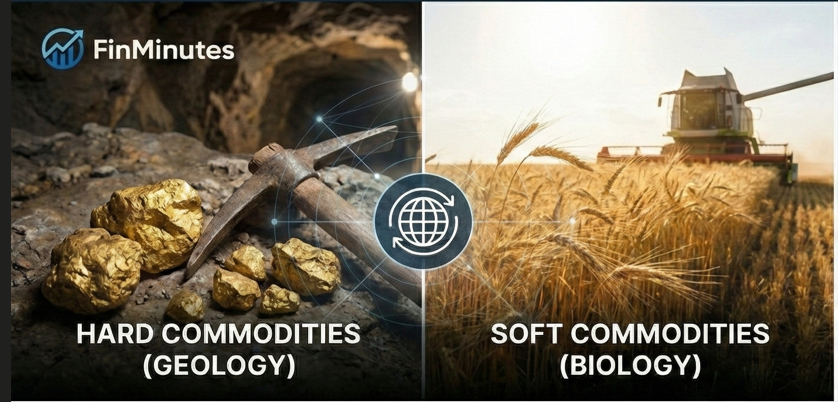
- Hard Commodities (Geology): Natural resources extracted from the earth (Gold, Oil, Copper). They are governed by Geology and the "Capex Cycle". You cannot "grow" more gold; you must find it and mine it. Because they are non-perishable, they act as excellent stores of wealth.
- Soft Commodities (Biology): Agricultural products grown on farms (Wheat, Coffee, Cotton). They are governed by Biology. Their price depends on nature—weather, monsoons, and disease. Unlike gold, they rot. You cannot store soybeans for 50 years; they will perish. This creates unique urgency in their trading cycles.
1.2 The Indian Ecosystem: A Tri-Partite System
To trade safely in India, you cannot just look at charts. You must understand the infrastructure that keeps the market running. It is built on three pillars: The Regulator, The Exchange, and The Broker.
1. The Regulator: From FMC to SEBI
For decades, India's commodity market was regulated by the Forward Markets Commission (FMC). However, the FMC was a toothless tiger; it lacked the power to penalize fraudsters or investigate money trails. This weakness was exploited during the NSEL Scam of 2013, where ₹5,600 Crores vanished.
The Merger (September 2015): In a historic reform, the government merged the FMC with the Securities and Exchange Board of India (SEBI). This was a game-changer. SEBI brought its stock-market-level surveillance, margin rules, and investigative powers to commodities. Today, if a broker cheats you, SEBI has the power to freeze their assets and bar them from the market. This gives retail traders a safety net that didn't exist 10 years ago.
2. The Exchanges: MCX vs. NCDEX
Just as you trade stocks on NSE or BSE, you trade commodities on specialized exchanges:
- MCX (Multi Commodity Exchange): Established in 2003, this is the giant, controlling over 90% of India's commodity volume. It is the home of "Hard Commodities." If you are trading Gold, Silver, Crude Oil, or Copper, you are trading on MCX. It closely tracks global benchmarks like COMEX (Gold) and NYMEX (Oil).
- NCDEX (National Commodity & Derivatives Exchange): This is the agrarian hub. It specializes in "Soft Commodities" unique to India, such as Jeera (Cumin), Dhaniya (Coriander), and Guar Gum. While MCX prices are driven by the US Dollar and Geopolitics, NCDEX prices are driven by the Indian Monsoon and MSP policies.
3. The Broker
You cannot walk into MCX and buy gold. You need a registered intermediary. Brokers (like Zerodha, Angel One, or traditional firms) provide the trading terminal and collect margins.
Warning: Always ensure your broker is SEBI registered. A shadow industry of "Dabba Brokers" exists on Telegram who offer illegal leverage. Trading with them is not trading; it is gambling with no legal recourse.
1.3 The Investment Thesis
Most retail portfolios are 100% Equity (Stocks). This is dangerous. When inflation rises, central banks raise interest rates, which usually causes stocks to crash due to higher borrowing costs.
But what causes inflation? Usually, it is high oil and food prices. Therefore, Commodities are a natural Hedge. When your stock portfolio is bleeding due to high inflation, your Oil and Gold positions are usually skyrocketing because they are the assets repricing upward.
1. Modern Portfolio Theory (MPT)
Institutional investors do not hold commodities for "stories"; they hold them for Variance Reduction. The goal is to minimize portfolio volatility by adding assets with low correlation.
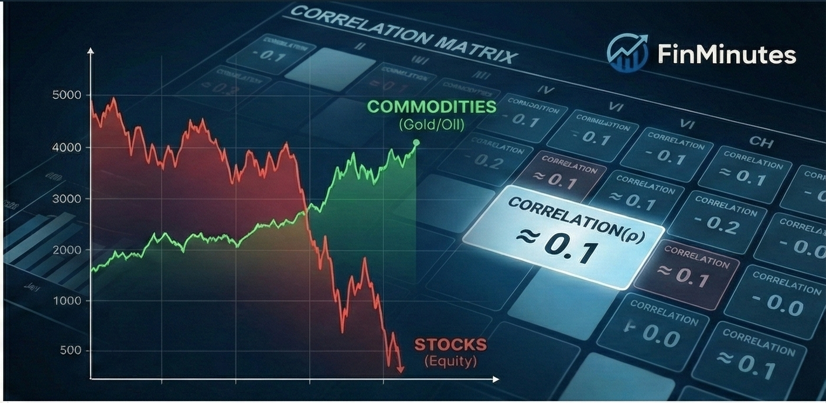
The critical variable is $\rho$ (Rho), the Correlation Coefficient. Historically, Commodities and Equities have a correlation of $\approx 0.1$. This means commodities "zig" when stocks "zag", stabilizing your portfolio during inflationary shocks.
2. The Cost of Carry Model
Futures prices are not random. They are calculated using the Arbitrage-Free Pricing Model to prevent risk-free profits.
- $S$: Spot Price (Cash price today).
- $r$: Risk-free Interest Rate (Cost of capital).
- $u$: Storage Cost (Rent + Insurance).
- $y$: Convenience Yield (Benefit of holding physical).
The Backwardation Signal
When there is a physical shortage (e.g., War), the Convenience Yield ($y$) spikes mathematically. Factories become desperate for physical inventory *right now*. If $y > (r+u)$, the formula turns negative, and Futures trade below Spot. This inverted curve (Backwardation) is the strongest fundamental buy signal in the market.
3. Liquidity Shifts: The "Mini" Contract
FAQ: "Why did MCX remove Mini contracts?"
The Context: In late 2024, MCX consolidated liquidity by removing many "Mini" and "Micro" contracts (e.g., SilverMIC).
The Impact: This forced small retailers to either trade the heavy "Mega" lots (High Margin) or migrate to Options.
The Risk: This structural shift pushes retail capital from linear assets (Futures) to non-linear, decaying assets (Options), drastically increasing the probability of loss.
1. The Capex Super-Cycle: A Historical Study
To understand the future of commodities, we must study the past. The market is not random; it is cyclical, governed by the "10-Year Capex Lag." The most definitive example of this is the China Super-Cycle.
Narrative Case Study: The China Boom (2001-2011)
In 2001, the global economic landscape shifted tectonically when China joined the World Trade Organization (WTO). This wasn't just a policy change; it was the starting gun for the largest urbanization project in human history. Over the next decade, 500 million people moved from rural farms to high-rise cities. This required concrete, steel, and copper on a scale the world had never seen.
The Supply Crisis: During the 1990s, commodity prices were low. Mining companies had slashed their exploration budgets. Nobody was building new mines. When Chinese demand hit in 2003, the supply simply wasn't there. You cannot build a copper mine in a month; it takes 10 years of permitting and construction. Supply was inelastic.
The Parabolic Move: With demand vertical and supply fixed, the only variable that could change was Price. Crude Oil rallied from $20 to $147 per barrel. Copper rose 500%. This wasn't speculation; it was a structural imbalance that lasted for a decade until new mines finally came online in 2011.
The Lesson for Today: We are currently seeing similar signs. The "Green Transition" and "AI Data Center" build-out are demanding massive amounts of Copper and Energy, yet global mining Capex has been flat for 5 years. The setup for the next Super-Cycle is mirroring 2001.
2. Global Arbitrage: MCX vs. COMEX
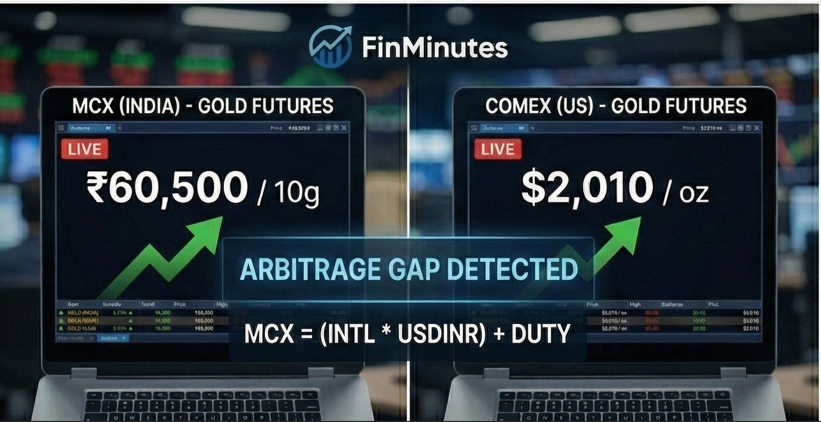
Professional traders track the "Arb Gap" between Indian Gold (MCX) and International Gold (COMEX/XAUUSD). The price is bound by a strict formula:
The Trade: If MCX Gold deviates significantly from this calculated value (due to local panic or currency lag), Pros execute an arbitrage trade: Buy the cheaper market, Sell the expensive one, and hedge the currency risk via USDINR Futures.
3. Algorithmic News Trading (EIA)
Seasoned traders use APIs to trade the EIA Crude Oil Inventory report every Wednesday at 9:00 PM IST.
FAQ: "How to automate EIA trades?"
The Setup: Connect a news feed (Bloomberg/Reuters) to your broker API via Python.
The Logic: If Inventory Draw > Forecast by 2M barrels $\rightarrow$ Instant Buy Market Order.
Latency: The move happens in < 200ms. Manual traders reacting to the TV flash are merely liquidity for the algorithms.
1. Taxation: The #1 Retail Query
There is massive confusion regarding how commodity profits are taxed in India. Let's clear it up once and for all.
FAQ: "Is it Capital Gains or Business Income?"
The Answer: It is Non-Speculative Business Income.
• It is added to your total income and taxed as per your slab (up to 30%+).
• It is NOT Capital Gains (15%/20%).
The Advantage: You can deduct legitimate business expenses (Internet, Advisory fees, portion of Rent) to lower your taxable profit.
The Audit Rule: If your turnover is high or you declare a loss, a Tax Audit (Sec 44AB) is often mandatory.
2. The Physical Delivery Panic
Traders often ask: "What happens if I forget to close my position?" The answer is terrifying.
The Tender Period Trap
5 days before expiry, contracts enter the "Tender Period." If you hold an open position, the exchange assumes you want to take delivery of 1kg Gold or 100 barrels of Oil.
The Risk: Your broker will drastically increase margins (up to 100%). If you don't have the funds, they will Force Square-Off your position at the market price, often hitting you with a huge loss. Rule: Never trade into the last 5 days.
3. Case Study: The "Negative Oil" Black Swan (2020)
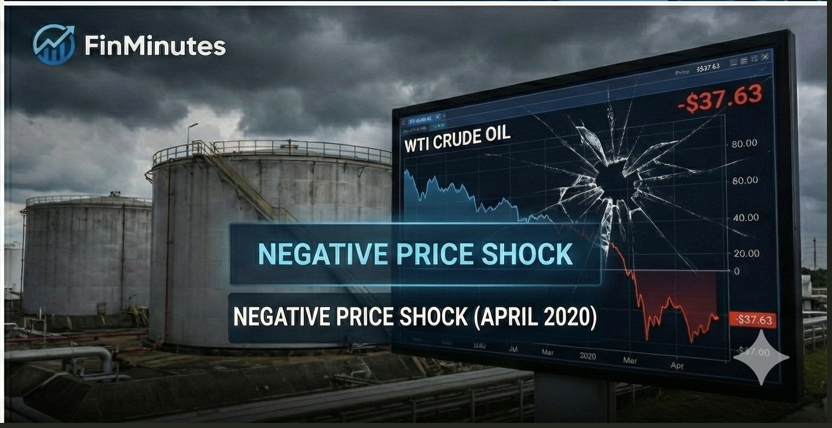
On April 20, 2020, history was made in the worst way possible. WTI Crude Oil futures didn't just crash; they broke the axis.
The Narrative: Global lockdowns had destroyed demand. Meanwhile, Saudi Arabia and Russia were pumping oil at maximum capacity. The world literally ran out of space. Every storage tank in Cushing, Oklahoma (the delivery hub for WTI) was full to the brim. There was physically nowhere to put the oil.
The Retail Trap: Retail traders looked at the screen. Oil was trading at $0.01. They thought, "It can't go lower than zero. I'll buy 100 lots and become a millionaire when it bounces." They treated it like a stock, assuming zero was the floor.
The Horror: Prices smashed through zero and went to -$37.63. Why? Because traders holding the contracts were required to take physical delivery, but they had no storage. They had to pay buyers $37 per barrel just to take the contract off their hands. Retailers who bought at $0.01 woke up owing their brokers millions of dollars. It was a bloodbath that redefined risk management.
4. The SEBI 91% Statistic
In FY25, SEBI data revealed that 91% of retail traders lost money in derivatives. The average loss was ₹1.1 Lakh per person. The reason? Retailers treat commodities like a casino, ignoring structural risks like Devolvement and Delivery.
Welcome to the FinMinutes Commodity Trading Masterclass. If you have explored the interactive learning modules above (if not, please read them first), you already have a tactical understanding of how prices move, how arbitrage works, and why seasoned investors allocate capital to raw materials.
But trading is more than just charts and formulas. It is about understanding the ecosystem, the regulatory framework, and the structural risks that are unique to the financial sector. This is module 1 of the multi-module Finminutes Commodity Trading masterclass.
This comprehensive guide serves as the textbook companion to our interactive tool. Whether you are a retail trader migrating from Nifty Options or a long-term investor looking to hedge against inflation, this guide will deconstruct the Indian commodity market, from the dust of the mandi to the digital vaults of MCX.
Why Commodity Trading? The Strategic Case for “Hard Assets”
For decades, Indian investors have followed a simple playbook: Fixed Deposits (FDs) for safety and Stocks (Equity) for growth. However, the post-2020 economic landscape has exposed the flaws in this “60/40” portfolio model.
When inflation spikes, as we saw during the supply chain crises of the 2020s, both stocks and bonds often fall together. High inflation forces central banks to raise interest rates. Higher rates kill bond prices and compress corporate profit margins, dragging down stock prices. In this scenario, the traditional portfolio has nowhere to hide.
1. The Inflation Hedge (Cost-Push Dynamics)
Commodities are unique because they are not just a hedge against inflation; often, they are the cause of it.
- When Crude Oil prices spiked from $60-70 to $110-120 per barrel during Russia Ukraine crisis, transport costs increased globally.
- This raised the price of vegetables, FMCG goods, and airline tickets; most of the countries around the globe saw a massive spike in inflation.
- This is called Cost-Push Inflation.
If you hold a portfolio of stocks, this inflation eats into your real returns. But if you hold the commodity itself (Oil, Copper, or Gold), you own the asset that is re-pricing the world. You are effectively “long” inflation. By allocating 5-10% of your capital to commodities, you create a natural shock absorber for your wealth.
2. Variance Reduction (The Math of Safety)
It sounds counterintuitive: “How can adding a volatile asset like Crude Oil make my portfolio safer?” The answer lies in Correlation.
- In finance, risk is not just volatility; it is the likelihood of all your assets crashing at the same time.
- Historically, Commodities and Equities have a low correlation coefficient (often near zero).
- This means they effectively “zig” when the other “zags.”
During the 2022 global market correction, while tech stocks were bleeding due to rising yields, energy and metal stocks rallied. Investors with exposure to commodities saw their overall portfolio stabilise, proving that the asset class is a vital tool for diversification, not just speculation.
Understanding the Asset Class: Geology vs. Biology
To navigate the market, you must first understand what you are buying. Unlike companies, which have CEOs and balance sheets, commodities are governed by the laws of physics and nature. We categorise them into two distinct worlds.
Hard Commodities: The Geology of Capital
This category includes natural resources that must be mined or extracted from the earth: Gold, Silver, Crude Oil, Copper, Zinc, and Natural Gas.
- The Driver: Supply Inelasticity. You cannot “print” more gold, and you cannot “grow” a copper mine overnight. Bringing a new mine online takes 10–15 years of capital expenditure (Capex).
- The Cycle: Because supply is fixed in the short term, any sudden surge in demand (like a war or an infrastructure boom) causes prices to spike violently. This creates “Super-Cycles” that can last for a decade.
- The Role: These are excellent stores of wealth because they are non-perishable. Gold mined by the Romans is still in circulation today.
Soft Commodities: The Biology of Renewal
This category includes agricultural products grown on farms: Wheat, Coffee, Cotton, Sugar, Mentha Oil, and Spices.
- The Driver: Nature. Prices are dictated by weather patterns (Monsoons, El Niño), pests, and harvest cycles.
- The Risk: Perishability. Unlike gold, you cannot store soybeans for 50 years. They will rot or lose moisture. This creates urgency in the market.
- The Cycle: Supply is elastic. If wheat prices are high this year, farmers will plant more wheat next year, naturally bringing prices down. This makes “Softs” mean-reverting over the long term.
The Indian Commodity Trading Ecosystem: MCX, NCDEX, and SEBI
Commodity Trading in India is structurally different from trading stocks. You cannot just walk into a market and buy 100 barrels of oil. You operate within a highly regulated “Tri-Partite” system.
1. The Regulators: From FMC to SEBI
For a long time, the commodity market was the “Wild West,” regulated by the weak Forward Markets Commission (FMC). However, after the infamous NSEL Scam of 2013, where ₹5,600 Crores of investor money vanished due to fake warehouse receipts, the government instituted a historic reform. In September 2015, the FMC was merged with the Securities and Exchange Board of India (SEBI).
- Why this matters: SEBI brought stock-market-level surveillance, strict margin rules, and investigative powers to commodities.
- Safety: Today, exchanges maintain an Investor Protection Fund (IPF) to compensate clients in case of broker defaults. This makes the modern ecosystem far safer for retail participants than it was a decade ago.
2. The Exchanges
Just as stocks trade on NSE and BSE, commodities trade on specialized exchanges:
- MCX (Multi Commodity Exchange): The giant. MCX controls over 92% of India’s commodity volume. It is the home of “Hard Commodities.” If you are trading Gold, Silver, Energy, or Base Metals, you are trading on MCX. Its prices closely track global benchmarks like COMEX (New York) and LME (London).
- NCDEX (National Commodity & Derivatives Exchange): The agrarian hub. NCDEX specialises in “Soft Commodities” unique to the Indian subcontinent, such as Jeera (Cumin), Dhaniya (Coriander), Guar Gum, and Turmeric. While MCX is driven by the US Dollar and Geopolitics, NCDEX is driven by the Indian Monsoon and Government MSP policies.
Commodity Market Structure: Spot vs. Futures
When you buy a share of Reliance, you pay cash and get the share in your Demat account (T+1). Commodity markets work differently. The Commodity market operates on two timelines.
The Spot Market (The “Now”)
This is the physical market. If a jeweler wants 1kg of gold today, they pay the Spot Price, take physical delivery, and carry it to their shop. This market is fragmented and varies from city to city (e.g., Gold prices in Mumbai differ from Delhi).
The Futures Market (The “Later”)
This is where traders operate. A “Futures Contract” is an agreement to buy or sell a specific quantity of a commodity at a fixed price on a future date.
- Example: An airline fears jet fuel prices will rise. They buy Crude Oil Futures for delivery in 3 months. They lock in the price today.
- Leverage: Futures are leveraged instruments. You don’t pay the full value (₹60 Lakhs for 1kg Gold). You only pay a Margin (approx 10-15%). This amplifies both profits and losses.
The Pricing Logic: Cost of Carry
Typically, the Futures price is higher than the Spot price. Why? If I sell you gold for delivery next month, I have to store it in a vault and insure it for 30 days. I will pass that cost on to you.
- Formula: Future Price = Spot Price + Storage Cost + Interest Cost.
- Contango: When Futures > Spot (Normal Market).
- Backwardation: When Futures < Spot (Crisis Market). This happens during acute shortages when factories are desperate for physical goods right now and willing to pay a premium over the future price.
The Retail “Kill Zones” in the Commodity Market: Risks You Must Know
While the profit potential is high, the risks in trading commodities are structural and brutal. SEBI data (FY25) indicates that 9 out of 10 retail traders lose money (the study was primarily focused on the Equity FnO market). Why? Because they treat commodities like a casino, ignoring these three specific traps.
1. The “Tender Period” Trap (Physical Delivery)
Unlike stocks, commodity contracts have a physical reality. If you hold a Gold contract until the expiry day, the exchange assumes you intend to take delivery of the actual 1kg bar.
- The Rule: 5 days before expiry, contracts enter the “Tender Period.”
- The Danger: During this period, margins skyrocket from 10% to 25%, 50%, and finally 100% of the contract value.
- The Trap: Many retail traders forget to close their positions. When the margin spike hits, they don’t have the funds. The broker’s system triggers a Force Square-Off at the market price (often the worst price of the day) and charges a hefty penalty.
- Solution: Always roll over or close your positions at least 7 days before expiry.
2. The Option Devolvement Nightmare
This is the most common reason for retail bankruptcy in recent years. Traders migrating from Nifty Options assume Commodity Options work the same way. They do not.
- Nifty Options: Cash Settled. If your call is In-The-Money (ITM), you get the cash difference.
- MCX Options: Devolvement. If your Crude Oil Option expires ITM, it devolves into a Futures contract.
- Scenario: You bought a Call Option for a ₹5,000 premium. It expires ITM. On Monday morning, you wake up to find a “Crude Oil Futures” buy position in your account. A Future requires a ₹2-3 Lakhs margin. Your account only has ₹10,000. You are instantly in a massive margin call.
3. The “Dabba” Trading Scam
For every ₹1 traded on MCX, an estimated ₹10 is traded in the illegal “Dabba” (Bucket Shop) market. These are unregulated operators running via Telegram or WhatsApp.
- The Pitch: “No Taxes (STT/GST)” and “500x Leverage.”
- The Reality: Your order never hits the exchange. You are betting against the broker. It is a zero-sum game. If you lose, he collects. If you win big, he simply blocks your number.
- Warning: Trading here is illegal. If the operator runs away (as seen in the 2013 Castor Seed crisis), you have zero legal recourse.
Taxation: Business Income vs. Capital Gains
A major area of confusion for Indian traders is taxation. Misclassifying your commodity profits can lead to notices from the Income Tax Department. The Golden Rule: In India, profits from commodity derivatives (Futures & Options) traded on a recognised exchange (MCX/NCDEX) are treated as Non-Speculative Business Income.
- It is NOT Capital Gains: You cannot pay the flat 15% (STCG) or 20% (LTCG) rate.
- It is Business Income: It is added to your total gross income (Salary + Business) and taxed according to your applicable slab (which could be 30% or higher).
The Silver Lining (Expense Deduction): Since it is treated as a “Business,” you are legally allowed to deduct legitimate business expenses to lower your taxable profit. These can include:
- Internet and Broadband bills.
- Advisory fees or paid newsletters.
- Software subscriptions (TradingView, Amibroker).
- A portion of rent/electricity (if you trade from a home office).
- Brokerage and other statutory charges.
Audit Requirement: If your trading turnover exceeds the prescribed limit (e.g., ₹2 Crores or ₹10 Crores, depending on digital transaction status), or if you declare a Loss and want to carry it forward to offset future profits, a Tax Audit by a Chartered Accountant is mandatory.
Conclusion: Moving from Speculation to Authority
Commodity trading is not a game of luck. It is the oldest and most logical market in the world. It responds to the laws of Geology (Supply) and Demographics (Demand), not the whims of CEO tweets or quarterly earnings management.
By mastering the concepts in this FinMinutes Commodity Trading Masterclass, from the mathematics of Arbitrage to the historical lessons of Super-Cycles, you are moving from a passive speculator to an informed market participant.
Next Steps:
- Use the “Pro Tier” tab above to study the Import Parity Formula.
- Use the “Real World” tab to memorize the Tender Period dates.
- Start small, respect the leverage, and never trade without a Stop Loss.
Disclaimer: This content is for educational purposes only. Commodity trading involves substantial risk of loss and is not suitable for every investor. Please consult a SEBI-registered investment advisor before trading.