
3.1 The Dollar-Gold Relationship: The Old Rule vs. The New Reality
For decades, the rule was simple: Dollar Up = Gold Down. Since Gold is priced in USD, a stronger currency made the metal expensive for foreign buyers, crushing demand.
The Anomaly (2022-2026)
In recent years, this correlation broke. We saw a rare phenomenon where Both Dollar AND Gold rallied together.
Why? The "Fear Trade" overpowered the "Rates Trade."
• The Dollar rallied because US interest rates were high (5%+).
• Gold rallied because of Geopolitical Fear (Wars) and Central Bank buying.
Lesson: Do not blindly short Gold just because DXY is green. If the world is scared, they buy both safe havens.
3.2 The Real Driver: Central Bank Buying (De-Dollarization)
While retail traders look at charts, the "Whales" are changing the ocean. Since the 2022 Russia Sanctions, global Central Banks (led by China's PBOC, India's RBI, and Poland) have been aggressively buying gold.
The Motivation:
1. Sanction Proofing: Nations realized that USD reserves can be frozen. Gold, physically held in domestic vaults, cannot be frozen.
2. Diversification: Reducing reliance on US Treasury bonds.
Impact: This buying sets a "Price Floor." Every time Gold dips, a Central Bank steps in to buy tonnes, preventing deep crashes.
3.3 Black Gold: The OPEC+ Cartel
While Gold is "Mined and Held," Crude Oil is "Pumped and Burned." It is a consumption asset controlled by a cartel.
The Supply Switch: OPEC+
The Players: OPEC (Saudi Arabia, UAE, etc.) + Russia control ~50% of global oil exports.
The Tactic: Unlike a free market, OPEC+ manages price. If oil drops below $70, they announce "Production Cuts" to artificially tighten supply and boost prices.
India's Role: As the world's 3rd largest importer, India has shifted from buying Middle Eastern oil to buying discounted Russian oil (sanctioned), altering global trade flows.
1. Silver: The "Photovoltaic" Structural Deficit
Silver is no longer just "Poor Man's Gold." It is a critical green energy metal.
The Industrial Pivot
Solar Demand: A single solar panel uses ~20g of silver paste. With the global push for Net Zero, the PV (Photovoltaic) sector now consumes nearly 20% of total annual silver supply.
The Deficit: Mines are not expanding fast enough. For the last 4 years, Silver has been in a Structural Deficit (Consumption > Mining).
Trade Implication: Silver is more volatile than Gold. It reacts to Industrial Data (PMI) more than Inflation Data.
2. The GRAM Model: Decoding Price Drivers
The World Gold Council's Gold Return Attribution Model (GRAM) helps us understand what moved the price this month. It is not random.
Component 1: Opportunity Cost (Rates & FX)
Gold pays no interest. If US Bond Yields rise to 5%, big funds sell Gold to buy Bonds. This is the biggest negative driver.
Component 2: Risk & Uncertainty
Market crashes (VIX spike) or Credit Default Swap (CDS) spreads widening drive "Safe Haven" flows into Gold.
Component 3: Momentum
Trend-following algos and ETF flows. If Gold breaks a 200-day Moving Average, Momentum funds pile in, accelerating the move.
3. "Dr. Copper": The Economic Thermometer
If Gold is Fear, Copper is Growth. It is used in everything from houses to iPhones to EVs. Therefore, Copper price is a leading indicator of Global GDP.
The PMI Correlation
Manufacturing PMI (Purchasing Managers' Index):
• PMI > 50 (Expansion): Factories are buying raw materials $\rightarrow$ Copper Rallies.
• PMI < 50 (Contraction): Factories are slowing down $\rightarrow$ Copper Crashes.
The 2026 Theme: AI Data Centers require massive copper cabling. This "AI Demand" is offsetting weak construction demand from China, keeping prices elevated.
1. Global vs. Indian Data Drivers
A smart commodity trader watches two calendars: The US Economic Calendar and the Indian Monsoon Calendar.
The "Dual-Dashboard"
Global Driver (EIA & US Jobs):
• EIA Crude Oil (Wed): Inventory Draw = Bullish.
• US NFP (Fri): Strong Jobs = Higher Rates = Bearish Gold.
Indian Driver (Imports & Monsoon):
• Trade Deficit Data (15th of Month): If Gold imports spike, the Trade Deficit widens $\rightarrow$ INR weakens $\rightarrow$ Domestic Gold Price ($\text{Intl} \times \text{USDINR}$) rises.
• IMD Monsoon Report: Poor rainfall = Lower rural income = Lower physical gold demand (60% of Indian demand comes from rural areas).
2. Geopolitics: The "War Premium"
Prices often trade above their fair value due to Geopolitical Risk Premium.
Case Study: Red Sea Crisis (2023-24)
Even though oil production wasn't hit, ships had to reroute around Africa. This raised freight/insurance costs.
The Trader's Trap: "Buying the Headline." Often, the price spikes on the news of a missile strike and crashes 48 hours later when no actual supply disruption is confirmed. Fade the spike unless physical supply is hit.
3. Trading the Weather: El Niño & La Niña
For Agri-Commodities (Jeera, Turmeric, Guar), the RBI Policy matters less than the Pacific Ocean temperature.
The Climate Cycles
El Niño (Hot Ocean): Typically causes Weak Monsoon in India.
• Impact: Crop failure in Sugar, Wheat, and Spices. Prices Skyrocket (Inflation).
La Niña (Cool Ocean): Typically causes Excess Rainfall.
• Impact: Bumper harvest but risk of floods damaging standing crops. Prices usually moderate.
1. Personified Case Study: Arjun's Wedding Hedge
The Situation: Arjun needs to buy 500g of gold for his daughter's wedding in December. It is currently August, and price is ₹70,000. He fears it will go to ₹75,000.
The Strategy:
1. Arjun buys 5 Lots of Gold Mini Futures (100g each) on MCX.
2. December arrives: Gold price hits ₹74,000.
3. Physical Market: He pays the jeweler ₹74,000 (Loss of ₹4,000/10g vs August price).
4. MCX Market: His Futures position gained ₹4,000/10g profit.
Net Result: The MCX profit offsets the extra cost at the jeweler. He effectively locked the price at ₹70,000. This is how real-world hedging works.
2. FAQs: Fundamental Drivers
Q: Why does Gold crash when US GDP is strong?
A: Strong GDP implies the economy is healthy. Investors sell safe havens (Gold) to buy risk assets (Stocks). Also, strong growth invites higher interest rates, which hurts Gold.
Q: Does the Indian Budget affect prices?
A: Yes, massively. A change in Customs Duty (Import Tax) changes the landing cost. If Duty is cut by 5%, MCX Gold crashes 5% instantly, regardless of global prices.
Q: What is the "Silver-Gold Ratio"?
A: It measures how many ounces of silver it takes to buy one ounce of gold.
• High Ratio (>90): Silver is cheap (Buy Signal).
• Low Ratio (<70): Silver is expensive (Sell Signal).
3. Case Study: The Manufacturer's Shield
Personified: Ramesh the Utensil Maker
The Problem: Ramesh manufactures Aluminium utensils. He has received a bulk order to be delivered in 3 months. He priced the order assuming Aluminium is at ₹200/kg. If prices rise to ₹220, his profit margin vanishes.
The Hedge:
1. Ramesh Buys Aluminium Futures on MCX today at ₹200.
2. 3 Months Later: Spot price rises to ₹220.
3. Physical Market: He buys raw metal at ₹220 (Loss of ₹20).
4. MCX Market: His Future is worth ₹220 (Profit of ₹20).
Result: The profit from the exchange pays for the expensive raw material. His input cost remains locked at ₹200.
The Engine of Wealth: Mastering Fundamental Analysis in Commodities
If Module 1: The Foundation taught you what to trade, and Module 2: The Mechanics taught you how to drive the vehicle (Futures & Options), then Module 3 of our commodity trading masterclass is about the Engine. What actually makes the price of Gold move from ₹60,000 to ₹150,000? Is it a random fluctuation? Is it manipulation? Or is it a predictable outcome of macroeconomic forces?
Unlike stocks, where prices are driven by quarterly earnings and management guidance, commodities are Macro Assets. They respond to the raw laws of physics and economics: Supply (Geology/Weather) and Demand (Central Banks/Industry). To succeed in the commodity market, you cannot simply be a technical analyst drawing lines on a chart; you must think like a global macroeconomic analyst to conduct proper fundamental analysis.
This comprehensive guide serves as the textbook companion to our interactive “Engine” module above. We will deconstruct the five massive forces that drive commodity prices and are important for commodities fundamental analysis: the dollar, central banks, Geopolitics, Industrial Shifts, and the unpredictable Indian Monsoon.
The Dollar Hegemony: The “See-Saw” Relationship
The single most important chart in commodity trading is not Gold or Oil, it is the Dollar Index (DXY).
The Pricing Mechanism
Global commodities are priced in US Dollars. Whether you are buying Gold in Mumbai, Oil in Tokyo, or Copper in London, the base transaction happens in USD. This creates a mathematical inverse relationship.
- When the Dollar Strengthens (DXY ↑): It takes fewer dollars to buy the same ounce of gold. Gold prices effectively fall in dollar terms. Furthermore, a strong dollar makes commodities expensive for countries with weaker currencies (like India or China), reducing global demand.
- When the Dollar Weakens (DXY ↓): It takes more dollars to buy the same ounce. Gold prices rise.
The “Decoupling” Anomaly (2022-2026)
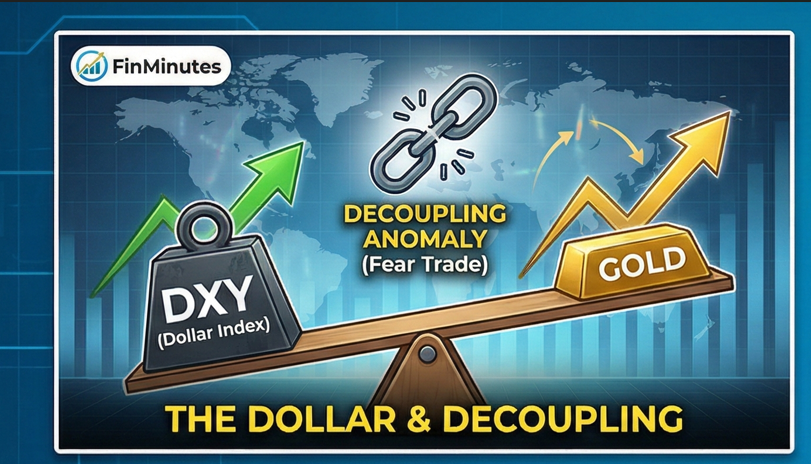
For 50 years, this inverse relationship was the golden rule. However, as we explore in the Beginner Tier of the interactive tool, this correlation broke down post-2022.
In a rare economic phenomenon, both the Dollar and Gold rallied simultaneously.
- Why did the Dollar rally? The US Federal Reserve raised interest rates to fight inflation, attracting global capital into the USD.
- Why did Gold rally? Usually, high interest rates crush Gold (which pays no interest). But “Fear” overpowered “Rates.” The war in Ukraine and instability in the Middle East drove investors to the ultimate safe haven.
The Lesson: Do not blindly short Gold just because the Dollar is green. In times of extreme geopolitical stress, the world buys everything that isn’t paper money.
The New “Whales”: Central Bank Buying
If you are wondering why Gold prices refuse to crash despite high US interest rates, look no further than the Official Sector.
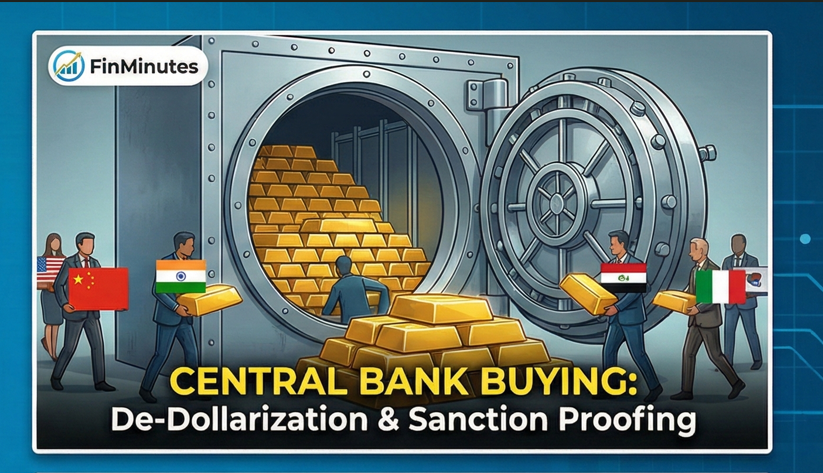
For decades, Central Banks were net sellers of gold. But after the 2022 sanctions on Russia, where $300 Billion of Russian forex reserves were frozen by the West, nations realised a hard truth: “If you don’t hold it, you don’t own it.”
The De-Dollarisation Drive
Led by the People’s Bank of China (PBOC)and the Reserve Bank of India (RBI), as well as other emerging economies, central banks embarked on the largest gold-buying spree in history.
- The Scale: In 2024-25 alone, Central Banks bought over 1,000 tonnes of gold.
- The Impact: This massive institutional buying creates a “Price Floor.” Every time gold prices dip, a Central Bank steps in to accumulate reserves. This has fundamentally altered the supply-demand balance, making Gold less sensitive to retail selling.
Black Gold: Trading the Energy Data
Crude Oil is the “Master Commodity.” It affects the prices of everything from transportation (Petrol) to food (Fertiliser) to plastic. Unlike Gold, which is mined and held, Crude oil is pumped and burned. It is a consumption asset.
The EIA Inventory Report
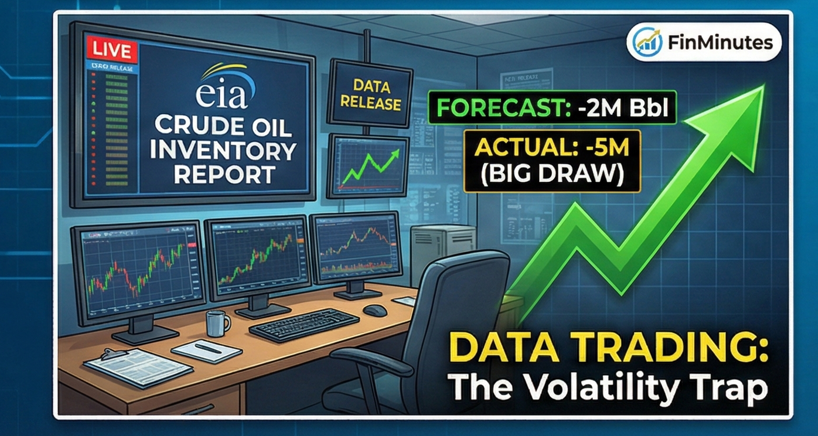
For energy traders, Wednesday Nights (9:00 PM / 10:30 PM IST) are the Super Bowl. The US Energy Information Administration (EIA) releases data on how much crude oil is sitting in US storage tanks.
- Inventory Draw (Bullish): US stockpiles decreased. Demand is exceeding supply. Traders usually Buy.
- Inventory Build (Bearish): US stockpiles increased. Supply is exceeding demand. Traders usually Sell.
The Trap: As explained in the Pro Tier simulation, the market reacts to the Expectation vs. Reality, not the absolute number.
- Scenario: Analysts expect a massive draw of -5 Million barrels.
- Reality: The report shows a draw of -2 Million barrels.
- Reaction: Crude Oil Price Crashes. Why? Even though inventories fell, they didn’t fall enough to satisfy the market’s high expectations.
The OPEC+ Cartel
Crude Oil is not a free market. It is a managed market. The Organisation of the Petroleum Exporting Countries (OPEC) and its allies (Russia) control nearly 50% of global exports.
- The Strategy: When crude oil prices drop below a profitable level (e.g., $70), OPEC+ announces “Production Cuts” to artificially tighten supply and force prices up.
- The Counter-Force: US Shale producers operate as free-market capitalists. When prices rise, they pump more, often neutralising OPEC’s cuts. This “Tug-of-War” keeps oil range-bound.
Silver: The Industrial “Green” Pivot
Silver is often called “Gold’s volatile cousin,” but this description is outdated. In the 2020s, Silver has transformed into a critical Green Energy Metal.
The Photovoltaic (PV) Boom
Silver is the most conductive metal on Earth. This makes it indispensable for Solar Panels.
- A standard solar panel uses approximately 20 grams of silver paste.
- With the global push for Net Zero, solar installation has grown exponentially.
- The Deficit: The PV industry now consumes nearly 20% of annual silver supply. However, silver mining (which is mostly a byproduct of Copper/Zinc mining) has not kept pace.
The Investment Thesis: We are currently in a “Structural Deficit.” For four consecutive years, the world has consumed more silver than it has mined. While Gold is driven by fear, Silver is driven by industrial growth. If you believe in the Green Energy transition, you are implicitly bullish on Silver.
The Indian Context: Monsoons & Weddings
For Indian traders on MCX/NCDEX, global factors are only half the story. The other half is written by the Indian Monsoon and the Hindu Calendar.
The Seasonality of Gold
India is the world’s second-largest gold consumer. Demand is not consistent; it comes in waves.
- Harvest Season (Q1): Rural India buys gold with farming profits.
- Wedding Season (Nov – Jan): Massive jewellery buying supports prices.
- Akshaya Tritiya (April/May): A cultural mandate to buy gold.
- Dull Period (June – Aug): Monsoon months typically see lower volumes and stagnant prices. Smart investors use this lull to accumulate positions before the festive spike.
Trading the Weather (El Niño)

For agri-commodities (Jeera, Turmeric, Guar), the Pacific Ocean temperature matters more than the RBI policy.
- El Niño: Warmer Pacific waters often lead to a weak Indian Monsoon.
- Result: Crop failure in sugar, wheat, and spices. Supply shocks lead to massive inflation (e.g., the Jeera rally of 2023).
- La Niña: Cooler waters often lead to excess rainfall.
- Result: Bumper harvests but potential flood damage. Prices tend to moderate or crash.
Geopolitics: The “War Premium”
Commodities are the ultimate hedge against chaos. When Russia invaded Ukraine, or when tensions flared in the Middle East, Oil and Gold spiked instantly. This extra value added to the price is called the War Premium.
The Trader’s Rule in commodity trading:
- “Buy the Rumour, Sell the Fact.”
- Prices often spike on the fear of supply disruption (e.g., “Missile fired at ship”).
- However, if the physical supply (the actual oil pipeline) is not damaged, prices usually crash back down within 48-72 hours.
- Warning: Do not chase geopolitical spikes unless you are an ultra-short-term scalper. The War Premium evaporates quickly.
How do I track the Dollar Index (DXY)?
You can track DXY on platforms like TradingView or Investing.com. It measures the USD against a basket of 6 major currencies (Euro, Yen, Pound, etc.). If DXY crosses 105, it is considered very strong (Bearish for Commodities). If it falls below 100, it is weak (Bullish).
Does the Indian Import Duty change often for gold and silver?
Changes usually happen during the Union Budget (Feb 1st). However, the government can issue ad-hoc notifications to hike duties if the Current Account Deficit (CAD) worsens. A hike in duty makes domestic Gold/Silver expensive instantly.
What is the “Gold-Silver Ratio”?
It is the price of Gold divided by the price of Silver. It tells you how many ounces of Silver it takes to buy one ounce of Gold.
Ratio > 90: Silver is undervalued relative to Gold (Buy Silver).
Ratio < 70: Silver is expensive relative to Gold (Wait or Buy Gold).
Can I trade based on the GRAM model?
The GRAM model is a monthly attribution tool, not a day-trading signal. It helps you understand the trend. If the GRAM model shows that “Momentum” and “Risk” are driving prices, it confirms a strong bull market where “buying the dip” is safe.
Why do Copper prices predict stock market crashes?
Copper is known as “Dr Copper” because it has a PhD in Economics. It is used in construction, electronics, and manufacturing. If Copper prices start crashing while the Stock Market is at an All-Time High, it is often a warning signal that the real economy is slowing down, and stocks might follow.
Conclusion: The Holistic Trader
By completing Module 3, you have added the final piece to your trading puzzle.
You now understand that a trade isn’t just a candlestick pattern. A successful Gold trade requires checking the DXY, glancing at US Bond Yields, and knowing if it’s wedding season in India. A successful Silver trade requires knowing the status of the Chinese solar industry. You are no longer gambling. You are analysing.