
2.1 The Futures Contract: The "Obligation" Engine
To trade commodities, we use Futures Contracts. A Future is a legal agreement to buy or sell a specific quantity of a commodity at a fixed price on a future date. Unlike shares, which represent ownership, Futures represent an obligation.
Personified Example: Vikram the Jeweler
The Need: Vikram owns a jewelry shop. He is worried Gold prices will rise before the wedding season (3 months away), increasing his raw material cost.
The Action: He buys 1 Lot of Gold Mini Futures (expiry 3 months later) at ₹70,000/10g.
The Result: Even if Gold hits ₹80,000, Vikram is safe. He locked his price at ₹70,000. He uses the profit from the Future to subsidize the expensive physical gold he buys for his shop. This is Hedging.
The Mathematics of Leverage
Commodities are traded in "Lots." Because the contract value is huge, you only pay a small "Margin" (approx 10%). This leverage is why retail traders flock to commodities.
- Gold (Standard): 1 Lot = 1 Kg.
Value: ~₹1.4 Crores. Margin: ~₹12 Lakhs.
Impact: A 1% move in Gold = ₹1.4 Lakh P&L impact. - Crude Oil (Standard): 1 Lot = 100 Barrels.
Value: ~₹5.5 Lakhs. Margin: ~₹1.5 Lakhs.
Impact: A ₹1 move in price = ₹100 P&L impact.
Retail Entry: Small Lots for Small Capital
If ₹12 Lakhs margin is too high, MCX offers smaller contracts designed specifically for retail traders. These are highly liquid and safer for beginners.
| Contract Name | Lot Size | Margin (Approx) | Profit per ₹1 Move |
|---|---|---|---|
| Gold Mini | 100 grams | ₹1.2 Lakhs | ₹10 |
| Gold Guinea | 8 grams | ₹9,000 | ₹0.8 |
| Gold Petal | 1 gram | ₹1,200 | ₹0.1 |
| Silver Micro | 1 Kg | ₹9,000 | ₹1 |
1. Mark-to-Market (M2M): The Cash Flow Reality
In stocks, losses are "paper" until you sell. In Futures, losses are debited from your account every night.
Narrative: Anjali's Margin Call
The Setup: Anjali has ₹2 Lakhs in her account. She buys 1 Lot of Copper (Margin: ₹1.5 Lakhs). She has a ₹50,000 Buffer.
Day 1 (The Dip): Copper falls 2%. On a ₹10 Lakh contract, that's a ₹20,000 loss.
The Night: The broker debits ₹20,000. Her buffer is now ₹30,000.
Day 2 (The Crash): Copper opens gap down 3%. Another ₹30,000 loss.
The Crisis: Her buffer hits ZERO. The broker triggers a Margin Call via SMS: "Deposit ₹50,000 immediately or we square off."
Day 3 (The Liquidation): Anjali is stuck in a meeting. At 10:15 AM, the broker's RMS system auto-sells her position at the market bottom. She lost 50% of her capital in 48 hours.
2. The "Four States" of Open Interest (OI)
Price tells you direction. Open Interest tells you strength. Combining them gives you the institutional view.
1. Long Build-up: Price $\uparrow$ + OI $\uparrow$ (Strong Bullish).
2. Short Build-up: Price $\downarrow$ + OI $\uparrow$ (Strong Bearish).
3. Short Covering: Price $\uparrow$ + OI $\downarrow$ (Weak Bullish - Bears are exiting).
4. Long Unwinding: Price $\downarrow$ + OI $\downarrow$ (Weak Bearish - Bulls are giving up).
1. The "Devolvement" Mechanism (Crucial)
Retail traders migrating from Nifty often go bankrupt here. Unlike Nifty (Cash Settled), MCX Options devolve into Futures.
Case Study: The "Surprise" Future
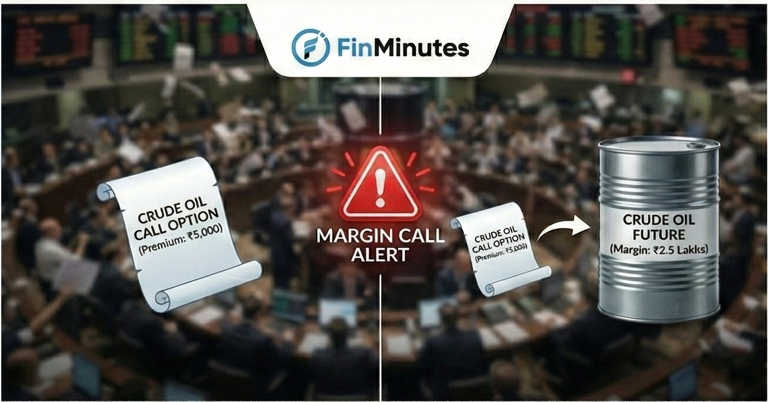
Rohan buys a Crude Oil Call Option for ₹5,000 premium. He thinks his max loss is ₹5,000.
Expiry Day: The option is In-The-Money (ITM). Rohan forgets to close it.
Monday Morning: The exchange converts his Option into a 1 Lot Buy Future.
The Shock: A Future requires ₹2 Lakhs margin. Rohan only has ₹10k.
The Consequence: Instant penalty. The broker liquidates his holdings to cover the margin shortfall.
2. The Four Greeks: The DNA of Options
To trade options professionally, you must understand the four forces that move the premium. It is not just about price.
1. Delta ($\Delta$): The Direction
Delta measures how much the option price moves for every ₹1 move in the underlying asset.
• ATM (At The Money): Delta is 0.5. If Gold moves ₹100, your option moves ₹50.
• OTM (Out of The Money): Delta is 0.1. If Gold moves ₹100, your option only moves ₹10. This is why cheap options rarely make money.
2. Gamma ($\Gamma$): The Acceleration
Gamma measures how fast Delta changes.
The Risk: During expiry week, Gamma explodes. A small move in Crude Oil can turn a ₹10 option into ₹100 in minutes. This is "Gamma Risk" for sellers and "Gamma Lottery" for buyers.
3. Theta ($\Theta$): The Decay
Options are "wasting assets." Every day, a portion of their value evaporates.
The "Theta Cliff": Time decay is not linear. It accelerates massively in the last 10 days before expiry.
4. Vega ($\nu$): The Event Factor
Before a major event (like an OPEC meeting), volatility rises. This pumps up option premiums (High Vega).
The Trap: You buy a Call before the meeting. The meeting is bullish! Price goes up! But your option price falls.
Why? The volatility crashed after the event ("IV Crush"). The Vega loss was bigger than the Delta gain.
1. The 11:55 PM Settlement Trap
Many retail traders carry positions overnight without checking their ledger balance. This is dangerous.
The Scenario: You hold a position in Silver. The market is volatile.
11:30 PM: Market closes. You think you are safe.
11:55 PM: The exchange runs the M2M process. If the closing price was against you, they debit your account instantly.
The Trap: If this debit pushes your balance into negative, the broker's system flags your account for "Pre-Open Liquidation" the next morning at 9:00 AM. You won't even get a chance to add funds.
2. The Liquidity Illusion (Bid-Ask Spreads)
In liquid stocks like Reliance, the difference between Buyer and Seller is ₹0.05. In Commodities (especially Mini lots), it can be huge.
Narrative: The "Market Order" Mistake
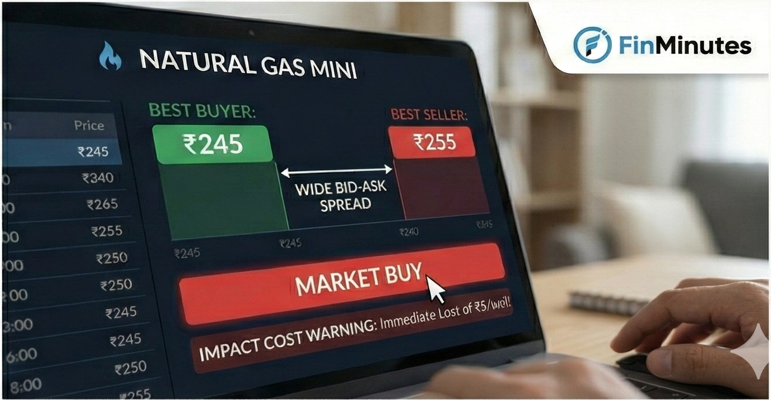
Priya wants to sell Natural Gas Mini at ₹250.
The Order Book: Sellers are at ₹250. But the best Buyer is sitting way down at ₹245.
The Error: Priya hits "Market Sell."
The Fill: The system matches her with the best buyer at ₹245.
The Damage: She lost ₹5 per unit instantly. This is Impact Cost.
Rule: NEVER use Market Orders in commodities. Only Limit Orders.
3. Extensive FAQs for Retailers
Q: Can I trade MCX on weekends?
A: No. Market hours are Monday to Friday, 9:00 AM to 11:30/11:55 PM. It is closed on Saturday and Sunday.
Q: What is the "Tender Period"?
A: It is the last 5 days of a contract. If you hold a position during this time, margins increase to 25%, 50%, and finally 100%. Rule: Always square off 7 days before expiry.
Q: Is Commodity Profit Taxable?
A: Yes. It is Non-Speculative Business Income. It is added to your salary slab. You can deduct expenses (Internet, Advisory fees) to lower tax. It is NOT Capital Gains.
Q: How does USDINR affect my trade?
A: MCX Price = International Price $\times$ USDINR. If Gold falls globally but Rupee weakens (dollar rises), MCX Gold might stay flat. You are trading both the asset and the currency.
Mastering Futures and Options on MCX
If you completed Module 1: The Foundation of Finminutes Commodity Trading Masterclass, you now understand what we trade, the asset class of commodities, from the geology of Gold to the biology of Soybeans. You understand the “Why” (Inflation Hedge) and the “Where” (MCX/NCDEX).
Now, we shift gears to the “How.”
Module 2: The Vehicle is about the mechanics of the trade. You cannot buy a barrel of Crude Oil and store it in your living room. To participate in this market, you must use financial instruments called Derivatives (Futures and Options). These instruments are powerful, but they are also dangerous. They carry leverage, daily cash settlements, and complex risks like “Devolvement” that do not exist in the stock market.
This guide acts as the textbook companion to the interactive tool above, deconstructing the math of leverage, the reality of Mark-to-Market (M2M) losses, and the specific traps that wipe out retail capital.
The Futures Contract: The Engine of Leverage
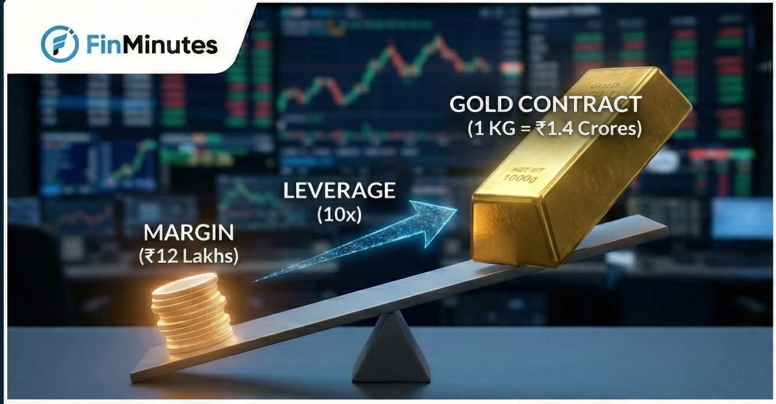
A Futures Contract is the primary vehicle for commodity trading. Unlike a stock, which represents ownership in a company, a Future is a legal obligation. It is a promise to buy or sell a specific quantity of a commodity at a fixed price on a future date.
The Mathematics of “Lots”
Commodities are heavy. We cannot trade them in grams or litres. We trade them in standardised blocks called Lots. This structure creates massive leverage.
- Gold (Standard Lot):
- Quantity: 1 Kilogram (1000 grams). Imagine,
- Contract Value: At ₹75,000/10g, the total value is ₹75,00,000 (₹75 Lakhs).
- Margin Required: You don’t pay ₹75 Lakhs. You pay a “Margin” of approx ₹6-7 Lakhs (10-12%).
- The Leverage Trap: You control ₹75 Lakhs of gold with just ₹6 Lakhs. If Gold prices drop by just 1%, you lose ₹75,000, which is more than 10% of your invested capital.
- The Retail Solution (Mini Lots): Recognising that standard lots are too big for most retail traders, MCX offers smaller contracts:
- Gold Mini: 100 grams (1/10th size).
- Gold Guinea: 8 grams.
- Silver Micro: 1 Kilogram.
- Crude Oil Mini: 10 Barrels.
- Tip: Always start with “Mini” or “Micro” lots until you have a proven profitable strategy.
The Daily Reality: Mark-to-Market (M2M)
This is the concept that surprises most equity traders. In the stock market (Cash segment), if you buy a share and it falls 5%, you can choose to “hold and wait.” It is a paper loss. In Futures, there are no paper losses. Every evening, between 11:30 PM and 11:55 PM, the exchange runs a settlement process called Mark-to-Market (M2M).
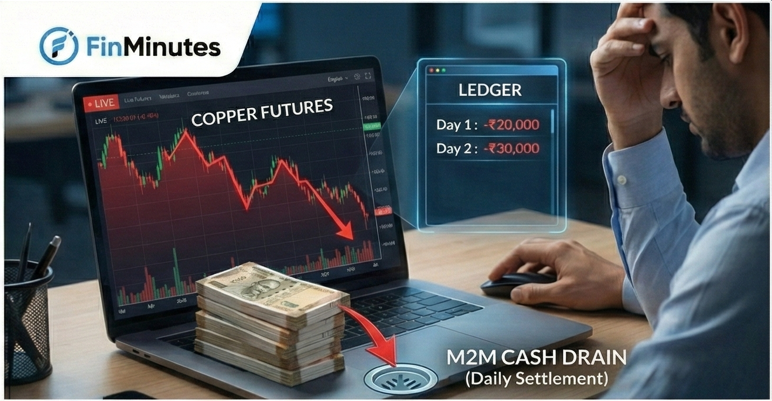
- The Calculation: The exchange compares the day’s Closing Price with your Buy Price (or previous day’s close).
- The Cash Flow:
- If you made a profit of ₹10,000, it is credited to your account immediately.
- If you made a loss of ₹10,000, it is debited from your account immediately.
- The Risk: If a losing streak drains your cash balance below the required “Maintenance Margin,” the broker will trigger a Margin Call. You must deposit more cash immediately, or the broker’s system will auto-square off your position at the market price, usually the worst price of the day.
Commodity Options: The “Devolvement” Shock
In recent years, retail volume has shifted heavily to Commodity Options because they are cheap. You can buy a Crude Oil Call Option for a premium of just ₹5,000. However, this cheapness hides a structural risk that does not exist in Nifty/Bank Nifty options.
The Mechanism of Devolvement
- Nifty Options: Cash Settled. If your option expires In-The-Money (ITM), you get the cash difference.
- MCX Options: Deliverable into Futures. If your Crude Oil Option expires ITM, the exchange converts it into a Live Futures Contract.
The Nightmare Scenario:
- Friday: You buy a Crude Oil Call for ₹5,000. You think your max loss is ₹5,000.
- Expiry Day: The option is ITM. You forget to close it.
- Monday Morning: You wake up to find a Crude Oil Futures Buy Position in your account.
- The Problem: A Futures contract requires ₹2.5 Lakhs margin. Your account only has ₹10,000.
- The Consequence: Your account goes into a negative balance. The broker charges a massive penalty and liquidates your other holdings to cover the shortfall.
Rule: Never hold commodity options until expiry. Always square off your positions at least 3-4 days before the contract ends.
The “Greeks”: Why Options Lose Money
Options are “Non-Linear” instruments. Their price is not just determined by the asset price, but by time and volatility. To trade them, you must understand the Greeks.
- Delta: The Direction. How much does the option move if the asset moves ₹1? (ATM Delta is approx 0.5).
- Gamma: The Acceleration. In the last week of expiry, Gamma explodes. Small moves in the underlying asset cause wild swings in the option premium. This is “Gamma Risk.”
- Theta: The Decay. Options are wasting assets. An At-The-Money (ATM) option loses significant value every single day due to time decay, even if the market price stays flat. This is why 90% of option buyers lose money over the long term.
- Vega: The Event Factor. Before major events (like an OPEC meeting or US Inflation Data), volatility rises, making options expensive. As soon as the event is over, volatility crashes (“IV Crush”), and option prices collapse, even if you got the direction right.
Execution and “The Trap”
Not all contracts displayed on your trading terminal are safe to trade. The commodity market has “Liquidity Pockets.”
The “Bid-Ask” Spread Trap
In liquid contracts (like Gold Mega or Crude Oil), the difference between the Buyer (Bid) and Seller (Ask) is small (₹1 or ₹2). However, in Illiquid Contracts (like Far-Month Expiries or deep OTM options), the spread can be huge.
- Example: You want to sell Natural Gas Mini. The Last Traded Price (LTP) is ₹250. But the best Buyer is sitting at ₹245.
- The Mistake: You place a “Market Order.”
- The Impact: You get filled at ₹245. You instantly lose ₹5 (2%) just entering the trade. This is called Impact Cost.
- Solution: Always use Limit Orders in commodity markets. Never use Market Orders.
Conclusion: Respect the Vehicle
If Module 1 was about choosing the right destination (Gold vs. Oil), Module 2 is about learning to drive the car (Futures and Options). It is a high-performance vehicle with massive leverage. If you respect the gears (Margins) and the brakes (Stop Losses), it can get you to your financial goals faster than any other asset class. If you drive recklessly, the M2M mechanism will ensure you crash.
Now that you understand the Asset and the Vehicle, you are ready for Module 3: The Engine. In the next module, we will explore the Fundamental Drivers, Supply, Demand, Geopolitics, and Weather that actually move the prices.
Commodity Trading: Futures and Options FAQs
Is profit from Commodity Futures & Options treated as Capital Gains or Business Income?
In India, commodity trading via derivatives (futures and options) on a recognised exchange, such as MCX, is treated as Non-Speculative Business Income. It is added to your total income (Salary + Business) and taxed according to your applicable income tax slab. It is NOT taxed as Capital Gains (15% STCG or 20% LTCG).
Can I deduct commodity trading losses from my salary income?
No. You cannot set off business losses against Salary income. However, you can set off commodity losses against other business income (e.g., from Equity F&O or a side business). If you have a net loss for the year, you can carry it forward for up to 8 years to offset future business profits, provided you file your ITR on time.
Is a Tax Audit mandatory for commodity traders?
A tax audit (under Section 44AB) is mandatory if your business turnover exceeds ₹10 Crores (if 95% of transactions are digital). However, if you declare a Profit lower than 6% of your turnover, or if you declare a Loss and want to carry it forward (and your total income exceeds the basic exemption limit), a tax audit by a CA is usually required.
What is the commodity market timing on MCX, and when is the best time to trade?
MCX operates from 9:00 AM to 11:30 PM / 11:55 PM IST (depending on US Daylight Savings). The Golden Hours: The best liquidity and volatility occur between 6:00 PM and 10:30 PM IST. This overlaps with the US market open (NYMEX/COMEX), where global institutional volume hits the market. Avoid trading “Mini” contracts before 10:00 AM due to low liquidity.
What is the difference between “Mini” and “Mega” contracts?
These refer to the lot size.
Mega (Standard): Designed for institutions/hedgers. E.g., Gold 1 Kg, Crude Oil 100 Barrels. High margin (₹5-10 Lakhs).
Mini/Micro: Designed for retail traders. E.g., Gold Mini (100g), Silver Micro (1 kg). Lower margin (₹5k – ₹1.5 Lakhs).
Tip: Beginners should strictly trade Mini lots to manage risk, but be aware that the Bid-Ask spread is slightly wider than in Mega lots.
Does the USDINR rate affect my MCX profit?
Yes, significantly. Commodities are priced in US Dollars globally.
The Formula: MCX Price ≈ International Price × USDINR + Import Duty.
Scenario: If Gold prices fall globally but the Rupee weakens (Dollar rises from ₹83 to ₹84), MCX Gold prices might stay flat or even rise. You are essentially trading two charts: The Asset and the Currency.
In commodity trading, what happens if I forget to close my position before expiry?
If you hold a “Compulsory Delivery” contract (like Gold, Silver, Aluminium) during the Tender Period (last 5 days), the exchange assumes you want to take/give physical delivery.
The Consequence: Your broker will likely force-square off your position. If they miss it, you may be liable to pay the full contract value (e.g., ₹75 Lakhs for Gold). Always close positions at least 5-7 days before the expiry date to avoid high margins and delivery risks.
Why did my Commodity Options turn into a Futures contract?
This is the “Devolvement” mechanism. On MCX, Options are “Deliverable into Futures.” If your Option expires In-The-Money (ITM), it converts into a Futures position.
The Risk: In Option Trading, a Future requires a massive margin (₹2-5 Lakhs) compared to the Option premium (₹5k-10k). If you don’t have the funds, you face a margin call and penalties.
Why is trading “Deep OTM” options dangerous in commodity trading?
Deep Out-of-The-Money (OTM) options in commodity trading often have Zero Liquidity. You might be able to buy them (from a market maker), but you won’t be able to sell them when you want to exit. Additionally, they suffer from rapid Theta Decay, making them “lottery tickets” with a near-100% probability of expiring worthless.
How much capital do I need to start commodity trading safely?
While one can buy commodity options for ₹5,000, trading safely requires more.
For Options: Minimum ₹50,000 (to absorb streaks of losses).
For Futures (Mini Lots): Minimum ₹1.5 – ₹2 Lakhs.
Rule of Thumb: Never use more than 50% of your account balance for margin. Keep the other 50% as a buffer for Mark-to-Market (M2M) drawdowns.
Can I trade commodities on weekends?
No. The MCX is closed on Saturdays and Sundays. However, global events (like war news or OPEC meetings) often happen on weekends, leading to massive “Gap Openings” on Monday morning. This makes holding positions over the weekend (Carry Forward) highly risky; for more details, check the Indian commodity market timing FAQ.
What is the “Inventory Data” everyone talks about?
This refers to the EIA Crude Oil Inventory Report released every Wednesday at 9:00 PM / 10:30 PM IST. It shows how much oil the US has in storage.
Impact: A surprise “Draw” (less oil than expected) usually causes price spikes. This is the most volatile trading event of the week for energy traders.