
5.1 The Mathematics of Survival
You can have a 90% win rate and still go bankrupt if you don't understand position sizing. Risk management is not just advice; it is math.
The "Drawdown Trap"
Fact: Losses work geometrically against you.
• If you lose 10%, you need 11% to recover.
• If you lose 50%, you need 100% to recover.
• If you lose 90%, you need 900% to recover (Impossible).
Rule: Never let a drawdown exceed 20%. Cut losses early.
5.2 The 1% Rule & Position Sizing
The Standard Formula
$$ \text{Position Size} = \frac{\text{Account Risk (1\%)}}{\text{Entry} - \text{Stop Loss}} $$
5.3 The "Small Account" Problem
The Issue: If you have ₹1,00,000 capital, your 1% risk is ₹1,000.
However, 1 Lot of Crude Oil Mini (10 barrels) moves ₹10 per tick. A normal Stop Loss (ATR based) might be ₹50 away.
Risk Required: ₹50 × 10 = ₹500. This fits!
But for Gold Mini: 1 Lot (100g) moves ₹100 per tick. A ₹300 stop loss = ₹3,000 risk (3%).
The Solution for Small Traders
If you cannot follow the 1% rule because contract sizes are too big, you have 3 options:
1. Trade Micro Lots: Stick to Silver Mic (1kg) where risk is minimal.
2. Hedged Spreads (Options): Instead of buying a Future, buy a "Bull Call Spread" (Buy Call + Sell Higher Call). This caps your max loss to exactly ₹1,000, enforcing the 1% rule mechanically.
3. The 3% Aggressive Rule: Accept that small accounts need slightly higher risk (3%) to grow, but never cross 5%.
5.4 The Casino Math: Kelly Criterion
Risking 1% is safe, but how do you grow fast? The Kelly Criterion tells you when to bet bigger.
The Probability Formula
Concept: If you have a strategy with a 70% Win Rate and 1:2 Risk-Reward, you should mathematically bet MORE than someone with a 50% Win Rate.
The Trap: Full Kelly is too volatile (you might lose 50% in a week).
The Pro Rule: Use "Half Kelly". If the math says bet 4%, you bet 2%. This gives you growth without the heart attack.
1. Strategy: The "US Open" ORB (Crude Oil)
MCX volume is low during the day. The real liquidity arrives when US markets open (NYMEX) at 6:00 PM IST. This strategy captures that volatility burst.
The 15-Minute ORB Setup
1. The Range: Identify the High and Low of the 6:00 PM to 6:15 PM candle.
2. The Trigger: Buy/Sell the breakout of this range.
3. Target: 1:2 Risk-Reward Ratio.
2. Strategy: The "EIA Inventory Fade"
Every Wednesday at 9:00/10:30 PM, Crude Oil goes crazy on data. Algos spike the price to hunt stops. We trade the reversal.
The Setup (5-Min Chart)
1. The Spike: Data is released. Price spikes UP vertically by ₹40-50 into a Resistance Zone.
2. The Reject: Watch for a "Shooting Star" or massive rejection wick.
3. The Trade: Enter SHORT below the low of the rejection candle.
Why it works: The initial spike is often "Algo Noise" triggered by keywords. Real sellers step in at resistance.
3. The Institutional Magnet: VWAP Strategy
Institutions are graded on whether they bought below the average price. That average is the Volume Weighted Average Price (VWAP).
The "VWAP Pullback" Setup
The Context: Market is trending UP (Price > VWAP).
The Trigger: Wait for price to drop and touch the VWAP line.
The Entry: If price bounces (green candle) off the VWAP, BUY.
The Logic: Institutions were waiting at the VWAP "Fair Value" to reload their buy orders. You are riding their wave.
1. Swing Strategy: Seasonal Accumulation
Professionals don't go "All In" at once. They build positions. We combine Fundamental Seasonality with Technical Entries.
The "Pyramiding" Technique
Scenario: Buying Gold before Wedding Season.
Trade 1 (Probe): Buy 30%. Stop Loss tight.
Trade 2 (Confirm): Price breaks 50 DMA. Buy 40%. Move SL to Breakeven.
Trade 3 (Expansion): New High. Buy 30%. Trail SL.
Result: Maximum profit with zero risk on initial capital.
2. Strategy: The Retail Arbitrage (Calendar Spread)
Want to trade Natural Gas without the fear of a 10% crash? Use a Calendar Spread. This is a "Market Neutral" strategy.
The Setup
The Logic: You expect a short-term supply crunch (Winter Storm). Spot prices rise faster than future prices.
The Trade:
• Leg A: BUY Nov Futures (Current Month).
• Leg B: SELL Dec Futures (Next Month).
Margin Benefit: Since you are hedged (Long + Short), MCX gives you a ~70% margin benefit.
Profit Source: You profit from the widening spread.
3. Advanced: The "Gold-Silver Ratio" Pair Trade
Sometimes, both Gold and Silver are risky. Instead of betting on price, bet on their relationship.
The Mean Reversion Strategy
The Metric: Gold Price ÷ Silver Price = Ratio. (Historical Avg: ~75).
Scenario A (Ratio > 90): Silver is too cheap.
• Trade: Long Silver + Short Gold. You profit if Silver outperforms Gold (even if both fall).
Scenario B (Ratio < 65): Silver is too expensive.
• Trade: Long Gold + Short Silver.
Why Pros do it: It hedges out the USD risk. You don't care what the Dollar does; you only care about the relative value of the metals.
1. The Psychology of "Tilt"
Your biggest enemy is not the market; it is your own amygdala.
Personified Case Study: Rahul the Revenge Trader
The Trigger: Rahul shorts Natural Gas. Stop Loss hit (-₹10k).
The Emotion: "I need to get my money back!"
The Mistake: Rahul doubles quantity and goes Long immediately.
The Reality: Market consolidates. He loses another ₹15k.
Lesson: Walk away after a loss. Reset. Never trade to recover.
2. The "YouTube Indicator" Trap
The Scam: "99% Accuracy Supertrend Strategy!"
The Reality: In range-bound commodity markets, Supertrend gives false signals every hour. You will be churned to death by brokerage.
The Fix: Never use an indicator in isolation. Combine it with Market Structure (Higher Highs) and Fundamentals (DXY).
3. Extensive FAQs
Q: Is Arbitrage risk-free?
A: No. While Calendar Spreads are lower risk, the spread can move against you.
Q: Can I use Algos for this?
A: Yes, simple strategies like "9 EMA Pullback" can be automated. But never automate "News Trading".
Q: What is "Inter-Exchange Arbitrage"?
A: Buying Gold on COMEX (US) and selling on MCX (India). Warning: Impossible for retail due to RBI rules.
4. Reality Check: The Equity Curve
Beginners expect a straight line of profits. Professionals know that Drawdowns are Normal.
What "Profitable" Really Looks Like
Phase 1 (The Grind): Small wins and small losses. You are breakeven for 3 months. Most quit here.
Phase 2 (The Drawdown): A bad week hits. You are down 10%. You stick to the system (Risk Management).
Phase 3 (The Trend): A massive trend (War/Shortage) begins. You catch it. Your account grows 40% in one month.
Summary: Trading is 90% waiting and 10% capitalizing. If you cannot survive the waiting (Drawdown), you will never see the capitalizing.
Options Trading Strategies: Turning Analysis into Execution
If you have completed Module 1 (Assets), Module 2 (Mechanics), Module 3 (Fundamentals), and Module 4 (Technicals), you are now more knowledgeable than 95% of retail traders. You know what to trade (commodities). You know why it’s moving (Central Bank buying, inventory, supply, demand etc,). You know when to enter.
But knowledge is not profit. Execution is profit. That is where the game starts with options trading strategies for commodities.
You can be the smartest analyst in the room and still go bankrupt if you bet too big on a single trade. You can predict the Crude Oil trend perfectly, but if you enter at the wrong time (during a news spike), your stop loss will be hunted before the market moves in your favor.
Module 5: The trading Strategy is the bridge between knowing and doing. This is the final and most critical layer of your education. Here, we stop looking at charts and start looking at Systems. We will discuss the mathematics of survival, the psychology of “Tilt,” and specific, actionable strategies for Intraday and Swing trading on MCX.
The Mathematics of Survival: Why Geniuses Go Broke
The most common question beginners ask is: “How much money can I make?”, but the question professionals ask is: “How much money can I lose?”
The “Drawdown Trap”
Losses in trading are not linear; they are geometric. As visualized in the Beginner Tier of the tool above, the math of recovery is brutal.
- Lose 10%: You need an 11% gain to recover. (Easy).
- Lose 50%: You need a 100% gain to recover. (Very Hard).
- Lose 90%: You need a 900% gain to recover. (Impossible).
The Lesson: Your primary job as a trader is not to make profits; it is to prevent the 50% drawdown. If you can survive the bad weeks with your capital intact, the good weeks will take care of themselves.

The 1% Rule
The Golden Rule of professional trading is: Never risk more than 1% of your total capital on a single trade.
The Formula: Position Size = (Total Capital × 1%) ÷ (Entry Price - Stop Loss Price)
- Scenario: You have ₹5 Lakhs. Your max risk per trade is ₹5,000.
- Trade: You want to buy Gold Mini. Stop Loss is ₹500 away per lot.
- Calculation: ₹5,000 ÷ ₹500 = 10 Lots.
- Why it works: Even if you lose 10 trades in a row (which is rare), you are only down 10%. You are still in the game. If you bet 10% per trade, a losing streak wipes you out.
The “Small Account” Reality
We must be honest: The 1% rule is hard for small retail accounts. If you have ₹50,000 capital, your 1% risk is ₹500. A single lot of Crude Oil Mini often requires a stop loss of ₹2,000. What should you do?
- Trade Micro Lots: Stick to assets like Silver Mic (1kg) where the tick value is small.
- Use Spreads: Instead of buying a naked Future, use an Option Spread Trading strategy (Buy Call + Sell Higher Call). This creates a “Defined Risk” trade where you physically cannot lose more than the premium paid, allowing you to stick to your risk limits.
Intraday Trading Strategy: The “US Open” (ORB)

Many Indian traders lose money because they trade at the wrong time. The Commodity market is global. From 9:00 AM to 5:00 PM IST, volumes on MCX are often low and choppy. The real “Whales” (US Hedge Funds) wake up when the NYMEX market opens.
The Golden Hour: 6:00 PM IST (Summer) / 7:00 PM IST (Winter).
Intraday Trading Strategy: Opening Range Breakout (ORB)
This Intraday trading strategy capitalises on the massive influx of volatility when the US market opens.
- The Setup: At 6:00 PM, open the 15-Minute Chart for Crude Oil or Natural Gas.
- The Wait: Do nothing for 15 minutes. Let the initial orders settle.
- The Mark: Draw a line at the High and Low of the 6:00 PM – 6:15 PM candle.
- The Trigger:
- If the next candle breaks the High, Enter Long.
- If the next candle breaks the Low, Enter Short.
- The Stop Loss: Place it at the midpoint of the range candle.
- The Target: Aim for a 1:2 Risk-Reward ratio.
Why it works: The US Open establishes the “Trend for the Day.” By waiting 15 minutes, you avoid the initial fake-outs and ride the institutional wave.
News Trading Strategy: The “EIA Fade”
Crude Oil inventory data (released every Wednesday at 9:00 PM or 10:30 PM IST) is the most dangerous event for retail traders. Algos are programmed to read the headlines and execute orders in milliseconds, causing massive “wicks.”
Do not try to be faster than a robot. Be smarter.
The “Fake-Out” Phenomenon
Often, the data is released, and the price spikes vertically by ₹50. Retail traders chase this green candle (“FOMO Buy”). Two minutes later, the price reverses completely and crashes by ₹80. Why? The initial spike was simply algos hunting for liquidity (Stop Losses) above resistance.
Options Trading Strategy: The Rejection Fade
- Wait: Do not trade the first 5 minutes of the data release.
- Observe: Look for a price spike into a key Resistance Zone (like VWAP or Previous Day High).
- Confirm: Watch for a Rejection Candle (Shooting Star or Long Upper Wick) on the 5-minute chart.
- Execute: Enter a Counter-Trend trade (Fade the move) below the low of the rejection candle.
- Logic: You are betting that the initial move was a trap, and the market is returning to its true value.
Swing Trading Strategy: “Pyramiding” into Strength
In their trading strategy, beginners make a fatal mistake: “Averaging Down.” They buy Gold. It falls. They buy more to “lower their average.” It falls more. They blow up. Professionals do the opposite: “Averaging Up” (Pyramiding).
The Seasonal Accumulation Method
Let’s say our Fundamental Analysis (Module 3) tells us Gold will rally for the Wedding Season.
- Probe Trade (30%): You enter your first position. Your Stop Loss is tight.
- Confirmation (40%): The trade moves in your favor. Price breaks a resistance level. You add more size. Crucial Step: You move the Stop Loss for both positions to your Break-Even point.
- Expansion (30%): The trend accelerates. You add the final chunk. You trail your Stop Loss behind the swing lows.
The Magic: By the time you are fully invested, your risk is zero. You are playing with the market’s money (“House Money”). If the trend reverses, you get stopped out at a profit. If it continues, you make a fortune. This is the swing trading strategy in commodities.
Low-Risk Strategy: The Calendar Spread (Arbitrage)
Trading outright Futures (e.g., Buying Natural Gas) is risky. A single geopolitical headline can gap the price against you by 10%. For risk-averse traders, the solution is Arbitrage.
The Calendar Spread
Instead of betting on the direction of the price, you bet on the difference between two contract months.

- Scenario: You expect a short-term Winter supply crunch in Natural Gas.
- The Trade:
- Buy November Futures (Near Month).
- Sell December Futures (Far Month).
- The Logic: In a shortage, the spot price (November) skyrockets because people need gas now. The future price (December) rises more slowly. The “Spread” widens.
- The Safety: If the entire Natural Gas market crashes, your Sell position profits, offsetting the loss on your Buy position. You are hedged.
- Bonus: Exchanges recognise this hedge and reduce your Margin Requirement by ~70%.
Advanced Institutional Edge: The Kelly Criterion
We discussed the “1% Rule” for safety. But how do billionaires grow their accounts so fast? They use probability sizing, known as the Kelly Criterion. The Kelly Formula tells you the optimal bet size to maximise growth based on your Win Rate and Payoff Ratio.
- Concept: If you have a trading strategy that wins 70% of the time with a 1:2 payoff, betting only 1% is mathematically inefficient. You are leaving money on the table.
- The Danger: The full Kelly number is often huge (e.g., “Bet 25% of your account”). This is too volatile for humans.
- The Pro Approach: Use “Half Kelly”. If the formula says bet 4%, you bet 2%. This provides superior growth to the fixed 1% rule, while drastically reducing the volatility of your equity curve.
Psychology: The “Inner Game”
Strategies are useless if you cannot follow them. The biggest enemy is “The Tilt.”
Case Study: Deepak the Revenge Trader
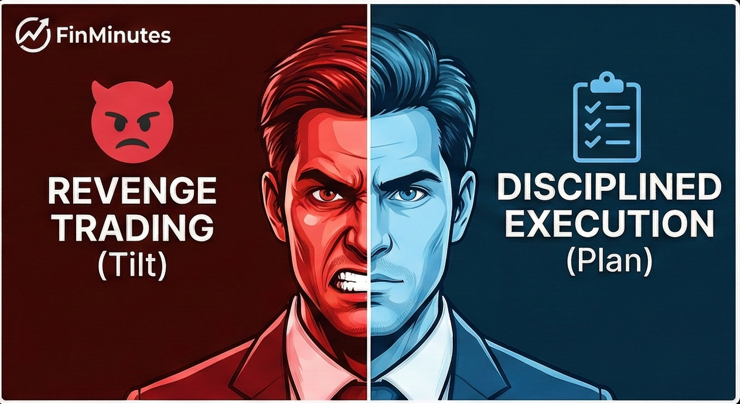
- The Loss: Deepak shorts Silver. A random news spike hits his Stop Loss. He loses ₹10,000.
- The Emotion: He feels angry. He feels the market “stole” his money. He wants it back now.
- The Mistake: He enters a massive Long position immediately (Revenge Trade), ignoring his setup.
- The Result: The market chops sideways. Theta decay eats his capital. He closes the day down ₹25,000.
The Solution:
- The 1-Hour Rule: After any losing trade, force yourself to step away from the screen for 1 hour. Let the adrenaline fade.
- Daily Loss Limit: Set a hard stop for the day (e.g., “If I lose ₹5,000, my broker auto-locks my account”).
- Journaling: Every evening, write down why you took the trade. If the reason was “I felt like it,” you are gambling.
FAQs: Options Trading Strategies & Execution
Can I use these options trading strategies for commodities with a ₹50,000 account?
Yes, but you must adapt. For the “US Open” strategy, use Silver Mic or Crude Oil Mini options. Do not trade standard lots. Focus on percentage returns (e.g., making 2% a day), not absolute Rupee amounts.
What is the “VWAP” trading Strategy mentioned in the Expert Tier?
Institutions execute large orders at the Volume Weighted Average Price (VWAP) to avoid moving the market.
– Trading Strategy: If the trend is UP, wait for the price to pull back to the VWAP line. If it bounces, buy. You are essentially buying at the same price as the institutional algos.
Is the “Gold-Silver Ratio” trade risk-free?
No trade or trading strategy is risk-free. However, “Pair Trading” (Long Gold / Short Silver) removes the Market Risk (Dollar risk). You are no longer betting on whether metals will go up or down; you are betting on whether Gold will outperform Silver. This makes it a market-neutral hedge, perfect for uncertain times.
Conclusion: You Are Now The Strategist
Congratulations. You have completed the FinMinutes Commodity Masterclass.
You started by learning the Assets (Module 1). You mastered the Mechanics of Futures (Module 2). You understood the Fundamental Engines of Supply and Demand (Module 3). You acquired the Technical Navigator (Module 4).
And now, with Module 5, you have the Battle Plan, the trading strategy.
You know how to manage risk, so you never blow up. You know when to attack (US Open) and when to defend (Hedge). You understand that trading is not about predicting the future; it is about managing probabilities.
The tools are in your hands. The market is open. Trade wisely.