
Advanced STP Calculator
Systematic Transfer Plan • Lumpsum Comparison • Tax Impact Analysis
How STP Taxation Works
When money moves from Source (Debt) to Target (Equity), it's treated as a **Redemption (Sale)** from the Debt fund.
Since STP is usually done over 6-24 months, the gains are **Short Term Capital Gains (STCG)**, taxed at your income tax slab rate.
This tool estimates that tax liability so you see the real net outcome.
You know you should invest in equity mutual funds for long-term growth. But you also know the stock market is volatile. What if you invest ₹10 Lakhs today and the market crashes 10% tomorrow? That fear of “bad timing” keeps millions of rupees sitting idle in Savings Accounts, earning a meager 3%.
Enter the Systematic Transfer Plan (STP), the bridge between safety and growth.
The FinMinutes Advanced STP Calculator is not just a math tool; it is a strategic decision-making engine. Unlike standard calculators that just show compound interest, our tool simulates the “Lumpsum vs. STP Battle,” accounts for hidden Taxation costs, and visually maps how your money transitions from a safe harbour (Debt Fund) to a high-growth engine (Equity Fund).
What is a Systematic Transfer Plan (STP)?
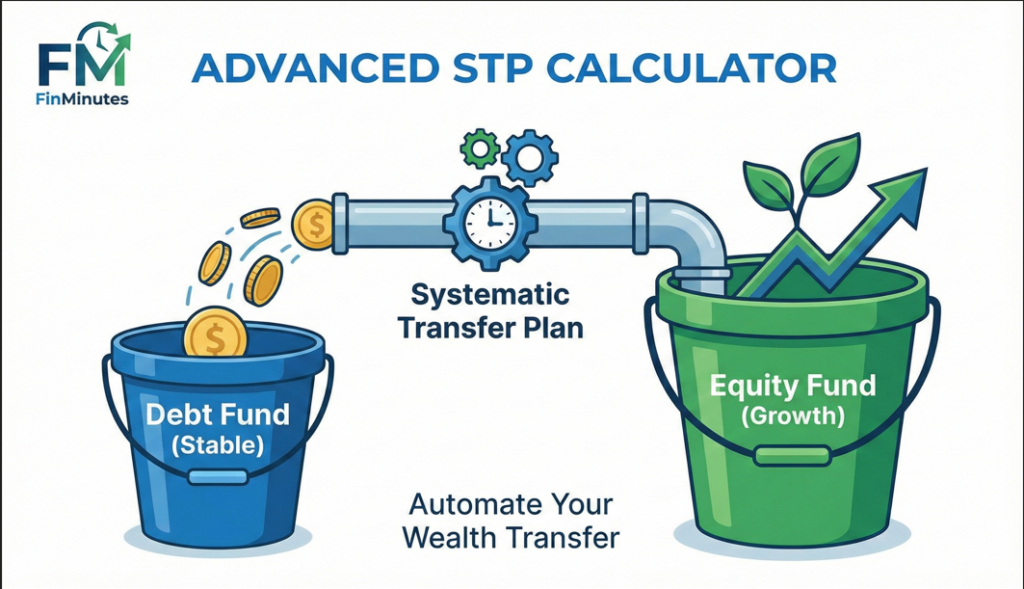
Think of STP as a “Smart Funnel.” Instead of dumping all your money into the volatile stock market at once (lump sum), you park that money in a safe, low-risk Mutual Fund (usually a Liquid Fund or Ultra-Short Term Debt Fund). Then, you instruct the fund house to automatically transfer a fixed amount into an Equity Mutual Fund on a specific date every month.
The Two Buckets of STP
- Source Fund (The Safe Bucket): This is where your lump sum sits initially. It earns decent returns (typically 6-7%), which is far better than a savings account.
- Target Fund (The Growth Bucket): This is where your money moves gradually. By investing monthly, you average out your purchase cost (Rupee Cost Averaging), protecting yourself from market volatility.
Why Use the FinMinutes Advanced STP Calculator?
Most free calculators online have a major flaw: they ignore Taxes and Opportunity Cost. When you move money from a Debt fund to an Equity fund, it is not a tax-free transfer. The government treats every transfer as a “Redemption” (Sale) from the Debt fund. This triggers Capital Gains Tax. If you ignore this, your retirement projections will be inflated and inaccurate.
Our tool solves this with three industry-first features:
1. The “Lumpsum vs. STP” Battle Mode
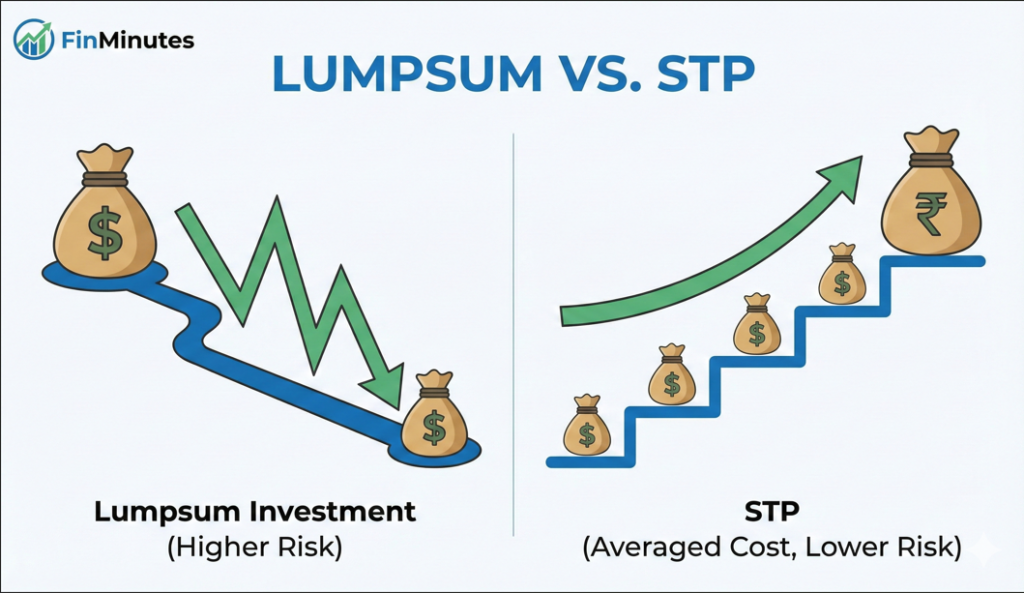
Stop guessing. Our tool runs two parallel simulations:
- Scenario A: Investing your entire amount in Equity today.
- Scenario B: Using an STP over 12 or 24 months. It then tells you exactly which strategy wins mathematically, and by how much.
2. Real-World Tax Impact Analysis
We calculate the tax liability on your Source Fund withdrawals. Whether you are in the 30% tax bracket or the 20% bracket, the tool deducts the tax from your returns to show you the Net Realisable Value.
3. The Visual “Wealth Flow” Map
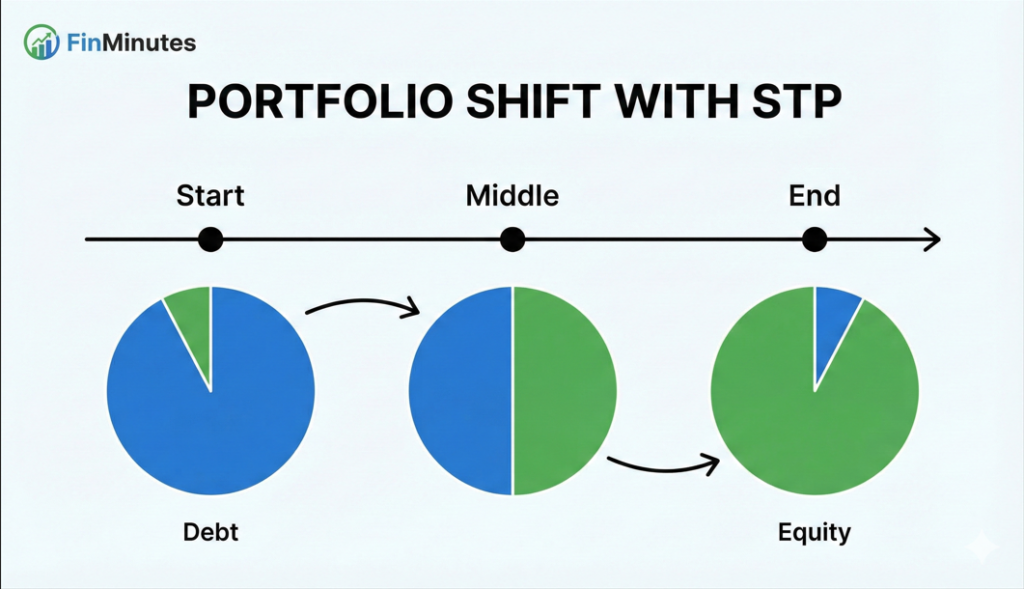
Don’t just read numbers; see them. Our dynamic chart and “Tank” visualizer show your Debt corpus depleting and your Equity corpus rising, pinpointing the exact month your growth strategy takes over.
STP vs. Lumpsum: The Eternal Debate
This is the most common question investors ask: “I have ₹10 Lakhs. Should I invest it all now or do an STP?” The answer depends on Market Valuation and Risk Appetite.
When Lumpsum Wins
Mathematically, lump-sum investing usually wins during a Bull Market (rising market). Since the market goes up more often than it goes down, putting all your money to work immediately allows it to compound longer.
- Risk: If the market crashes 20% next month, your portfolio takes a massive hit, and you may panic-sell.
When STP Wins
STP wins during Volatile or Bear Markets. If the market falls during your transfer period, your monthly instalments buy more units at lower prices. When the market eventually recovers, these cheap units generate massive profits.
- Benefit: It protects your psychology. Even if the market falls, you feel happy because your next instalment will buy more units. This peace of mind is often worth the slightly lower theoretical returns.
Our Calculator’s Verdict: Use the tool to check the difference. Often, you will find the “cost” of safety (lower returns in STP) is minimal compared to the risk protection it offers.
The Hidden Cost: Taxation on STP

This is technical, but critical. Many investors mistakenly think transferring money within the same fund house is tax-free. It is not.
How Taxation Works
- Source Fund (Debt): When you transfer ₹50,000 from your Liquid Fund to an Equity Fund, you are essentially selling ₹50,000 worth of Liquid Fund units.
- The Gain: If your Liquid Fund grew by 6%, a small portion of that ₹50,000 is “Profit.”
- The Tax: Since STPs are usually completed within 1-3 years, these profits are classified as Short Term Capital Gains (STCG) on Debt.
- New Rule (post-April 2023): Gains from Debt Mutual Funds are taxed at your Income Tax Slab Rate (e.g., 30%).
Example: You withdraw ₹50,000.
- Principal portion: ₹49,000
- Gain portion: ₹1,000
- Tax (30% slab): ₹300.
While ₹300 may seem small, over 24 transfers on a large corpus, this amountadds up. Our calculator automatically estimates this liability, so you aren’t blindsided come tax filing season.
Strategic Use Cases: When to use this Tool
1. Investing a Yearly Bonus
You receive a ₹5 Lakh bonus in March. Instead of timing the market, park it in a Liquid Fund and set up a 6-month STP into a Mid-Cap fund.
2. Windfall Gains (Property Sale/Inheritance)
You have ₹1 Crore. Investing this instantly is dangerous.
- Strategy: Put it in an Ultra-Short Term Debt fund.
- STP Tenure: 18 to 24 months.
- Logic: Spreading the entry over 2 years ensures you capture the average market price, neutralising the risk of entering at a peak.
3. Retirement “Bucket” Strategy
Retirees can use a “Reverse STP.” They can move gains from their volatile Equity Funds into stable Debt funds systematically to protect their corpus as they age.
How to Use the FinMinutes STP Calculator
Step 1: Enter Your Lumpsum Details
- Total Lumpsum Investment: The cash you have right now (e.g., ₹25,00,000).
- Monthly Transfer Amount: How much do you want to move to Equity monthly?
- Pro Tip: A good rule of thumb is to deploy the capital over 12 to 18 months. If you have ₹12 Lakhs, transfer ₹1 Lakh/month.
Step 2: Set Expected Returns
- Source Return (Debt): Be conservative. Liquid funds typically give 6.0% to 7.0%.
- Target Return (Equity): For diversified equity funds, 12% is a standard long-term assumption.
Step 3: Configure Taxation (Advanced)
- Toggle the “Apply Debt Fund Taxation?” switch.
- Enter your Tax Slab (e.g., 30%). This ensures the “Battle Mode” comparison is realistic.
Step 4: Analyze the “Battle”
Click “Compare Strategies.”
- Look at the “STP Strategy” card vs. the “Lumpsum” card.
- Check the “Insight Box”: It will tell you if STP reduced your risk significantly or if Lumpsum would have been mathematically better.
- Visual Flow: Watch the Red Tank (Debt) empty into the Green Tank (Equity) to visualize the pace of your deployment.
Finminutes STP Calculator: FAQs
Can I do an STP between different fund houses?
No. A Systematic Transfer Plan works only within the same Asset Management Company (AMC). For example, you can transfer from HDFC Liquid Fund to HDFC Top 100 Fund, but you cannot transfer from HDFC Liquid to SBI Bluechip.
Workaround: If you want to switch AMCs, you must manually redeem (SWP) from one and invest (SIP) into the other.
What is the ideal tenure for an STP?
There is no fixed rule, but financial planners typically recommend:
Equity Large Cap: 6 to 12 months.
Mid/Small Cap: 12 to 24 months (due to higher volatility).
General Rule: If the market feels “expensive” (high PE ratio), extend the tenure. If the market has already crashed, shorten the tenure to deploy cash faster.
Is STP better than keeping money in a Savings Account?
Yes, absolutely.
Savings Account: Earns ~5% interest.
Liquid Fund (STP Source): Earns ~7-8% interest.
On a corpus of ₹10 Lakhs pending deployment, the difference is ₹30,000 – ₹40,000 per year. Using STP makes your “waiting money” work harder for you.
Does Exit Load apply to STP?
Yes. STP transfers are treated as redemptions.
Liquid Funds: Usually have zero exit load after 7 days.
Debt Funds: May have an exit load if withdrawn within 1-3 months.
Strategy: Always check the exit load of your Source Fund. Liquid funds are the preferred choice because they have negligible exit loads.
Can I stop or modify my STP mid-way?
Yes. You have full control. If the market crashes 20% tomorrow, you can cancel your STP and choose to lump-sum the remaining balance immediately to catch the bottom. Or, if you face a financial emergency, you can stop the STP and withdraw the balance from the Source fund.
Conclusion: The Power of Disciplined Deployment
Investing is 10% math and 90% psychology. While a Lumpsum investment might mathematically win in a straight bull run, the STP Strategy wins the psychological battle. It allows you to sleep peacefully at night, knowing that market volatility is actually helping you buy more units cheap.
Use the FinMinutes Advanced STP Calculator to engineer your entry into the market. Don’t let your hard-earned capital sit idle in fear; automate your way to wealth.