- Log in to your broker app.
- Search for the ETF symbol (e.g., "GOLDBEES" or "HDFCGOLD").
- Use the FinMinutes Terminal above to check for a discount (Buy signal).
- Place a 'Limit Order' near the iNAV price.
- Nippon Gold BeES: Highest liquidity, best for intraday/short-term.
- HDFC/SBI Gold ETF: Lower expense ratios (0.50%), better for long-term holding.
- Avoid: Illiquid ETFs with wide bid-ask spreads.
The Ultimate Guide to Smarter Gold Investing in India
Finminutes GOLD ETF Intelligence Terminal: For decades, buying gold in India was simple: you went to your family jeweller, bought a coin or heavy jewellery, and kept it in a bank locker. But the digital revolution changed everything. Today, millions of Indians trade Gold Exchange Traded Funds (ETFs) on the NSE and BSE, believing it’s the most efficient way to own gold.
They are partially right. Gold ETFs are efficient, charge-free, low-risk, and highly liquid, but there is a catch. A hidden layer of complexity that 90% of retail investors miss.
Have you ever noticed that Nippon Gold BeES trades at a different price than HDFC Gold ETF, even though they both track the same asset? Have you ever bought an ETF thinking it was “cheap” because it was trading lower than the MCX spot price, only to realise later that it wasn’t a discount at all?
This is where the FinMinutes Gold ETF Intelligence Terminal changes the game. This isn’t just a simple Gold ETF calculator; it is an institutional-grade auditor that stops you from losing money to hidden spreads, structural decay, and “fake” discounts.
In the comprehensive guide, we will decode how Gold ETFs actually work, why “Spot Price” is a misleading benchmark, and how to use our tool to build real, tax-efficient wealth.
The “Gold ETF” Illusion: What You Are Actually Buying
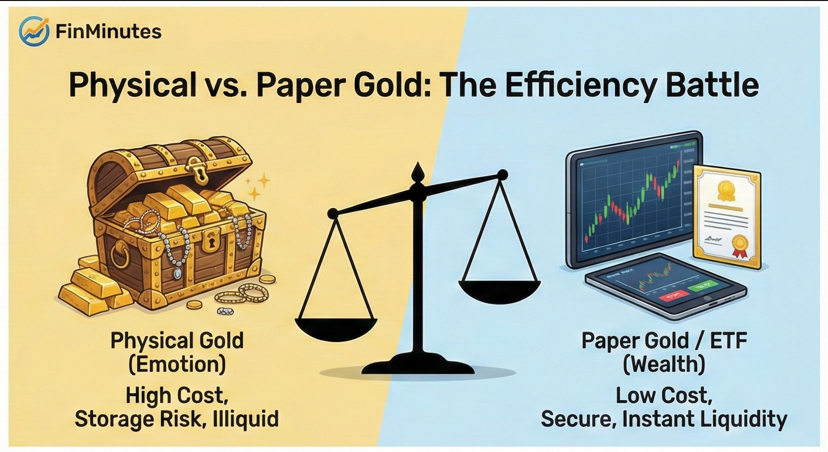
To understand why you need an intelligence terminal, you first need to understand the structural flaw in how most people view Gold ETFs.
The “0.01 Gram” Myth
When you read the brochure of any popular fund, be it SBI Gold ETF, Kotak Gold, or Nippon BeES, it will tell you that 1 Unit = approx. 0.01 grams of physical gold. So, if gold is trading at ₹1,58,000 per 10 grams on the MCX, simple math suggests:
1,00078,000 = ₹158 per unit.
But when you open your trading app (Zerodha, Groww, etc.), you might see the ETF trading at ₹128. “Wow!” you think. “An 18% discount! Free money!” Stop. This is the classic Retail Trap.
Why the Discount is (Mostly) an Illusion
That gap is usually not a discount. It is Structural Decay.
- Purity Mismatch: The MCX/Spot price you see on TV often refers to 999 Purity (24 Karat). However, most ETFs hold 995 Purity standard delivery bars. 995 gold is naturally cheaper than 999 gold.
- Cash Component: ETFs don’t hold 100% gold. They keep 1-3% in cash for liquidity. Cash doesn’t grow like gold.
- Expense Ratio Erosion: This is the silent killer. Every year, the fund house deducts 0.50% to 0.80% as fees. They don’t ask you to pay a bill; they just reduce the amount of gold backing each unit.
Over 10 or 15 years, a fund that started at 0.01g per unit might now effectively represent 0.008 grams. If you compare today’s price against the “0.01g” theoretical price, you will always see a discount. But you aren’t getting 0.01g. You are paying a fair price for 0.008g.
Our FinMinutes Gold ETF Intelligence Terminal fixes this. We don’t just look at the price; we look at the Real Value.
Decoding the FinMinutes Gold ETF Intelligence Terminal Features
We designed this smart Gold ETF Calculator to replicate the screens used by professional arbitrageurs. Here is how to read every gauge and data point.
1. The “Smart Money” Arbitrage Gauge
This is the heart of the system. Retail investors track “Price vs. Spot.” Smart money tracks “Price vs. iNAV.”
What is iNAV?
iNAV stands for Indicative Net Asset Value. It is the “Fair Value” of the fund calculated in real-time by the AMC, accounting for the exact amount of gold held and the exact cash balance.
- If Price < iNAV: This is a True Discount. You are paying ₹99 for a basket of gold worth ₹100. This is a “Buy” signal.
- If Price > iNAV: This is a Premium. You are paying ₹101 for ₹100 worth of gold. This is a “Wait” or “Sell” signal.
How to use the tool: Enter the live iNAV (available on NSE, your broker’s stock quote page or the AMC website) into the “Official iNAV” field. Our gauge will instantly tell you if the current market price is a “Discount Opportunity” or a “Premium Trap.”
2. The Structural Decay Audit
This panel is a reality check. It answers the question: “How much gold do I actually own?” You enter the MCX Spot Price (for 10g). The tool reverse-engineers the ETF price to tell you the “Real Grams per Unit.”
- Scenario: You see Nippon Gold BeES at ₹128. MCX Gold is ₹1,58,000.
- The Math: If it were truly 0.01g, the price should be ₹158.
- The Terminal Says: “Real Value: 0.0081g”.
This confirms that the “gap” you see isn’t a trading opportunity, it’s just the historical drift of the fund. Knowing this prevents you from panic-buying a “fake” dip.
3. The “Expense Ratio Drag” Visualizer
Many investors ignore the Expense Ratio (ER), saying, “It’s just 0.5%, who cares?” But you should care. 0.5% compounded over 10 years is massive.
Our tool includes a dynamic “Leakage Chart.” It takes your investment amount (e.g., ₹10 Lakhs) and shows you exactly how much money goes into your pocket versus how much leaks out to:
- The AMC (Fees): Often ₹1.5 Lakh+ on a large corpus!
- The Government (Tax): 12.5% LTCG.
Seeing this visualised in a pie chart helps you choose funds with lower expense ratios.
Wealth Commanda: SIP vs Lumpsum Projector
Investing is not just about buying right; it’s about projecting growth. The right side of the terminal is a dedicated Net Wealth Projector. Most online calculators are misleading because they show Gross Returns. They tell you: “Gold grew 11%, so your money grew 11%.” That is false. Your money grew at:
Gold Growth (−) Expense Ratio (−) Taxes
FinMinutes Gold ETF Intelligence Terminal projector is brutally honest:
- Select Mode: Choose Lumpsum (one-time buy) or SIP (monthly accumulation).
- Set CAGR: Use the slider to set your expected gold return (historically 10-12%).
- The Result: It shows your “Net Realised Wealth.” This is the actual cash amount you would get in your bank account if you sold everything today, after paying the AMC their cut and the Taxman his 12.5%.
Pro Tip: Use the slider to see the difference between a 5-year hold and a 15-year hold. You will notice that while taxes and fees increase, the power of compounding (CAGR) starts to outrun them significantly after Year 7.
How to Place a “Smart” Trade (Step-by-Step)

Don’t just open your broker app and hit “Buy.” Follow this 2-minute routine using the FinMinutes Terminal: Step 1: Select Your ETF. Choose your target fund from the dropdown (e.g., “HDFC Gold ETF”). The tool automatically pre-fills the correct Expense Ratio.
Step 2: Get the Live Data
- Enter the LTP (Last Traded Price) from your trading app.
- Click the “NSE Quote” icon next to the dropdown. It opens the official NSE page for that specific ETF. Copy the “iNAV” or “NAV” figure from there.
- Enter the MCX Spot Price (search “Gold MCX Live” on Google).
Step 3: Analyse the Signal. Look at the Arbitrage Gauge.
- Is it Green? (Discount > 0.20%). Action: Place a Limit Order slightly below the current price. You are getting gold cheaper than fair value.
- Is it Red? (Premium > 0.20%). Action: Do not buy. Wait for the price to cool off, or check a different ETF.
Step 4: Check the “Alpha” If there is a discount, the tool will show a “Smart Entry Impact” box. It tells you: “Buying at this discount adds ₹5,400 to your final corpus.” This confirms the monetary value of your patience.
Gold ETF Academy (Frequently Asked Questions)
We analysed the most searched queries about Gold ETFs in India. Here are the definitive, research-backed answers.
Which is better: Sovereign Gold Bond (SGB) or Gold ETF?
This is the number 1 debate.
Choose SGB if: You can lock your money for 8 years. The 2.5% interest + tax-free maturity makes SGB mathematically superior for long-term holders.
Choose ETF if: You need liquidity. You can sell an ETF in seconds during market hours. SGB liquidity on exchanges is often very poor (wide spreads). ETFs are better for short-to-medium term goals (1-5 years) or for active traders.
With no new issuance of SGBs in sight, it is now the secondary market SGB vs Gold ETF.
How are Gold ETFs taxed in 2026?
The tax rules changed recently.
Short Term (< 12 Months): If you sell before 1 year, the profit is added to your income and taxed at your slab rate.
Long Term (> 12 Months): If you hold for more than 1 year, the profit is taxed at a flat 12.5% (without indexation).
Note: Our Terminal automatically applies this 12.5% rule to its projections.
Which is the “Best” Gold ETF in India?
“Best” depends on what you value:
For Traders (Liquidity): Nippon India Gold BeES. It has the highest volume, meaning you can buy/sell huge quantities without moving the price.
For Investors (Cost): SBI Gold ETF or HDFC Gold ETF. They historically maintain lower expense ratios (often 0.50% vs Nippon’s higher legacy rates), which saves you significant money over 10+ years.
What is “Tracking Error” in a Gold ETF?
Ideally, if gold moves up 1%, your ETF should move up 1%. Tracking Error is the deviation. If gold moves up 1% but your ETF only moves 0.98%, that 0.02% is the tracking error. It is caused by cash drag and expenses.
Rule: Lower tracking error is better. It means the fund manager is doing a good job of mirroring the actual gold price.
Why is the Gold ETF price not moving even though Gold is up?
This happens due to Market Depth. Sometimes, even if global gold prices jump, there may not be enough buyers on the NSE to push the ETF price up immediately. Conversely, if the Rupee strengthens against the Dollar (USD/INR falls), domestic gold prices might remain flat even if global gold (in Dollars) is rallying. Remember: Indian Gold ETFs track INR Gold, not USD Gold.
Conclusion: Stop Investing Blindly
The difference between a “good” investment and a “great” one often comes down to entry price and cost management. Buying an ETF at a 1% Premium might not seem like a big deal today. But combined with a 0.80% Expense Ratio, you are effectively starting your investment race 2% behind the starting line. It might take you a full year just to break even!
The FinMinutes Gold ETF Intelligence Terminal is designed to put you ahead of the race.
- It filters out the noise.
- It exposes the hidden fees.
- It highlights the true arbitrage opportunities.
Bookmark this tool. Use it before every single buy order. Because in the world of finance, intelligence isn’t just power, it’s profit.
Disclaimer: This tool provides financial data analysis for educational purposes. It does not constitute investment advice. Gold markets are subject to market risks. Please consult a SEBI-registered investment advisor before making large financial decisions.