Advanced XIRR Calculator
Calculate the Real Return of your SIPs and irregular investments with visuals.
The XIRR Formula
XIRR solves for the rate ($r$) where the sum of all discounted cash flows equals zero:
$$ \sum_{i=1}^{N} \frac{P_i}{(1 + r)^{\frac{d_i - d_0}{365}}} = 0 $$Why not CAGR?
CAGR only looks at Start and End Value. XIRR assigns a weight to every single rupee based on how long it stayed invested.
Tracking mutual fund returns in India is confusing. You open your broker app, and it shows an Absolute Profit of 25%. You check your bank statement, and it feels different. Then you hear financial influencers talking about CAGR, and you wonder why your calculation doesn’t match theirs.
The problem: Most standard return formulas (like CAGR) assume you invested all your money on Day 1 and took it out on Day 1000. But that’s not how real life works, is it? You invest via SIPs (Systematic Investment Plans). You buy more when the market dips. You skip a month when finances are tight. You withdraw ₹50,000 for a vacation. You increase your SIP by 10% every year as your salary hikes.
In some cases, you do an STP(systematic transfer plan); in such cases, our XIRR calculator allows you to calculate accurate returns. Accurate numbers help you in better risk analysis while investing.
Your money enters and leaves the market at different times. Standard calculators cannot handle this chaos. They break. Enter XIRR (Extended Internal Rate of Return), the only metric that tells you the absolute truth about your money’s performance.
Welcome to the FinMinutes Advanced XIRR Calculator, the most powerful engine on the web, designed to handle the messy reality of your investments.
XIRR Calculator: The “Reality Check” Your Portfolio Needs
To understand XIRR, you first need to understand why the “Simple” methods fail.
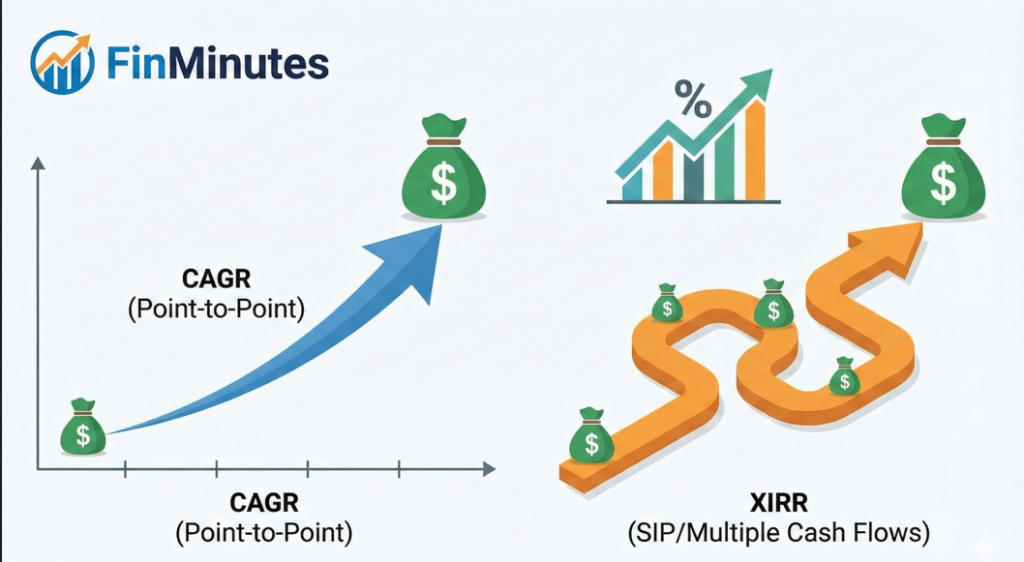
The “Train” Analogy
Imagine a train travelling from Mumbai to Delhi.
- CAGR (Compound Annual Growth Rate): Assumes all passengers boarded the train in Mumbai and stayed until Delhi. It calculates the speed for the full journey.
- SIP Investing: In reality, your money is like passengers boarding at every single station along the way. Your first SIP instalment travelled the full distance (worked for 5 years). Your last SIP instalment only travelled for 1 month before you checked the value.
You cannot assign the same “speed” (return) to the money that worked for 1 month vs. the money that worked for 5 years.
XIRR is the smart conductor. It assigns a specific “Time Weight” to every single rupee you invested. It rewards the money that stayed long-term and adjusts for the money that entered late. In short:
- Lumpsum Investment? Use CAGR.
- SIP / Irregular Investments? You MUST use XIRR.
Meet the FinMinutes Flagship XIRR Calculator
Most XIRR calculators online are lazy. They ask you to manually type 60 different dates into a grid for a 5-year SIP. Nobody has time for that. We built the FinMinutes Flagship XIRR Calculator with a “Dual-Mode Engine” to solve this specific pain point.
Mode 1: The “Smart SIP” Mode (Automation)
This is for 90% of investors. You don’t need to enter dates.
- What it does: You simply tell us: “I invested ₹10,000/month from Jan 2020 to Jan 2025.”
- The Magic: Our tool automatically generates the backend schedule for all 60 months, assigns the correct dates, and calculates the result instantly.
- The “Step-Up” Factor: Did you increase your SIP by 10% every year? Standard calculators fail here. Ours allows you to input an Annual Step-Up %, simulating your real-world investing behaviour.
Mode 2: The “Precision” Mode (For Power Users)
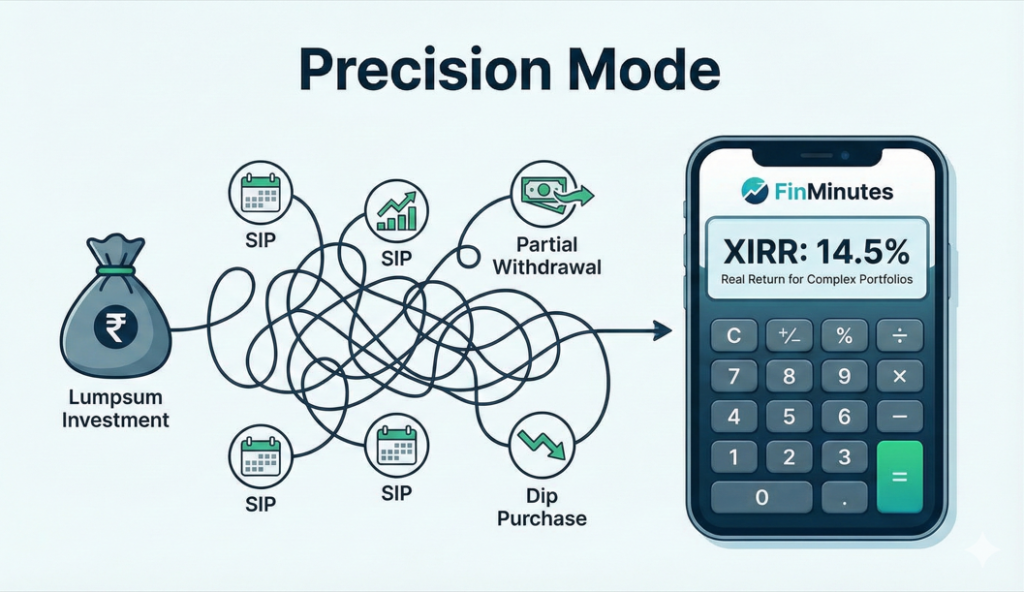
This is for the messy portfolios.
- Use Case: You did an SIP for 6 months, then paused it. Then you invested a lump sum of ₹1 Lakh during a market crash. Then you redeemed ₹50,000 for a medical emergency.
- How it works: An Excel-style interface where you can add specific dates and amounts. You select “Invested” or “Withdrew” from a dropdown, and we handle the complex positive/negative cash flow math.
The “Hidden” Features That Matter
We didn’t just stop at calculating returns. We added features that actually help you plan better.
1. Inflation Adjustment (Real Returns)
A 12% return sounds great. But if inflation is 6%, your real wealth grew by only ~6%. Our tool features an “Adjust for Inflation” toggle. Flip it on, and we will discount your XIRR by the inflation rate (default 6% for India). This shows you the Purchasing Power growth of your portfolio.
2. The Wealth Multiple
In the scorecard, you will see a metric called “Wealth Multiple” (e.g., 1.5x, 2.3x). This answers the psychological question: “How many times has my money multiplied?” It is a simple, powerful way to visualise long-term compounding.
3. Downloadable Schedule (Excel Export)
Need to show this to your financial advisor or keep a record? Click “Download Schedule,” and we will generate a neat .CSV file of all your cash flows and dates that you can open in Excel or Google Sheets.
How the Math Works in our XIRR Calculator
For the data geeks and the trust-seekers, let’s open the hood. How does XIRR actually calculate a single percentage from 50 different transactions?
The Formula
XIRR solves for the rate(r) in the following equation:
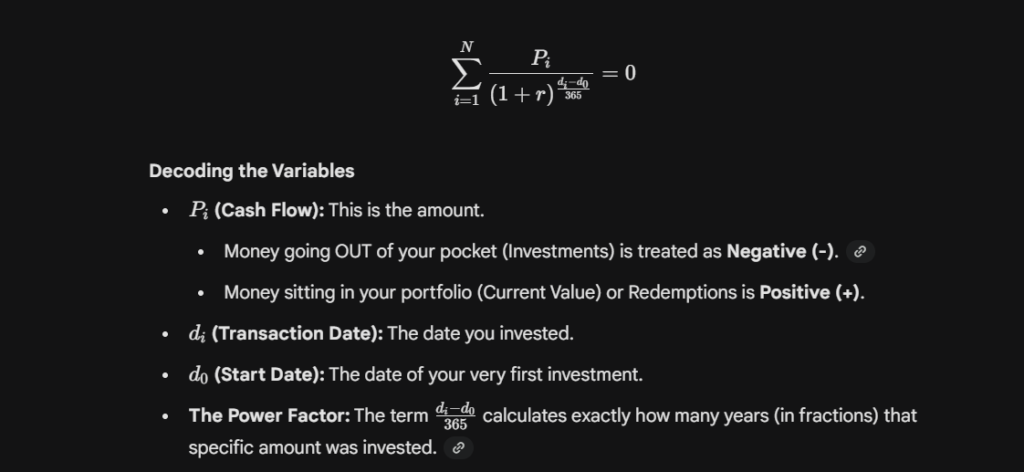
The Calculation Method (Newton-Raphson)
Unlike a simple multiplication sum, XIRR cannot be solved directly. It is an iterative equation. Our tool uses the Newton-Raphson Method, a complex algorithm that “guesses” a rate, checks the error, refines the guess, and repeats this thousands of times per second until it finds the rate (r) that balances the equation to exactly zero.
This is why doing XIRR manually on paper is impossible, and why you need this tool.
Step-by-Step Guide to Use the Tool
Scenario A: Checking Your SIP Performance
You have been investing ₹5,000/month in a Nifty 50 Index Fund for 5 years. The app shows the current value is ₹4.5 Lakhs. What is your return?
- Click “Smart SIP Mode.”
- Enter Monthly Investment: ₹5,000.
- Set Annual Step-Up: 0% (unless you increased it).
- Select Start Date (5 years ago) and End Date (Today).
- Enter Current Portfolio Value: ₹4,50,000.
- Click “Calculate Returns.”
- Result: The tool might show an XIRR of 14.2%. This is your true annualised return.
Scenario B: The Complex Portfolio
You bought a stock for ₹50,000 on Jan 1st. You bought more for ₹20,000 on June 1st. You sold ₹10,000 worth in December. Today, the remaining value is ₹80,000.
- Click “Precision Mode.”
- Row 1: Jan 1 | Type: Invested | ₹50,000.
- Row 2: June 1 | Type: Invested | ₹20,000.
- Row 3: Dec 1 | Type: Withdrew | ₹10,000.
- Current Value: Enter ₹80,000 in the bottom box.
- Click “Calculate.”
- Result: The tool accounts for the fact that the ₹10k withdrawal was a profit-taking move, and the remaining ₹80k is an unrealised gain, providing you withthe precise performance figure.
XIRR vs. Other Metrics
1. XIRR vs. CAGR
- CAGR is point-to-point. It only cares about the Start and End. It ignores the journey.
- XIRR is the journey. It accounts for every stop you made along the way.
- Verdict: Use CAGR for FDs and Lumpsum. Use XIRR for SIPs.
2. XIRR vs. Absolute Return
- Absolute Return is simple: (Profit / Investment)*100
- The Trap: If you double your money in 1 year, Absolute Return is 100%. If you double your money in 20 years, Absolute Return is still 100%.
- Absolute return ignores Time. XIRR respects Time.
- Verdict: Absolute return is vanity. XIRR is sanity.
Strategic Insights for Indian Investors

1. What is a “Good” XIRR in India?
Based on historical Nifty 50 and active fund performance:
- 10% – 12%: Decent. You are beating inflation and most traditional assets.
- 12% – 15%: Excellent. This is the sweet spot for long-term equity SIPs.
- > 15%: Exceptional. Usually achieved during bull runs or by high-quality Mid/small-cap funds.
- < 8%: Poor. If your equity XIRR is below 8% over the years, you might be in the wrong funds.
2. The “Negative XIRR” Phenomenon
Can XIRR be negative? Yes. If the market crashes shortly after you start your SIP, your portfolio value will be lower than your invested amount.
- Example: Invested ₹1 Lakh, Current Value ₹90,000.
- Result: Negative XIRR.
- Advice: Please don’t panic. Negative XIRR in the early years of an SIP is actually good. It means your next instalment will buy units at a lower price, setting you up for massive XIRR when the market recovers.
3. Why does my broker show a different XIRR?
Brokers calculate XIRR based on the exact date the money hit the fund house (NAV date). You might be estimating the date (e.g., 1st of every month).
- Weekend Effect: If the 1st is a Sunday, the SIP executes on the 2nd or 3rd.
- Discrepancy: A difference of 0.1% or 0.2% is normal due to these date differences. The FinMinutes tool is precise enough for all planning purposes.
Finminutes XIRR: FAQs
Can I use this calculator for PPF and EPF?
Absolutely. Public Provident Fund (PPF) involves yearly or monthly deposits, which makes it an irregular cash flow. Use the Smart SIP Mode (set Step-Up to 0 if fixed) or Precision Mode (if you deposit random amounts) to find the actual return of your PPF account.
Does XIRR account for Tax (LTCG)?
The basic XIRR calculation is Pre-Tax. To calculate Post-Tax XIRR, you should enter the Net Withdrawal Amount (amount after deducting taxes) in the Precision Mode. However, for general tracking, Pre-Tax XIRR is the industry standard.
Why is my XIRR higher than my Absolute Return?
This happens in SIPs shorter than 1 year. If you invest for 6 months and gain 10%, your Absolute return is 10%, but your annualised (XIRR) return might be 20%+ because XIRR projects what you would earn if that performance continued for a full year.
What is the “Annual Step-Up” feature?
This is for investors who increase their SIP amount every year (e.g., to match their salary hike). If you started with ₹5k and increased it by 10% yearly, your cash flows change drastically. Our tool is one of the few that accurately models this growth curve.
I made a partial withdrawal. Which mode should I use?
Use Precision Mode. Enter your investments as “Invested” (negative flows handled internally) and your partial withdrawal as “Withdrew” (positive flow). Finally, enter the remaining corpus as “Current Value.”
Conclusion
Your wealth isn’t just about how much you save; it’s about the Rate at which it grows. Don’t rely on back-of-the-envelope math or misleading absolute returns.
Use the FinMinutes Flagship XIRR Calculator to strip away the noise and see the true performance of your hard-earned money. Whether you are a disciplined SIP investor or a tactical lumpsum deployer, the math doesn’t lie.